



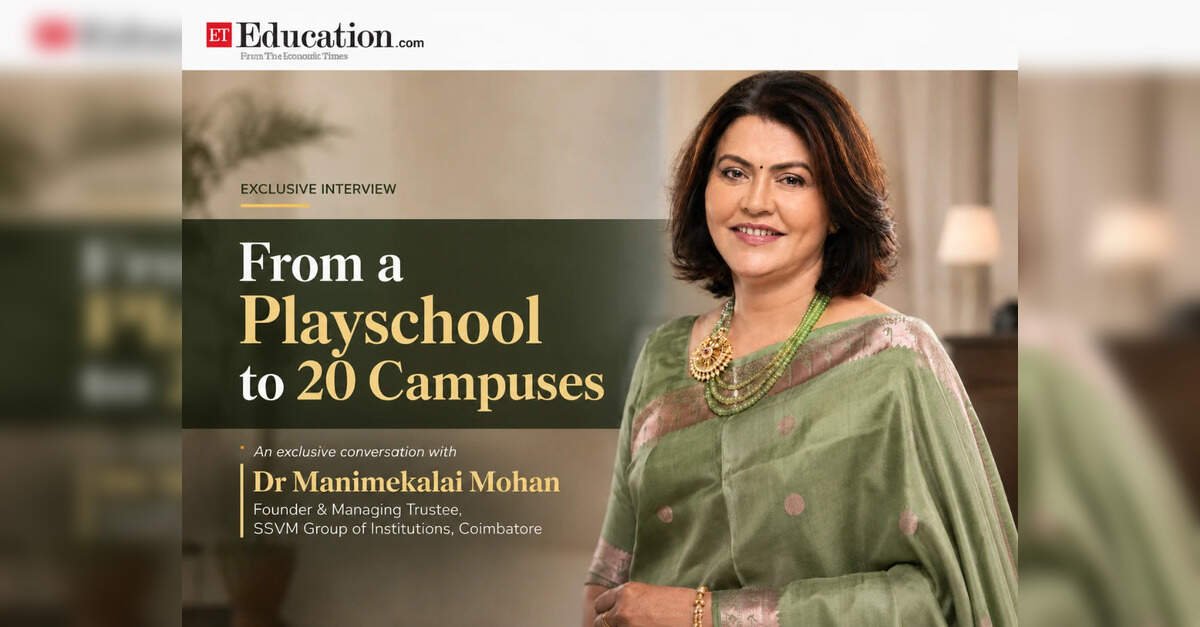
From starting with a single playschool in 1998 to building a growing education ecosystem, Dr Manimekalai Mohan, Founder and Managing Trustee, SSVM Group of Institutions, Coimbatore has built her journey around a simple principle: growth should never come at the cost of quality. In an exclusive conversation with ETEducation, she reflects on the decisions that shaped SSVM, why teacher well-being and student mental health deserve greater attention, how schools should rethink their approach to AI, and why institutional growth must remain rooted in purpose.For Dr Mohan, institution-building has never been about simply adding campuses or filling classrooms. Her approach has been to understand the needs of each community, build thoughtfully and grow progressively. That philosophy has shaped SSVM’s expansion as well as its approach to students, teachers and parents.
In this exclusive conversation with ETEducation, Dr Manimekalai Mohan, Founder and Managing Trustee, SSVM Group of Institutions, Coimbatore reflects on the journey from a single playschool to a 20-campus education group. From growing without losing sight of quality to rethinking AI, teacher development and student well-being, Dr Mohan offers candid insights into what it takes to build institutions that remain relevant, resilient and rooted in purpose.Here are the edited excerpts from the interview.
Q From a playschool to a multi-campus education group, what was the biggest risk you took in building SSVM?
Dr Manimekalai Mohan: When I started my journey in 1998, I started with a playschool. My vision at that time was only to run a playschool and send the children to other campuses in the city. But when parents came back and said that the kind of knowledge and learning their children received at our playschool was not available elsewhere, they asked me, “Why can’t you start a K-12 school?”
That made me think. At that time, the curriculum was largely about memorising and reproducing what was taught. I thought, why can’t I start a CBSE school focused more on critical and analytical thinking?
It was a big challenge because this was a small village, Sirumugai, with a population of less than 20,000. But I had a gut feeling that when you give something with the right quality and exposure, you can transform that place.
That’s how the playschool became a K-12 campus. It never stopped with one campus. The quality we provided has now grown to 20 campuses in Coimbatore. We started with 25 students, and today we have more than 10,000 children studying across our campuses.
Q Where should schools be investing more today, and where are they simply spending to appear future-ready?
Dr Manimekalai Mohan: Today, everybody talks about schools being future-ready. The moment people hear “future-ready”, they think about technology classrooms and infrastructure.
Of course, technology and infrastructure are needed, but that is not 99%. I would say that is around 30%. The balance 70% should be on student well-being.
We also need to focus on teacher well-being, upgrading teachers’ knowledge and developing leadership skills among both teachers and students.
What value are we giving children? Today, children turn to technology for almost everything. They should have the ability to analyse whether what technology tells them is right or wrong.
Teacher training also needs greater attention. It is not only about technology; the mental well-being of teachers and children is equally important.
Q What should schools stop teaching, start teaching and teach differently in the age of AI?
Dr Manimekalai Mohan: We are living in the AI era, so we cannot simply ignore it. But children should understand that AI is a supportive tool, not something they have to completely depend on.
We have to teach them values.
I recently had an interesting conversation with a few IIT faculty members about value-based education. In every engineering field, there are positives and negatives. We cannot teach only the positive; we also have to teach the negative, but ethically: what is right, what is wrong and what they should know to do.
The same value connection has to be given to AI.
When a child searches for something using AI, they should understand that the answer is not necessarily the final answer. It is like a library reference or a guide. During our time, we used different publications and guides, and each could have a different answer or questioning style. AI is similar.
If we give children value-based knowledge about AI, I am very sure its usage in any field will be in the right form.
Q SSVM has grown into a significant education group. Could you share the scale of the group today, including the number of schools, campuses and students you serve?
Dr Manimekalai Mohan: We have different scales of schools and different curricula. The way we develop our schools depends on the community and the location. Every place has its own requirements.
For example, one campus may have a large sports infrastructure, while another may have a radio station where students learn broadcasting, recording and video production. Another campus has a space lab.
Every school has its own unique feature. We don’t simply replicate the same thing everywhere. We look at the space, the environment and what the people need.
Today, we have around 20 campuses in Coimbatore, with more than 10,000 children across our campuses.
Q What is the biggest challenge in attracting and retaining exceptional teachers today?
Dr Manimekalai Mohan: One thing is that you should not see them simply as teachers. You should see them as part of your family.
I don’t sit separately as management. I sit with them during orientations and participate in the sessions they attend. Ultimately, they understand that if there is any problem, they can easily approach the management.
There should be no unnecessary hierarchy or barrier. If you take any of my campuses, I am not sitting inside my cabin. I am always accessible and moving around the campus.
When they tell you their problems, you should be able to remove that knot without damaging anybody. Sometimes there may be differences of opinion between teachers, the principal and the coordinator, but I make sure the team remains united.
Even employees who joined as security staff, bus drivers, attendants or housekeeping staff have stayed with us for many years. The key is the way we respect them.
When you respect people properly, they start loving the environment and owning it. When employees own the environment, they don’t think about leaving.
These are the things I strongly maintain. That is the reason for the high retention: continuous training, a family-like environment and respect.
Q Can schools deliver world-class education at scale without making it unaffordable?
Dr Manimekalai Mohan: Yes. We have different fee structures across our schools. If I have 20 schools, all 20 schools do not have the same fee tariff. It depends on the facilities and the space available.
But the quality of education is not compromised.
A smaller campus may not have the same facilities as a 60-acre campus, but we look at what is best possible within that space. The child should still receive maximum exposure.
If a school charges a particular fee, it should ensure that what parents pay is utilised properly for the child. There should be a balance.
We should not think that a large campus must automatically provide everything that another large campus has. Every campus can have something unique, while maintaining the same quality of education.
Q If you were building SSVM from scratch today, what would you stop doing, what would you build differently, and what is the one thing you would never compromise on, even if protecting it meant slowing the institution’s growth?
Dr Manimekalai Mohan: Building a school today is very different from what it was in 1998. When I started, you needed a computer lab and a composite lab. Today, a school needs a STEM lab and so many other things that children should learn.
If I am selecting a particular area, I first understand the environment. How are the people there? What is the real need that I should focus on in the school?
If the area is well equipped and the parents and children already have a foundational level of knowledge, I can start from K to 8. But if it is a place where we need to progress slowly, I may start with K to 5 or even kindergarten and then add one class every year.
I need the right teachers. If I cannot get them, I have to ensure that I provide facilities for them to stay there. Teachers should also be ready to move from a happening city to a non-happening town.
But I don’t compromise on the quality of the building. I give the best infrastructure.
At the same time, I don’t rush to fill the infrastructure with students. If I have infrastructure for 2,000 students, it doesn’t mean I need 2,000 students immediately. I may start with 200 and progressively add students.
At SSVM, we have never worked simply to fill the infrastructure. We have worked towards progressive and consistent growth. My agenda is not to fill the space. My agenda is to slowly fill the space while ensuring that quality is maintained.
Q What is the biggest challenge Indian schools are underestimating today?
Dr Manimekalai Mohan: What schools are underestimating is the mental well-being of children.
I feel that this is still not being taken into consideration enough. What they are underestimating is the mental well-being of children. I don’t think this is being taken sufficiently into consideration.
Today’s generation is different. Earlier, when you gave a punishment, the child would accept it. Today, you cannot simply punish a child. You have to explain why something is right and why something is not right.
We also have to help children understand the emotional well-being of another student. They should understand how the other child would feel and put themselves in that situation.
We need to start building leadership characteristics among children because we need leaders for the future. At the same time, we have to groom children with problem-solving techniques and adaptability.
For example, if a child comes from North India to South India for a residential programme, the child has to adapt to a different culture. Similarly, students who go from the South to the North have to adapt. These are the adaptability challenges that children have to experience and go through.
Building institutions that outlast the moment
Across the conversation between ETEducation and Dr Mohan, one idea kept returning: education cannot be reduced to infrastructure, technology, enrolment numbers or even academic outcomes alone. For Dr Mohan, the real measure of an institution lies in the quality of its people, the trust it builds with families and the impact it creates for students.
Her approach to growth reflects the same philosophy. Start with the need, build quality, listen to the community and expand without losing the values that made the institution meaningful in the first place.
As schools navigate AI, changing learner expectations, teacher challenges and growing pressure to demonstrate outcomes, Dr Mohan’s message is ultimately about keeping the human element at the centre.
Because for her, being future-ready is not simply about giving students access to what is new. It is about giving them the judgement, values, adaptability and confidence to use it well.


