



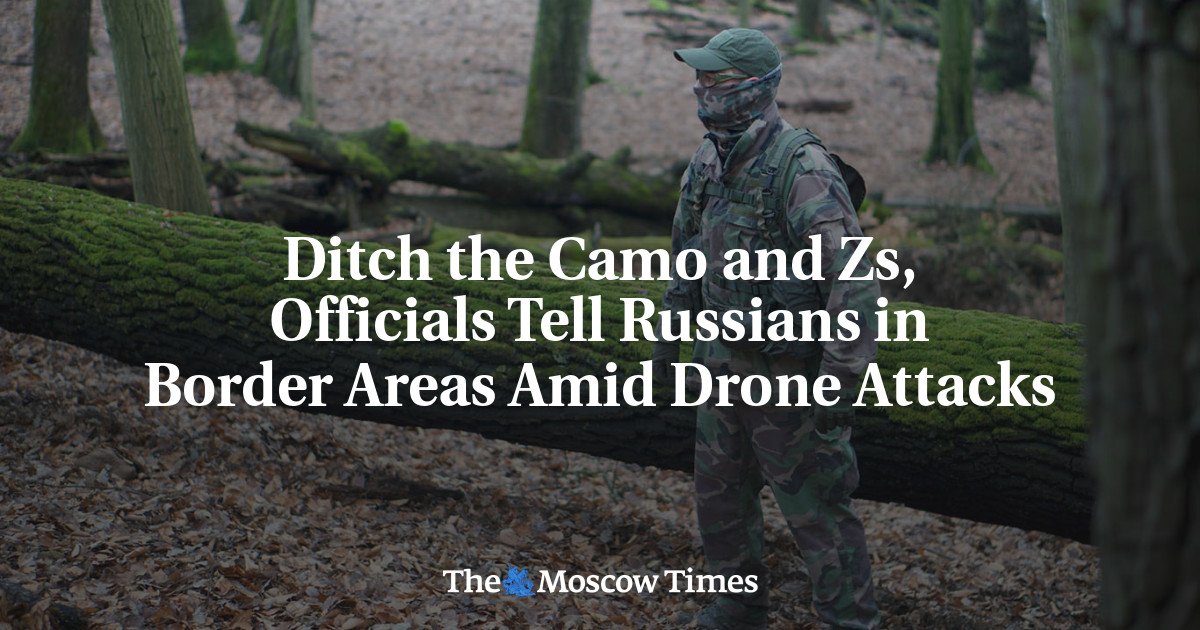
Civilians close to Russia’s border with Ukraine are being told to avoid wearing camouflage and driving in vehicles marked with army symbols, as it could make them look like military targets amid near-daily Ukrainian drone attacks.
Vladimir Zaytsev, who heads the Bolshesoldatsky district in the southwestern Kursk region, is at least the second official in recent weeks to issue civilian visibility guidelines in areas that regularly face cross-border strikes.
“Refrain from wearing military uniforms or using vehicles with military-style coloring (khaki, dark green, gray or olive), especially those bearing markings used by the Russian Armed Forces, when traveling in border areas and nearby districts,” Zaytsev said Wednesday.
Zaytsev, who detailed the guidelines in a post on the social media website VKontakte, may have been referring to the pro-war Z and V symbols in mentioning military “markings.”
He said following the guidelines is necessary in order to “prevent death or injury to the civilian population and the destruction of motor vehicles.”
At least two people, including a citizen of St. Kitts and Nevis, have been killed in Ukrainian drone strikes on moving vehicles in the Bolshesoldatsky district since the start of the year.
The district does not share a border with Ukraine, but it had briefly become a frontline area after Ukrainian troops launched a surprise incursion into parts of the nearby Sudzhansky and Korenevsky districts in August 2024.
The governor of the Belgorod region, which borders both the Kursk region and eastern Ukraine, also recently urged civilians to avoid wearing military uniforms within 15 kilometers (9 miles) of the Ukrainian border.
Kursk and Belgorod have faced frequent shelling and drone strikes since the start of Russia’s full-scale invasion of Ukraine.
A Message from The Moscow Times:
Dear readers,
We are facing unprecedented challenges. Russia’s Prosecutor General’s Office has designated The Moscow Times as an “undesirable” organization, criminalizing our work and putting our staff at risk of prosecution. This follows our earlier unjust labeling as a “foreign agent.”
These actions are direct attempts to silence independent journalism in Russia. The authorities claim our work “discredits the decisions of the Russian leadership.” We see things differently: we strive to provide accurate, unbiased reporting on Russia.
We, the journalists of The Moscow Times, refuse to be silenced. But to continue our work, we need your help.
Your support, no matter how small, makes a world of difference. If you can, please support us monthly starting from just $2. It’s quick to set up, and every contribution makes a significant impact.
By supporting The Moscow Times, you’re defending open, independent journalism in the face of repression. Thank you for standing with us.
Continue
Not ready to support today?
Remind me later.
×
Remind me next month
Thank you! Your reminder is set.


