



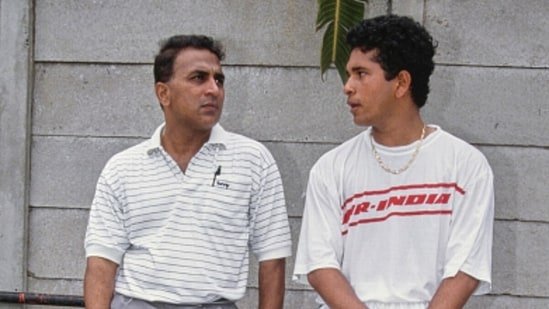
The period between 1983 and 1989 was a fascinating phase in Indian cricket. Kapil Dev’s Devils had delivered the country its first World Cup triumph, and just two years later, India lifted the 1985 World Championship of Cricket in Australia with a group of players that’s still regarded by many as India’s greatest ever ODI team. Sunil Gavaskar, though in the twilight of his career, remained a guiding force as captain, supported by the emerging Mohammad Azharuddin and the experienced core of Dilip Vengsarkar, Kris Srikkanth and Madan Lal. The team was further strengthened by the exciting young leg-spinner Laxman Sivaramakrishnan and, of course, the Audi-winning Player of the Tournament, Ravi Shastri.
Change arrived rather quickly. One by one, that generation began to step aside, and by the end of the decade, Indian cricket was introduced to a young phenomenon named Sachin Tendulkar. Earmarked as the heir to Gavaskar, Tendulkar went on to become, quite possibly, India’s greatest-ever. Remarkably, it did not take him a decade or more to earn that reputation. In fact, Tendulkar was still in his early teens, all of 14, when he was already being spoken of as the next best after the legendary Gavaskar.
It was evident early on that Tendulkar was destined for greatness. He became the first Indian cricketer to score centuries in all three major domestic tournaments: the Ranji Trophy, Duleep Trophy and Deodhar Trophy. That is a well-established fact. But did you know that in 1987, two years before he made his India debut, Tendulkar had already surpassed the likes of Kapil, Azharuddin, and Vengsarkar in batting reputation? Former BCCI selector Jatin Paranjpe recalls a fascinating story involving his father, the renowned Vasoo Paranjpe, who once introduced the young Tendulkar to the legendary Mushtaq Ali (after whom the Syed Mushtaq Ali Trophy was christened) in a way that summed up Tendulkar’s growing stature.
When Tendulkar arrived
“Mushtaq Ali sir was a giant in Indore, so he was invited to watch a practice session and share his experiences with the youngsters. Sachin once recalled that ‘Vasoo sir’ introduced him to Mushtaq Ali and said, ‘Mushtaq sir, he is currently India’s second-greatest batsman after Sunil Gavaskar.’
“Sachin said that, as a 14-year-old, those words made a huge difference and instilled immense confidence in him. From that day onward, he felt driven to live up to that belief. He knew ‘Vasoo sir’ would never lie about him or say something like that lightly, so he became determined to justify the faith shown in him and dedicated himself to shaping his talent. Sachin mentioned that this compliment sharpened his mindset and motivated him to improve with every passing day,” Jatin Paranjpe said on the Great Indian Cricket Show.
That it came from Paranjpe, a mentor to several greats of Mumbai cricket, remains the ultimate stamp of approval. Although Paranjpe did not achieve major success as a player, his legacy as a mentor helped shape generations of Indian cricketers. From Gavaskar to Rohit Sharma, his deep understanding of technique and ability to bring out the best in players made him a revered figure in Mumbai’s cricketing circles. So deep was his influence that when he passed away in 2021, Tendulkar said it felt as though a part of him had gone with Vasu sir.
Stats prove whether Tendulkar was indeed the next-best after Gavaskar
At 14, Sachin was selected in Bombay’s Ranji squad for the 1987–88 season (though he didn’t make the XI). In school cricket, he and Vinod Kambli put on the famous 664-run unbroken partnership in 1988, where Sachin scored 326 not out and 1000-plus runs in the tournament. In the 1988–89 Ranji Trophy (age 15), Tendulkar scored a hundred on his first-class debut and finished as Bombay’s highest run-scorer with 583 runs at 64.77 in 7 matches (11 innings, one century and six fifties)
Some notable Indian batters that season:
1. WV Raman (Tamil Nadu): 1018 runs @ 145.42 (3 hundreds) – Season’s top scorer.
2. Raman Lamba (Delhi): 731 runs @ 73.10.
3. SS Bhave (Maharashtra): 730 runs @ 91.25.
4. IB Roy (Bengal): 668 runs @ 60.72.
5. Manoj Prabhakar (Delhi): 532 runs @ 76.00.
Mumbai seniors that season:
1. Lalchand Rajput: 474 @ 43.09
2. Sanjay Manjrekar: 344 @ 68.80
3. Dilip Vengsarkar: 127 @ 31.75
Even in a team like Bombay, which featured big names, Sachin stood out.
Tendulkar’s 1988-89 season, in fact, rivalled, and in some cases eclipsed, returns of several of India’s finest batters of that era. It was during this period that Tendulkar began quietly forcing his way into the national conversation. Representing one of the strongest domestic sides in the country, he did not merely hold his own among senior players; he produced numbers that reflected remarkable maturity for his age.
Tendulkar’s scorching form becomes clearer in comparison with his peers. After him, Sadanand Viswanath was the next-highest run-scorer with 555 runs from 16 matches across three Ranji Trophy seasons, closely followed by Sanjay Manjrekar, who scored 554 runs from six matches across two seasons. Dilip Vengsarkar featured in two seasons for 484 runs from seven matches, while Ravi Shastri accumulated 411 runs across three seasons. Kris Srikkanth, meanwhile, managed 499 runs from seven matches spread over three seasons. Tendulkar’s rise was unprecedented and unstoppable.


