



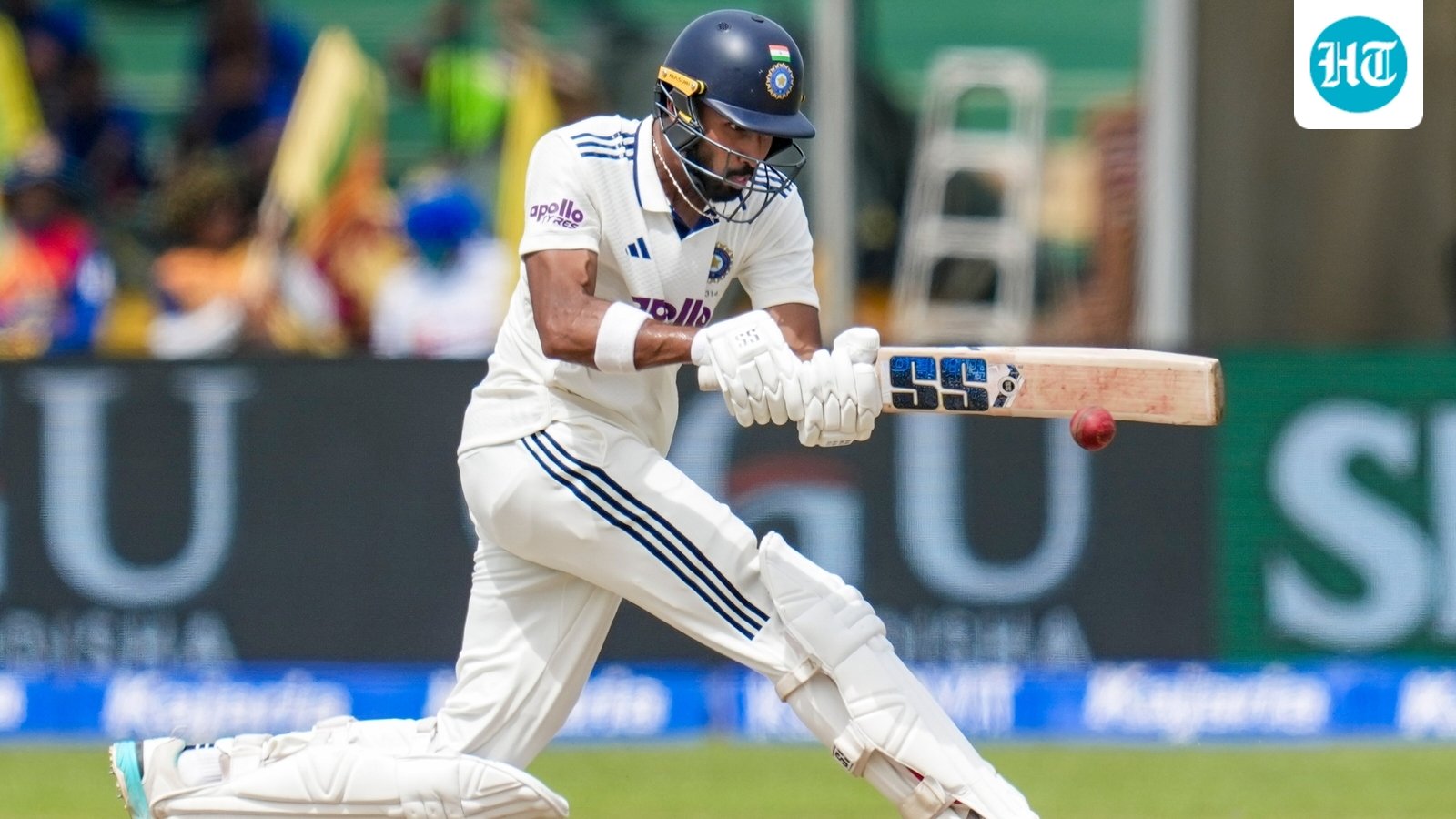
India arrived in Galle carrying questions about the future of their batting order. By the end of the opening day of their 600th Test, Devdutt Padikkal had supplied a rather persuasive answer to one of them. Padikkal walked in after Yashasvi Jaiswal’s run-out had broken a promising opening partnership and finished the day unbeaten on 131 from 178 deliveries, his maiden Test century carrying India to 288 for two. It was an innings of considerable consequence within the match, but potentially an even more important one for the shape of India’s Test batting beyond it.
KL Rahul provided stability alongside him, making 77 before retiring hurt, and the pair added 150 runs to drag Sri Lanka away from the opening they needed after India chose to bat. Shubman Gill’s dismissal for 16 briefly offered the hosts another opening, but Padikkal remained, ensuring India finished a rain-interrupted day with control of both the scoreboard and the contest.
The hundred itself will dominate the immediate conversation. The method behind it should interest India considerably more. Padikkal did not simply survive spin in Galle. He found a way of making Sri Lanka’s preferred lengths work for him.
Padikkal went backwards to move India forward
The defining statistic of Padikkal’s innings was not his century or even his strike rate. It was where the runs came from. Of his 131 runs, 82 were scored from the back foot, off only 95 deliveries. He made 40 from 76 balls on the front foot, with the remaining nine coming when he advanced down the pitch.
For a Test innings in Galle, that is an unusual distribution. The conventional method against spin in these conditions generally begins with getting forward. Smother the turn, reach the pitch of the ball, sweep when required and occasionally advance to disturb the bowler’s length.
Padikkal did all of those things, but his principal weapon was different. He trusted the depth of his crease. Anything marginally short was quickly transformed into something genuinely short. He went deep enough to create additional time, opening up the pull, the punch and the ability to work the ball strongly through the leg side.
It meant Sri Lanka’s spinners could not simply settle into the familiar process of landing ball after ball on a good length and waiting for the surface to do the rest. That length was often Padikkal‘s scoring length. The tactical importance of it became apparent very early. Padikkal was prepared to use his feet against Prabath Jayasuriya and launched the left-arm spinner straight for six before he had properly settled into the innings.
Sri Lanka were therefore presented with two conflicting problems. Go fuller, and Padikkal could advance. Pull the length back, and he was comfortable retreating and attacking from the crease. A spinner’s greatest strength on a turning surface is often uncertainty over length. Padikkal reduced that uncertainty by giving himself two different scoring solutions.
The tempo was as impressive as the technique
Padikkal’s innings was not played at one speed. That was another reason it looked like a genuine Test No. 3 innings rather than simply a talented batter cashing in on favourable conditions. He reached his half-century from 81 deliveries. The second fifty required only another 53. There was no frantic transformation between those phases. Padikkal simply expanded the number of balls he considered scoreable.
Early in the innings, he was prepared to leave runs untouched while understanding the surface and Sri Lanka’s plans. After the rain interruption, when the bowlers briefly found better rhythm and Asitha Fernando produced extra bounce, Padikkal did not attempt to manufacture momentum. He absorbed the spell. Once settled again, the scoring resumed. That ability matters at No. 3 because the position rarely offers the same match situation twice.
Sometimes the batter arrives in the second over and effectively becomes an opener. Sometimes he enters after a century opening partnership and has to prevent the innings from losing momentum. Sometimes he has to repair damage; on other days, he must turn an advantage into domination. Padikkal’s Galle innings contained several of those demands within a single day.
He entered during the first session after an unexpected wicket. He rebuilt alongside Rahul. He became the more dominant partner as the stand developed. He restarted after interruptions. He watched Rahul leave injured, and Gill come and go, yet his own innings retained its shape. That adaptability is exactly what India have struggled to consistently find at first drop.
Also Read: Devdutt Padikkal scripts rare history with maiden Test century, ends India’s long drought at No.3
A little Rahul Dravid in the responsibility, not the method
Any Karnataka batter beginning to establish himself at No. 3 for India will inevitably find Rahul Dravid somewhere in the conversation. The comparison should not be stretched into the lazy territory of declaring Padikkal the next Dravid. They are very different batters, operating in different eras and with markedly different methods.
But there is something instructive in comparing how they address one of the position’s fundamental challenges. Dravid turned No. 3 into his own domain for India. His game against spin was often built around eliminating danger before thinking about domination. The long stride forward, the bat close to the pad, the ball played beneath the eyes, and the willingness to repeatedly smother a spinner’s best length were central to the method. Dravid could, of course, use the crease and possessed excellent back-foot strokes. But his first victory was frequently to make the bowler’s good ball harmless.
Padikkal approached the problem differently in Galle. Where Dravid often shortened a spinner’s effective length by going forward and meeting the ball, Padikkal repeatedly went the other way. He moved backwards and made that same good length feel short.
One method compressed the space available to the ball. The other created more space for the batter. The common thread was control.
That is where the Dravid parallel becomes useful. India do not need Padikkal to reproduce the Wall. Test batting itself has changed considerably since Dravid occupied first drop, and India now possess a middle order whose natural instinct is far more aggressive.
What they require at No. 3 is the principle Dravid represented: a batter capable of adapting his game to what the innings demands. Padikkal’s version of that responsibility can be considerably more modern. He does not necessarily have to wear down a spinner for an hour before attempting to score. His ability to find runs from relatively good deliveries can prevent the bowler from building that pressure in the first place.
India’s No. 3 debate has changed
That is what makes this hundred more significant than a personal landmark. India’s No. 3 position has lacked permanence since the end of the Pujara era. Shubman Gill occupied it before moving deeper into the order, while several other possibilities have been examined without anyone completely owning the role.
Padikkal himself did not necessarily begin this tour as the undisputed answer. Sai Sudharsan had been part of the conversation, and Padikkal’s opportunity came amid competition for the position. But international selection is often decided as much by what a player does when the door unexpectedly opens as by where he stood in the queue beforehand.
Padikkal had already strengthened his case with an unbeaten 142 in the warm-up game. He then converted his opportunity in the Test itself. More importantly, there was a recognisable method beneath the runs. He was organised against spin. He could score without constantly taking risks. He remained composed when the tempo dropped. He restarted after interruptions. And once established, he accelerated without turning the innings into a series of low-percentage strokes.
One hundred cannot settle a Test career, and sterner examinations will come. Greater pace, steeper bounce and lateral movement away from the subcontinent will ask questions Galle could not. But India do not have to decide today whether Padikkal is their No. 3 for the next decade. They only have to decide whether what they saw deserves continuity.
At the start of the Sri Lanka series, Padikkal was still competing for ownership of a position. After 131 unbeaten runs in Galle, the equation has shifted. There was something recognisably old-school about the responsibility he assumed at first drop, something that would have pleased another famous Karnataka No. 3. The way Padikkal solved the problems, though, was entirely his own.


