






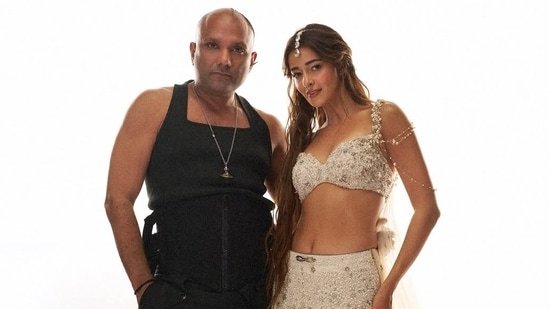
Indian couturier Gaurav Gupta unveiled his latest collection – Light Song – in Mumbai on July 17. Developed over a period of six months, the collection featured over 70 looks spanning from bridal couture and cocktail dressing to occasion wear, reception dressing and menswear.

Created by a team of over 200 artisans, the collection represents more than 6,000 hours of craftsmanship. The showcase had Ananya Panday closing the collection, and even had Indian supermodel Mehr Jesia return to the runway. In fact, the designer revealed Ananya’s finale look was brought to life using over 2,600 individually hand-cut three-dimensional camellia petals, hand-embroidered with 12,000 pearls and over 680 crystals.
In an interview with HT Lifestyle, the designer opened up about his new couture collection, why he chose Ananya Panday as his showstopper, a silhouette that pushed his technical boundaries, his design philosophy, and how he envisions the future of his brand.
Excerpts from the interview:
The Divine Androgyne in Paris explored duality, but this collection focuses on the union of solar and lunar energies. What shifted in your creative headspace that made you want to move to harmony and connection?
I don’t think the conversation changed as much as it evolved. The Divine Androgyne was about recognising that seemingly opposite energies already exist within each of us. Light Song asks what happens when those energies move beyond the individual and into the world around us. I found myself thinking about relationships, between light and shadow, stillness and movement, the Moon and the Sun. In Indian philosophy, they are not opposites but complementary forces. That felt like a natural progression, especially at a time when we are all searching for greater balance and connection.
Ananya Panday represents a new generation of Indian celebrities with a growing global presence. What made her the right muse to embody the spirit of this collection, and what qualities did you see in her that aligned with your vision?
Ananya represents a generation that is confident in embracing both tradition and modernity without seeing them as contradictions. She has an effortless ease, curiosity, and openness that felt very aligned with the spirit of Light Song.
This collection is about harmony and evolution, and she embodies that through the way she approaches fashion and her growing global presence. She brought a quiet confidence to the final bridal look, allowing the craftsmanship and emotion of the garment to speak for themselves.
Which celebrity look of yours has been the most memorable, and why?
It’s difficult to choose one because every collaboration has its own story. Some become memorable because they mark an important moment in culture, while others stay with me because they pushed our atelier creatively. What I value most is when a look creates an emotional connection, when the person wearing it truly inhabits the garment rather than simply wearing it. Those are the moments that stay with me long after the event itself.
Your partner has been a huge inspiration for your collections in the past. Is her presence in this new collection as well?
Navkirat continues to be an important source of inspiration, not in a literal sense, but through the conversations we have and the way she experiences the world. She has always encouraged me to approach creativity with honesty and vulnerability. Those ideas naturally find their way into my work. While Light Song draws from Indian philosophy and cosmology, the emotional core of the collection is still shaped by the people and relationships that inspire me every day.
You’ve divided the collection into two chapters: cool lunar tones and warm solar tones. How do you envision these two interacting on the runway?
I wanted the audience to experience a gradual emotional shift rather than simply see two colour stories. The Lunar chapter unfolds through powder blues, midnight blues, silver and ivory, creating a sense of reflection and calm.
Solar introduces richer golds, warmer metallics, and ceremonial tones that feel more energetic and expansive. As the show progresses, those worlds begin to merge until they arrive at Cosmic Union, where neither energy dominates. Instead, they exist in harmony, which is really the emotional destination of the collection.
Is there a specific technique or garment in this collection that pushed your team’s technical boundaries to their absolute limits?
This season was less about creating new silhouettes and more about advancing the language of craftsmanship. We invested significant time in developing custom jacquard brocades, weaving Pegasus and fantasy-inspired motifs directly into the textile to create a new expression of couture.
The bridal finale became another defining moment, with over 5,000 individually hand-cut fabric Camellia petals meticulously crafted and layered to transform the gown into a living floral sculpture. Both represent the kind of innovation that can only happen through the extraordinary skill and patience of our artisans.
There are over 70 looks in this collection, and you are including everything from bridal couture to menswear and cocktail dressing. How do the themes of solar and lunar energy translate differently when designing for a bride versus designing for menswear?
The philosophy remains the same, but the expression changes. In bridal couture, those ideas are explored through ceremony, emotion, and transformation. The garments feel softer and more romantic, often using intricate surface development and delicate craftsmanship to express that sense of union.
In menswear, the dialogue is translated through tailoring, textile innovation, and structure. This season, we developed custom jacquards, metallic brocades, and kaleidoscopic embroideries that allowed the same philosophy to take on a different visual language while remaining part of the same narrative.
After presenting in Paris, you’ve chosen Mumbai as the stage for this collection. Why was it important for you to bring this specific collection back to Mumbai rather than debuting it on a European stage?
Light Song is deeply rooted in Indian philosophy, craftsmanship, and ceremony, so it felt important for the collection to be experienced here. Mumbai has incredible energy. It brings together creativity, culture, and ambition in a way that feels very contemporary while remaining connected to tradition. Presenting the collection in India also allowed us to celebrate the artisans whose work makes couture possible and to share this story with the audience that understands its cultural references most intuitively.
You have always blurred the boundaries between fashion and performance. When you begin designing a collection, do you think first about the emotion, the silhouette, or the narrative you want the wearer to embody?
It always begins with an idea or an emotion. The narrative comes first because it gives meaning to every creative decision that follows. Once that foundation is clear, the silhouette, embroidery, textiles, and performance all begin to develop organically around it. I don’t see them as separate disciplines. They are different ways of telling the same story.
Indian bridal fashion is evolving rapidly, with younger clients embracing unconventional colours and silhouettes. How is that influencing the way you design couture without compromising your signature aesthetic?
Today’s bride is incredibly confident in expressing her individuality. She is no longer dressing to meet expectations but to tell her own story. That gives us the freedom to experiment with new colours, textiles, and silhouettes while remaining true to the House’s identity. For me, innovation doesn’t mean abandoning tradition. It means allowing tradition to evolve in ways that feel relevant to the woman wearing it today.
You’ve spent years building an internationally recognised couture house. Looking back, what has changed the most in your own understanding of luxury, and what do you hope the next decade of Gaurav Gupta stands for?
When I began, I think I associated luxury primarily with exceptional craftsmanship and exclusivity. Today, I see luxury as something much deeper. It is about authenticity, emotional resonance, and creating work that has meaning. Craftsmanship will always remain at the heart of the House, but I also want the next decade to be defined by curiosity, innovation, and cultural storytelling. My hope is that Gaurav Gupta continues to push the language of Indian couture forward while remaining deeply rooted in the philosophies, traditions, and artistry that inspire us.


