






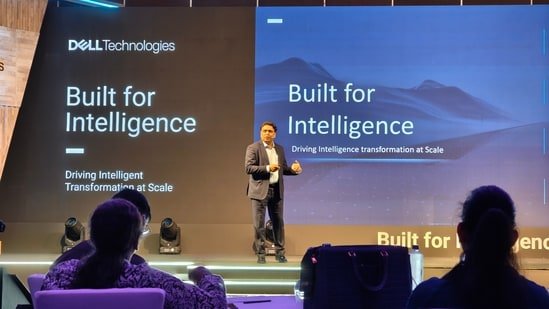
As Indian enterprises move their artificial intelligence initiatives from pilot projects to full-scale deployment, Dell Technologies is betting that the future of enterprise AI will remain inside the data centre rather than the public cloud.
On Tuesday, 30 June, Dell launched its new PowerStore Elite storage platform in India. The company is positioning it as infrastructure for organisations that want to run AI workloads on-premises while keeping sensitive data within their own environments.
The launch comes as enterprises increasingly prioritise data sovereignty, predictable costs, lower latency, and long-term infrastructure investments. Dell positions PowerStore Elite as more than a storage array. It is designed to serve as the foundation of a continuously modern data centre that can adapt to evolving AI workloads without requiring disruptive hardware refreshes.
Venkat Sitaram, Senior Director and Country Head of Dell Technologies’ Infrastructure Solutions Group in India, said the platform brings together AI ecosystems from companies including NVIDIA, OpenAI, and Google. The goal is to consolidate them within a single, controlled infrastructure.
Hardware upgrades and higher storage density
The new 3U storage appliance uses industry-standard E3 NVMe flash memory instead of proprietary storage modules. According to Dell, this enables higher storage density while reducing vendor lock-in and supply chain risks. The platform also features a modular architecture that simplifies hardware upgrades.
Customers can replace controllers, network cards, and other components without taking systems offline. They also avoid migrating large datasets during upgrades. Dell added that the platform supports mixed-generation clustering, allowing newer PowerStore systems to run alongside existing deployments without disrupting operations.
Dell claims the platform delivers up to three times the performance, throughput, and storage density of previous-generation models. It also supports an effective storage capacity of up to 5.8 petabytes through a guaranteed 6:1 data reduction ratio.
According to the company, the higher storage density allows AI models to run closer to primary datasets. This reduces latency and improves performance for AI workloads.
Dell has also refreshed the underlying hardware with next-generation Intel Xeon processors, DDR5 memory, PCIe Gen 5 connectivity, and a faster node interconnect. Combined with software enhancements such as an AI-optimised data path and intelligent workload balancing, the company says the platform improves read performance while lowering CPU overhead and reducing manual storage management.
Reducing dependence on the cloud
Dell is also positioning the platform as a way to reduce recurring cloud costs.
The company estimates that businesses running locally hosted AI models can significantly lower software expenses. The estimate covers models ranging from 30 billion to one trillion parameters on its Deskside Agentic AI system. Dell says cloud software costs could fall by up to 87 per cent over two years.
For larger AI deployments, Dell also introduced PowerRack. The integrated platform combines compute, networking, and storage into a single system.
Built on NVIDIA’s Vera Rubin architecture, PowerRack can be deployed in under six and a half hours, according to Dell. The company says this helps reduce the cost per token for large-scale AI inference.
Security and enterprise adoption
Dell also announced Cyber Detect, a security tool scheduled to launch in the third quarter of 2026. The AI-powered software scans storage at the byte level to detect ransomware. Dell claims it delivers 99.99 percent detection accuracy.
If malicious activity is detected, the system automatically isolates the last known clean copy of the data. Dell says this can reduce manual recovery effort by up to 95 per cent.
Several organisations in India have already adopted Dell’s private cloud infrastructure. Among them is Omega Healthcare, which uses the platform across its delivery centres in India. The infrastructure supports administrative and clinical operations for US hospital networks, where uninterrupted access to data is critical.


