



The way we work, the way we learn, the way we collaborate is changing rapidly. One minute, we are in our offices brainstorming ideas for an upcoming project, the next moment we are in a client’s office giving a presentation. While our work lives have become more dynamic in the past couple of years, the tech supporting this workflow is yet to catch up. Sure, there are platforms like Sheets, Powerpoint and more that run on almost any PC with all the critical security protocols, connectivity, especially when swapping office spaces is still a bit of a hassle. Enter: BenQ InstaShow VS25 and RP05.
The InstaShow VS25 is a wireless conferencing system that BenQ launched in India a few days back. What it essentially does is that it lets anyone connect to a meeting room or a conference simply by plugging in a wireless button or transmitter in their laptops. It works irrespective of the type of device, operating system, security protocols and even connecting to the local wireless network. Simply put, it uses a ‘plug and play’ mechanism to let anyone connect to an ongoing conference. Furthermore, it delivers 4K videos at 60fps, supports CVSS 4.0 certified encryption and up to four presenters on one screen.
On the other hand, the RP05 is an interactive display panel that comes in 65-inch, 75-inch and 86-inch screen sizes, runs Android 15, is backed by 16GB of RAM and 256GB of storage space and offers up to 10 TOPS NPU for edge AI computing. This smart screen also supports NFC, has two 25W speakers and a 20W subwoofer, on-device edge AI, BenQ’s own suite of apps along with Google Play, an air-quality monitoring system and a built-in ionizer to regulate impurities in the air. While these machines work perfectly together, you don’t need to spend around ₹4 lakhs ( ₹1.79 lakhs for InstaShow VS25 and ₹2 lakhs for RP05) in a single go. Instead, you can use them separately with whatever conferencing solution or smart display you have.
What’s truly unique about these devices is the problem that they sought to solve. The idea is that different people come to a conference room with different devices and these devices should be able to interact with each other and the meeting without any hassle.
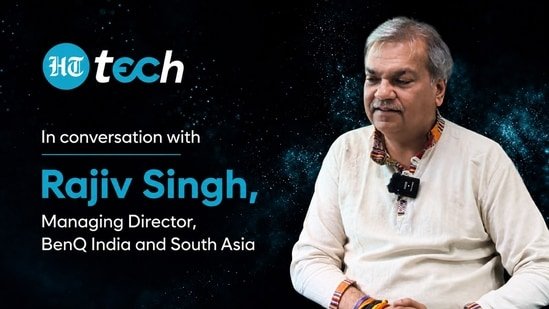
“…what we are seeing on a practical level is that today’s meeting room when we are moving into it and we have all these kind of different set of people, some customer, some internal, some hybrid, some other office people joining the meeting, they are facing a lot of challenge in order to be able to be a seamless part of the meeting…So, we looked at all these pain points of the customer, we decided to come out with an absolutely top of the line,” Mr Rajeev Singh, MD BenQ India and South Asia said in a conversation with HT Tech.
“…whichever device you bring to the conference room…they all should be able to connect to the system that you are having. So, that is where the BenQ RP05 interactive flat panel for meeting room applications as well as for the VS25 which is our video conferencing system comes into play,” he added.
Changing demands of Indian buyers
Beyond these newly launched devices, we also talked about the broader trends in the Indian electronics market. India, for the longest time, has been a price conscious market. On one hand, this has benefited Indian buyers by intensifying competition, on the other hand, it has restricted some of the top quality products from entering the market at the same time as the global market. However, this scenario is changing now.
“It is value centric or value sensitive and within that there is a part of the market which is moving towards premium products. So, what we are seeing is that mid to high end shift. While in the mid end, you have the value buying customer but it is not price conscious…At the same time, there is a set of customers who really want certain premium features. Then they are moving towards those premium devices,” Mr Singh said.
During our conversation, he noted that Indian consumers are becoming more and more value centric now and that they are now looking at things that are of real use to them. “So, people are moving away from just buying something to show. Right. To really find value for them,” he added.
Electronics manufacturing in India
Apart from the newly launched devices and consumer trends, Mr Singh also touched upon the topic of the electronics manufacturing ecosystem in India. He said that the government is very particular about putting the manufacturing infrastructure in India and that it has tailored duty structure such that companies get enough time frame to develop their ancillary businesses locally. This effort is being made not just at the level of the centre government but also the state government that are equally serious about attracting investment.
However, he pointed out that India still lacks behind in the kind of manpower that is needed for manufacturing. “While we have a very tremendous quality of manpower for the softer skills point of view or the software or tech point of view, but when it comes to manufacturing, I think the type of skilled manpower which is needed is still lacking and we need to catch up fast,” he said.
Coming to BenQ’s manufacturing plans in India, Mr Singh said that at the moment one third of the company’s revenue of its portfolio sold in India is coming from Make in India initiatives. In the coming two to three years, the company aims to manufacture around 50 percent of its devices sold in India locally.
“…so almost one-third of our total portfolio of the total revenues that we are doing in India is coming from Make in India initiatives…we would like to move towards almost 50 percent of local content when it comes to manufacturing and that is the roadmap for next maybe our next two to three years time frame,” he added.


