



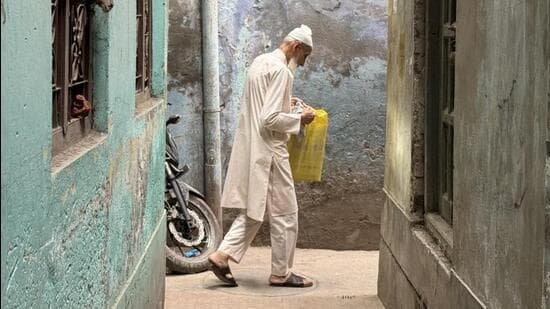
One long, walled alley is painted blue; another, green; a third is divided between grey and white. In all of them, the paint curls and flakes from the walls.


Katra Nizam ul Mulk sits in the heart of Old Delhi, yet feels spiritually removed from it. Consider its setting in Old Delhi’s street layout: here stands the iconic Jama Masjid. Facing it runs the main road of Urdu Bazar, daily choked with nightmarish traffic, so noisy, so chaotic that no peace survives near it. Along its edge lies a narrow alley, easy to miss and easy to dismiss. This is Katra Nizam ul Mulk. On steeping into the lane, it first tapers, then splits into a network of lanes, all part of the same katra—a term that traditionally refers to a neighbourhood shaped by a shared trade.
This afternoon, the lane is silent. Rows of weathered, ornate doorways are punctuated by newer metal doors, already rusting; even these new doors feel absorbed into the scene.
Now, a resident appears. He introduces himself as Tabish. The katra, he says, is always this quiet; and even in peak summer, a cool breeze moves through the lane. He steps aside to let an elderly man in a white kurta-pajama pass, then adds that, unlike other neighbourhoods, where old houses have given way to flats filled with newcomers (he means people who don’t ancestrally belong to Old Delhi), this katra has seen no such change. “Here we only have makaan, not flats,” he says, implying that the neighbourhood consists entirely of old, mansion-like houses, none of which have been replaced by multi-storey apartment complexes, as has been the fate of most Old Delhi neighbourhoods. Each large house, he says, belongs to a single household. The families here, per his account, are all original Old Delhi wale. “In new Purani Dilli flats, many people are crammed together. Here, there’s actually one big house in which just one man lives.”
Two more residents join our narrator: Amaan and his much younger brother, Arhan. The older two try to guess the origin of the katra’s name, then give up. Nizam ul Mulk, they decide, must have been someone long gone, from another time. They then leave. The street returns to silence—until a man appears, calling out: kabadi… kabadi-wale.


