





Gurgaon, the Millennium City of corporate complexes and residential towers, looks so vertical that it seems to have no past. Even its newer name, Gurugram, sounds too modern, rhyming with Instagram, though gram here means gaon, or village.

But saying Gurugram has no past because it looks new would be like saying a new migrant to the city has no past. Walk through the city and see how the impression changes.
In Jacobpura, a bungalow is being demolished by migrant-labourers from Bundelkhand. The skeletal frame still reveals old-fashioned courtyards and doors. A handful of similar structures are still standing intact in adjacent lanes. One has a wooden door bearing carved designs, the parapet above pierced by tiny openings. These houses belong to an old Gurugram, but even they are only a recent layer of its past.
Although walking through the city reveals much of its past, browsing through a book at times uncover aspects no walk can reveal as clearly. The 1910 Gazetteer of the Gurgaon District traces the region to the late Harappan phase and the age associated with the Mahabharata. It records the belief that Yudhishthira gave the village to Dronacharya, his guru. Other eras, other rulers. The Mauryans held the region. Harsha’s rule came later, followed by the Gurjara-Pratiharas, the Tomars, the Chauhans… then Muhammad Ghori conquered the region. The ensuing Sultanate struggled to impose its authority on the Gurugram area, with the Meos resisting and Bahadur Nahar emerging as the powerful ruler of Mewat. The Lodhis, the Sur dynasty and the Mughals followed, under whom Gurgaon became part of the “subah” of Delhi.
The British arrived in 1803. Their presence survives in Civil Lines, most visibly in the Church of Epiphany with its tall lancet windows and gabled roof, like a village church transplanted from a gram of England.
Independence left its mark in Gurugram in less monumental ways.
Mianwali Colony, not the town in Pakistani Punjab but a neighbourhood in Gurugram, is named after the large number of Mianwali wale who came here after leaving their homeland during Partition. This being just one more fragment of the centuries-old past borne by the new-looking city.
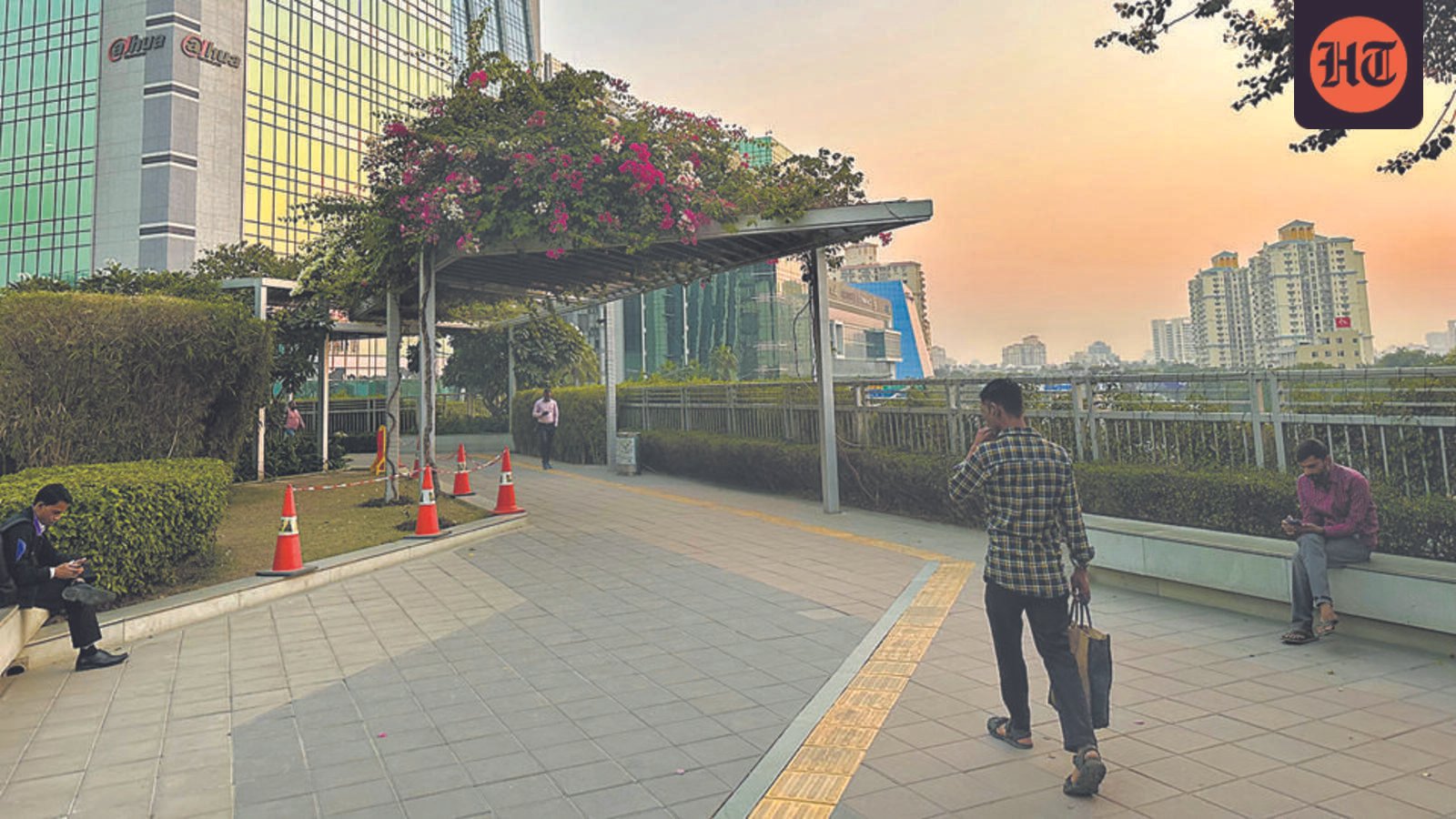
And the city’s new look has its own poetry. One evening, the glass towers of Gurugram catch the fading light, while dark pink bougainvillea spills over a shaded walkway, totally free of litter.
Two citizens are sitting on facing benches, two more are nearing each other beneath the flowering canopy. And beyond the railings, the Millennium City stretches into a horizon that seems to reach back to the times of the Mahabharata. See photo, made for Instagram.


