



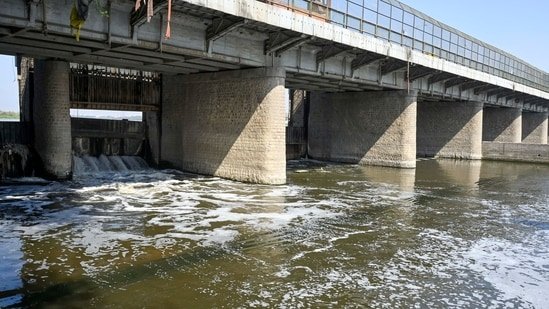
Amid delays in a project to expand water storage capacity at the Wazirabad barrage on the Yamuna, Delhi’s plan to tackle summer water demand with a buffer was also thwarted by a severe ammonia spike in the water level over the past fortnight, forcing authorities to flush down the polluted water to improve water flow and ensure fitness for consumption.


Officials said the dredging of the pondage area has been pushed to October, post monsoon. The dredging of the Wazirabad barrage has been on the agenda for authorities, given that it holds an estimated 363,000 cubic metres of silt, shoal and other material, removing it could bring its base level to 204 metres from the sea level.
An official of the Delhi Jal Board (DJB), who did not wish to be named, said, “The ammonia levels around 10 days back reached more than 2.8ppm and 40-50% capacity of Wazirabad and Chandrawal water treatment plants were impacted. Acting quickly, we restored the normal supply in two days but the episode also forced us to flush down the contaminated water from the Wazirabad barrage reducing our buffer.”
“The supply is normal but if the river dries up in coming weeks, this water could have helped us in such a situation,” the official said.
Also Read: Amid scorching temperatures, IMD puts Delhi on ‘orange’ alert until May 26
To be sure, the exact quantities of the buffer and loss were unavailable.
The source of contamination was tracked to a breach of a minor check dam in the DD2 drain upstream, in Haryana, which led to contaminated industrial effluents mixing with the raw water supply.
Over the past decade, periodic spikes in ammonia levels have been a long-standing point of dispute between Delhi and Haryana. The DJB argues that pollutants, such as dyes, chlorides and ammonia-based chemicals, flow from the Panipat industrial dye drain, while Haryana has maintained that there are no leaking pollution sources in its industrial areas.
The Wazirabad pondage area serves as the primary raw water holding area from the Yamuna for two of the largest water treatment plants: Wazirabad and Chandrawal.
A senior government official, requesting anonymity, said, “We had again started the process to revival the Wazirabad pondage area—excavation and dredging of river pondage area from Wazirabad barrage to Ram Ghat will be carried out. Pre-bid meeting has been held but the project is now only likely to be taken up after the monsoon.”
Also Read: Eight injured in clash after road-rage for overtaking on Delhi-Mumbai E-way
The pondage area has not been cleared for more than a decade and its capacity has almost halved. “We estimate that there is an average of 2.15m of siltation in the riverbed. The agency hired for the work will pay DJB for the excavated sand,” the official said.
A water-stressed city which is primarily dependent on its neighbours for the raw water supply, Delhi has considered multiple options for increasing the buffer water storage capacity projects. HT reported previously that according to the assessment carried out by the irrigation and flood control (I&FC) department, the 15 identified mine pits can cumulatively hold 5,200 million litres per day (mld) of water or 5.2 million cubic metres per day. The storage volume of six floodplain sites is around 13.7 million cubic metres.
Bhim Singh Rawat, a Yamuna activist and member of the South Asia Network on Dams, Rivers and People (SANDRP), said, “Even if a larger buffer is created, the contamination will keep forcing the DJB to flush down the polluted water. The pollution from drain number 8 and DD2 has become a frequent problem.”


