



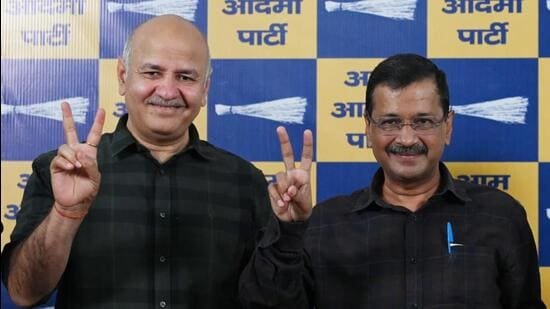
Even as a Delhi court junked the CBI’s case against former Delhi chief minister Arvind Kejriwal and former deputy CM Manish Sisodia, among 23 others, in the Delhi Excise Policy case, it took exception to a phrase used repeatedly in throughout the federal agency’s charge sheet — the ‘South Group’.


Special Judge Jitendra Singh, even before formally reading out the operative parts of the order, orally said in court that he had concerns with the use of the term.
The judge remarked, “Such kind of terminology I feel should be avoided…is it possible that if the Central Bureau of Investigation (CBI) had filed the same charge sheet in a Chennai court, it would not be perceived offensive?”.
The court went on to question special public prosecutor DP Singh on who had coined the term. “Why didn’t you say those in the north among the accused are the north group”.
Also Read: Case doesn’t survive judicial scrutiny: Court exonerates Kejriwal, Sisodia in excise case
The court went on to caution the prosecution against using such terms and reiterated that it should be avoided.
According to the CBI’s case, several accused officials of the Delhi government’s Excise Department, in connivance with Kejriwal, Sisodia and others, are alleged to have made changes in terms of manipulating margins, relaxing eligibility norms and diluting related-entity restriction, allegedly in favour of a lobby of liquor businessmen referred to as the ‘South Group’, in pursuance of a prior understanding.
The court’s disagreement to the use of the phrase was also reflected in its detailed order, which the court said amounted to identity-based labelling, unwarranted in a fair criminal trial.
The court said that the CBI’s deliberate and repeated use of the expression to describe a set of accused persons, apparently on the basis of their regional origin, finds no foundation in law.
The order read, “The prosecution narrative does not speak of any ‘North Group’ or similar categorisation. The selective adoption of a geographically defined label is, therefore, plainly arbitrary and unwarranted”.
The judge emphasised that a criminal proceeding, which must remain dispassionate and evidence-centric, gets prejudiced due to such region-based labelling.
The court stated, “The continued use of this label, despite the absence of any legally sustainable basis, carries a real risk of colouring perception, causing unintended prejudice, and diverting focus from the evidentiary material, which alone must guide adjudication”.
The court said that while it could not find a comparable judgement within the framework of the Indian law to complement its argument, it referred to a case precedent in the United States from 2000, wherein the United States Court if Appeals for the Seventh Circuit went as far as to set aside a conviction as the prosecution was repeatedly using of an identity-based terminology — Dominican drug dealers.
The court said that the case proved how criminal trials must be about what the defendant did, and not who the defendant is.
The judge went on to caution investigating agencies to exercise restraint in its choice of language while drafting charge sheets and investigative narratives. “Description of accused persons must remain strictly neutral, evidence-based, and free from expressions that carry a stigmatic, divisive, or pejorative undertone,” the order said.
The court added that the use of such terms had a direct bearing on the guarantee of a just and fair trial.
While referring to the alleged South group in its charge sheet, the prosecution includes at least four accused persons, Abhishek Boinpally, Arun Ramchandra Pillai, Mootha Goutam and Satath Chandra Reddy, who as part of the group, negotiated illegal gratification of ₹90-100 crore, part of which was to be routed through hawala channels.
The CBI had claimed that Sisodia had played a vital role in coordinating and holding discussions with members of the South group, while formulating the policy.
The prosecution claimed that the alleged South group was headed by a private firm Indospirits, which allegedly earned profits of ₹29.29 crore, which formed part of the funds which were circulated as bribe money.


