



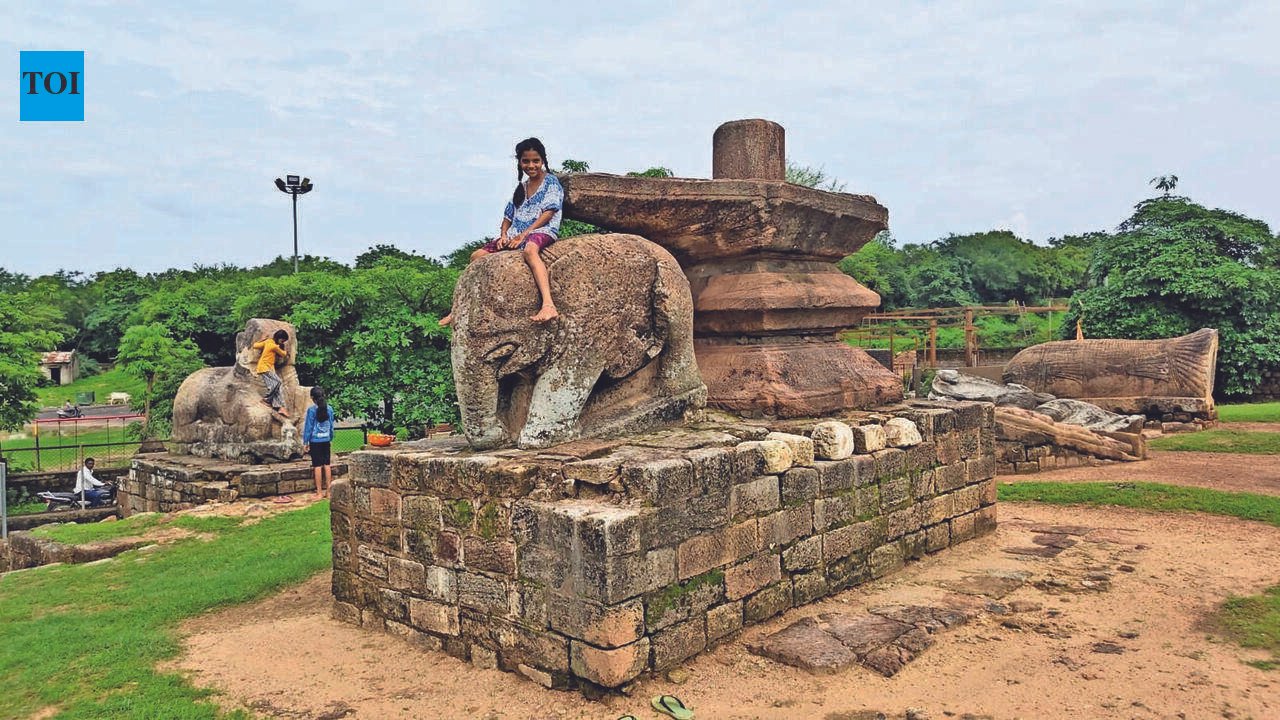
Chandrapur: Children’s footsteps echo near an 11-foot Shivalinga that has not felt the touch of a devotee’s hand in generations. A few feet away, a 10-headed Durga idol lies damaged, her surface scarred by years of stone-throwing after locals mistook it for an idol of demon. In Chandrapur’s Bhiwapur ward, a 400-year-old set of monumental idols lies in an open field —no priest, no bell, no incense. Only weeds, weather, and the quiet persistence of sandstone that has outlasted the man who carved it and the temple he never finished.Four hundred years ago, a wealthy merchant named Rayappa Vaishya looked at the forts and shrines rising under Gond rule and decided Chandrapur deserved a temple complex to rival them. He commissioned an extraordinary set of idols — an enormous Shivalinga, a four-armed Ganesha in South Indian style, and a monumental depiction of Durga in her ten-faced, demon-slaying form — meant to anchor what could have become one of Maharashtra’s grandest temple sites. Then he died, mid-dream, and no one finished what he started.The Durga idol suffered the worst fate. For nearly two decades, villagers pelted it with stones every Vijayadashami, believing it symbolised Ravana. The practice stopped only after Chandrapur historian Ashok Singh Thakur, now head of Indian National Trust for Art and Cultural Heritage (INTACH), documented the iconography and clarified the idol’s identity. “This is not Ravana — this is Goddess Durga in her Mahishasura Mardini form, a rare and powerful iconographic tradition,” says Thakur. INTACH is one of the world’s largest heritage organizations.His clarification stopped the stone-throwing, but the damage remains.The Shivalinga is also unusual: it rests on a sculpted elephant, a rare feature in Shaiva iconography. The site has drawn outside attention, including a London-based historian Barry Tabor who flagged its neglect years ago.The monument has even appeared on the cover of a 2007 Mumbai numismatic journal. The eight-foot Ganesha idol, carved from a single sandstone block, features Sheshnag behind it and holds an axe, a mace and a modak, with the fourth hand in abhaya mudra. Even during Ganesh festival, it receives little attention.A decade ago, historians’ advocacy secured a watchman for the site. That arrangement has since lapsed, and the field has reverted to what it was before — an informal playground, its ancient stone spine used for games rather than worship. The Archaeology Department has preserved a replica of the Durga idol in a Nagpur museum.“If this temple had been completed, it would have emerged as Maharashtra’s largest shrine housing monolithic sculptures. Such extraordinary heritage deserves protection, not prolonged apathy and poor conservation,” says Thakur.Had Rayappa Vaishya lived to complete his vision, Bhiwapur might today be spoken of alongside Maharashtra’s great temple towns. Historians warn that without renewed intervention — security, documentation, conservation — Chandrapur risks losing not just these idols, but the layered history of devotion, artistry, and mistaken identity they quietly carry.Besides Shivalinga, Ganesha and Durga idols, the field holds carvings of Mahishasur Mardini, Hanuman, Kalbhairav, Garuda, Sheshnag, Bhairava, Matsya and Kurma avatars, Nandee, the Bhima, and a square Shivalinga — too massive to lift, too fragile to ignore. Without raised platforms, even photographing them properly is difficult, let alone studying or conserving them.Standing just a few metres away from the scattered cluster of stone deities, a massive Shivlinga is the only deity that has continued to be worshipped by local devotees for decades. Believed to be the largest Shivlinga in Maharashtra, the monolith measures about five feet in height and 20 feet in circumference. In recent years, local MLA Kishore Jorgewar has initiated a grand Mahashivratri festival at the site, drawing thousands of devotees. Villagers have also begun constructing a temple over the Shivlinga. However, construction is prohibited at a protected archaeological monument.Scattered across Chandrapur district are numerous sculptures of comparable age and craftsmanship, many still undocumented, uncatalogued, and unprotected — remnants of a regional artistic tradition that rarely makes it into textbooks on Indian temple architecture.


