



Agriculture accounts for nearly 20% of the country’s total electricity consumption (1623 TWh for FY 2024-25). The power supplied to agriculture sector is heavily subsidized in the majority of states, resulting in low-cost recovery for distribution companies (DISCOMs). The average cost of supply is around ₹7–8 per unit, while recovery is typically less than ₹1 per unit, creating a substantial gap. This gap is bridged through government support, leading to a persistent financial strain on both public finances and the balance sheets of power utilities.


At the national level, agricultural subsidies (including subsidies for low-income households) are estimated at around ₹1.5 lakh crore annually constraining the financial position of DISCOMs, limiting their ability to invest in network strengthening, loss reduction, and service quality improvements. It also leads to cross-subsidization, wherein higher tariffs are charged to industrial and commercial consumers to offset losses from subsidised segments.
In this context, decentralised solar applications enable generation at the point of consumption, reducing dependence on subsidised grid electricity while simultaneously addressing issues of supply reliability and power quality. PM-KUSUM Launched in 2019, institutionalised this approach through three components:
- decentralised, grid-connected renewable plants;
- standalone solar pumps in off-grid or underserved areas; and
- solarisation of existing grid-connected pumps, including feeder-level solarisation with surplus power export), collectively transforming farmers from subsidy-dependent consumers into active energy participants.
However, while PM-KUSUM provides a national level framework, its real impact depends on state-level execution. Maharashtra presents a particularly instructive case in this regard. Prior to the introduction of PM-KUSUM, the state had already initiated a transition towards solar-based irrigation through programmes such as the Atal Solar Krushi Pump Yojana (2015), MukhyaMantri Saur Krishi Vahini Yojna (MSKVY 2017) and subsequently the Magel Tyala Saur Krushi Pump Yojana. These early interventions enabled the development of institutional capacity, including digital platforms for beneficiary identification and monitoring, as well as a robust vendor ecosystem capable of supporting deployment at scale.
By the time national support mechanisms were introduced, Maharashtra had already reduced key barriers related to awareness, administrative processes, and supply chains. As a result, the state has been able to achieve a significantly higher pace and scale of deployment compared to the national average, supported by the convergence of state and central schemes.
Nationally, PM-KUSUM targets about 49 lakh pumps. Of the 10.7 lakh installations completed under Component B, Maharashtra alone accounts for roughly 5.22 lakh pumps nearly 50% of the total. While agricultural cost of supply continues rising nationally, Maharashtra recorded a shift from a +9.19% increase to a –1.94% decline. Tariff impacts remain state-specific, but Maharashtra reports ₹1–1.5/kWh reductions for commercial and industrial consumers, alongside AT&C loss reductions to 6–10%.
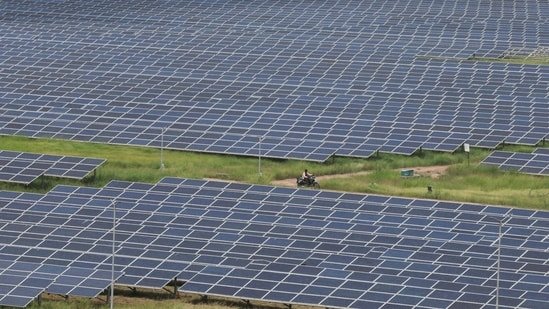
The financial impact of agricultural solarization is most evident in its ability to ease DISCOMs’ cost burden by reducing power procurement for a high-consumption, low-revenue segment. Even partial substitution of agricultural demand with decentralised solar generation leads to substantial savings given the sector’s scale. This shift is clearly visible in Maharashtra, where MSKVY 2.0 has advanced from individual pumps to large-scale feeder solarisation, installing over 5,800 MW. By solarising entire agricultural feeders, the state has significantly curtailed grid-supplied irrigation power, especially during daytime hours when solar output aligns with demand.
Feeder-level solarisation enables faster, lower-cost implementation and has delivered large fiscal gains in Maharashtra, cutting power procurement for subsidised agriculture. With projected savings of about ₹10,000 crore and annual subsidy reductions near ₹4,500 crore, it shifts agricultural solarisation from a recurring subsidy to a one-time investment that lowers long-term costs. This creates a payback pathway that is fundamentally different from traditional subsidy-based approaches.
This shift is about reallocating resources more efficiently moving from subsidising consumption to investing in assets that lower long-term costs. Maharashtra’s experience shows that scale, institutional readiness like land banks, and financial innovations are critical to making feeder-level solarisation effective and sustainable for other states.
However, replication will require adaptation to local conditions, particularly groundwater availability, land constraints, and grid capacity. A targeted, region-specific approach rather than uniform implementation will be essential. If these elements are aligned, agricultural solarisation can evolve from a scheme-driven intervention into a cornerstone of DISCOM reform, delivering sustained financial, operational, and environmental gains across states.
(The views expressed are personal)
This article is authored by Arunendra Kumar Tiwari, Fellow and Shubhangi Choudhary, consultant, TERI.


