



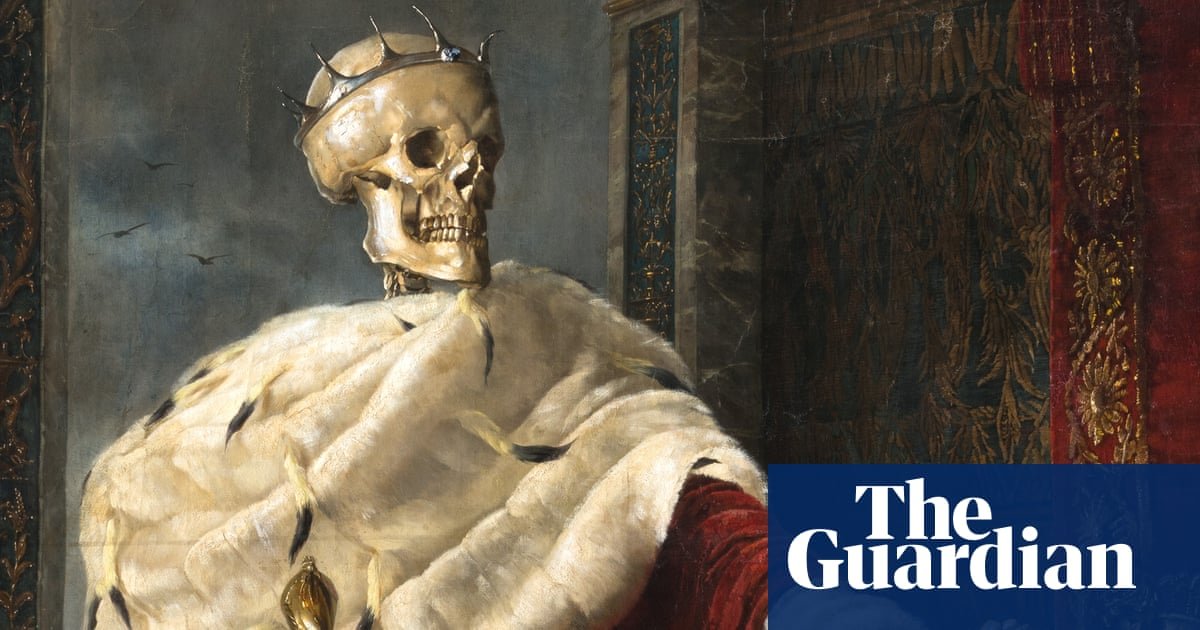
Wrapped in a cloak with ermine fur and wearing a jagged iron crown, a hulking skeleton rests one foot on a globe and knocks over a royal throne with a dramatic flick of its ivory wrist.
Entitled Mors Imperator (“Death is the Ruler”), the German artist Hermione von Preuschen’s 1887 symbolical painting was meant to express the transience of fame and power. But authorities feared the picture could be seen as mocking the ageing German Emperor Wilhelm I, who then had recently turned 90, and refused to accept its submission to the Berlin Academy of the Arts’ annual exhibition that year.
More than 100 years after the painting’s rejection and subsequent display in the 19th-century equivalent of a pop-up gallery caused a stir in Berlin society, Mors Imperator is returning to the German capital. From Sunday until mid-November, the 2.5-metre by 1.3-metre painting will be shown in a state institution at last, at the Alte Nationalgalerie museum.
The scandal around von Preuschen’s work illustrates how prone single-ruler autocracies can be to paranoia about hidden meanings in art. According to the Berlin exhibition’s curator, an offence against the monarchy was neither what the artist intended nor how it was perceived by its supposed target.
Born in Darmstadt in 1854, von Preuschen was a poet, world traveller and painter known for her large-scale and flamboyant historical still life pictures. At the 1896 International Women’s Congress in Berlin she gave an impassioned speech calling for women to be allowed education at artistic academies.
“Hermione von Preuschen was bold, not short of self-belief, and an early advocate of female emancipation,” said Birgit Verwiebe, an art historian. “But she was not a political person, and there is no record of her having any anti-monarchical instincts. After all, she came from nobility herself.”
In-depth studies of the painting had yielded no signs of hidden intent to identify the skeleton as the German kaiser, she added. The coat of arms on the throne was a creative invention, at best comparable to French royal insignia. The crown set with precious stones falling to the ground in the bottom half has been identified by researchers as being based on a French royal crown at the Louvre.
Mors Imperator was originally meant to form the first part of a 10-painting cycle depicting themes of life, death and love, and to be directly counterposed at the academy exhibition with a painting called Regina Vitae, the queen of life. The second picture, however, was not completed in time for the submission deadline.
Devastated by the rejection, the then 33-year-old painter wrote directly to the German emperor and king of Prussia to explain her intentions. Wilhelm’s secretary replied, saying the monarch had no problem with the subject of her painting, and it was for those judging its aesthetic value to decide.
The academy, however, subsequently changed tack and said it had rejected the picture on grounds of artistic merit, dismissing it as “the inartistic expression of a skewed thought”.
Von Preuschen escalated the situation further, publishing a letter on the affair in a Berlin newspaper and hiring a shop room on Leipziger Strasse in central Berlin to showcase the painting, hiding it behind curtains so it could be unveiled in a dramatic flourish. In spite of an admission fee equivalent to €8 today, the exhibition became the talk of the town and made the artist famous overnight.
Mors Imperator was sold to a Swiss businessman in 1892. After von Preuschen’s death in 1918, her remaining works were donated by her daughters to a small neighbourhood museum in Berlin’s Alt-Mariendorf district; a 2013 retrospective of her work at the museum featured a copy of the scandalous painting. It has been loaned to the Alte Nationalgalerie for the new exhibition.
“Von Preuschen was an intelligent, highly educated but also highly emotional person, who spent a lifetime grappling with the big questions around life, death and fate,” said Verwiebe. “Mors Imperator was a picture that came from the heart.”
The painting’s central message – that death overrules earthly authority – would also prove true; Wilhelm I did indeed die shortly after the painting’s completion, on 9 March 1888. The year is known in Germany as the “Year of the Three Emperors”, because by the time Wilhelm’s son, Frederick III, took the throne he was already fatally unwell with throat cancer. He would die 99 days later.


