






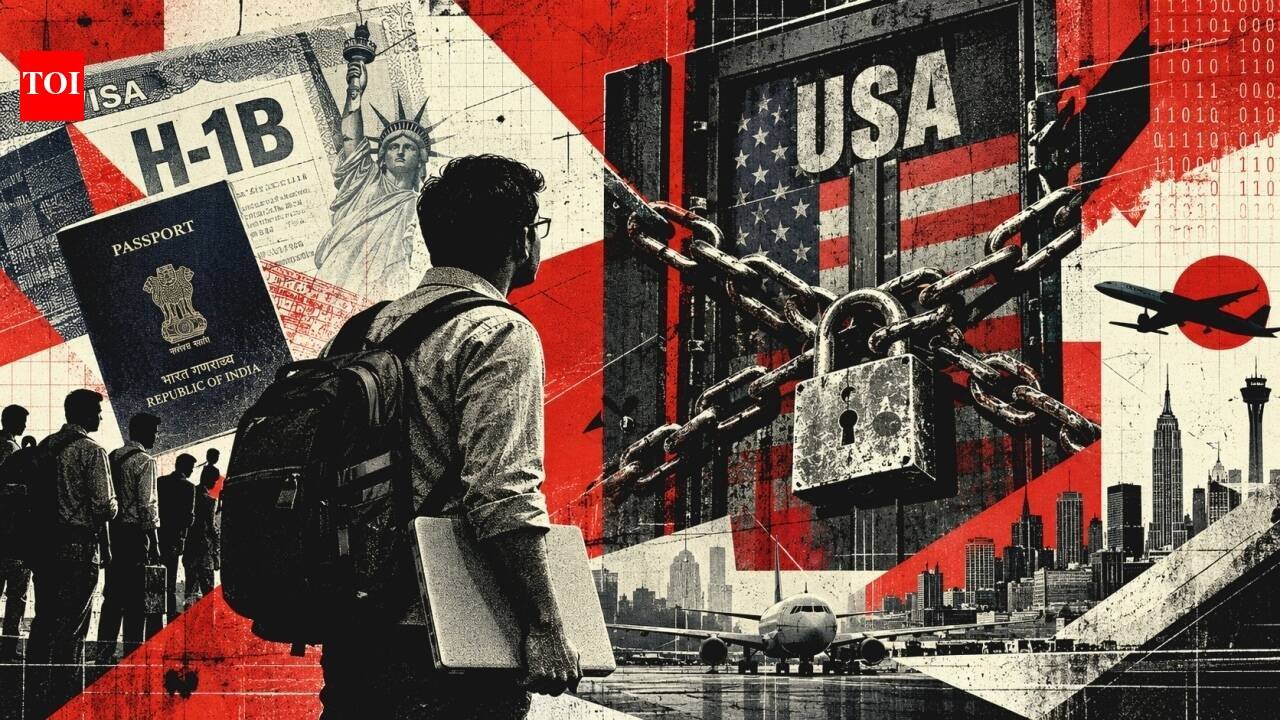
Indians, particularly IT sector professionals, hoping to work in the US, have a steep uphill climb. And, under the Donald Trump administration the fear is that the path may itself be lost! The repeated tightening of entry under the H-1B visa program is proof of the growing uncertainty.Three H-1B related changes are stacking on top of each other: the multiple $100,000 fee proposals, the wage-weighted lottery favoring more senior workers, new layoff and compliance scrutiny, and now the OPT/STEM-OPT $70,000 fee proposal for students looking to work in the US.And then there are statements from the Trump administration, hinting at doing away with the H-1B visa system itself. While admittedly, experts find that to be a far-fetched possibility, they do treat it as a symptom of the growing restrictions.Indians are the biggest beneficiaries of the H-1B visa programme, making up around 70% of the total approved list. Hence, it’s obvious that they would absorb the maximum impact of the immigration restrictions.
H-1B visas: Indians biggest beneficiaries
The first consequence is the disruption to the traditional Indian pathway: Indian education gets you into an Indian IT company, which gets you an H-1B visa and US employment, and you get added to the green-card queue.That pathway is set to become much narrower or worse may even disappear!
H-1B visas: What is happening?
Experts say H-1B visas are an indication of the larger crackdown to ensure Americans don’t lose out on jobs.Rajiv Dabhadkar, Founder, National Organization For Software and Technology Professionals makes an important point: what is happening is not a visa system overhaul, it’s a deeper labour market problem from the US government perspective.“The US government is increasingly looking not only at the worker but at the entire employment chain,” he tells TOI.That means asking:
- Who sponsored the worker?
- Who actually employs and controls the worker?
- Where does the worker actually work?
- What wage is being paid?
- Was the worker recruited for a genuine job?
- Is an intermediary taking a margin between the employer and the worker?
- Was an American worker displaced?
- Was a qualified American worker given a genuine opportunity to compete for the position?
“There is an older but highly relevant principle here. The 2010 Neufeld memorandum placed emphasis on the employer’s “right to control” an H-1B beneficiary – essentially, who determines when, where and how the worker performs the job. That principle is particularly relevant when examining third-party staffing and intermediary arrangements,” Dabhadkar says.“This matters because the H-1B worker can actually be a victim of the same system that potentially disadvantages the American worker. The DOL OIG’s investigation specifically refers to foreign workers being exploited through wage kickbacks and coercive arrangements, while also referring to below-wage labour undercutting American workers,” he adds.
Indian IT professionals to be hit hardest
Indian-born professionals continued to dominate the H-1B programme in FY 2025. The US Citizenship and Immigration Services (USCIS) approved 406,348 H-1B petitions, of which 283,772, or approximately 70%, were for beneficiaries born in India.Technology-related occupations were the largest category across the H-1B programme overall. Computer-related roles accounted for 252,088 approvals, or 62% of all beneficiaries. Systems analysis and programming was the largest detailed occupation, representing 50.4% of approvals.
H-1B visas by occupational Groups
According to Akhil Chandna, Partner and Global People Solutions Leader, Grant Thornton Bharat, these figures point to sustained demand for technology skills, although USCIS does not publish a combined breakdown showing occupations specifically for Indian-born beneficiaries.As Xiao Wang, CEO, Boundless Immigration notes: A typical Indian H-1B holder is a computer and IT professional; the main beneficiaries are software developers, systems analysts, programmers, and IT consultants.Indian nationals took about 70% of all approved H-1B petitions last year, and IT workers were over 65% of H-1Bs over the past 5 years!The median annual compensation for all approved H-1B beneficiaries in FY 2025 was around $133,000, with median computer-specific roles at $140,000.But, as Wang says: the range is large – $117,000 at the 25th percentile and $179,000 at the 75th.According to the Boundless Immigration CEO, the impact for Indians is split across various job levels.For example, senior and highly paid Indian engineers at US tech firms are relatively insulated, and the wage-weighting actually favors them.But, early-career Indian workers and the IT-services staffing model are the ones squeezed hard, because that model runs on volume at lower wage levels, which is precisely what both the flat fee and the wage-weighting penalize.As Akhil Chandna points out, the H-1B programme continues to be driven largely by demand for technology talent, and it’s a trend that is only expected to accelerate with the rapid adoption of artificial intelligence and emerging technologies.“Against this backdrop, recent policy changes appear less focused on reducing H-1B numbers and more on reshaping the programme to attract highly skilled, higher-paid talent while strengthening safeguards for the US workforce,” he tells TOI.
H-1B visa selection rate by wage level
The bottom line is that litigation is now becoming a recurring feature of the immigration system.The $100,000 H-1B fee has been blocked by two federal judges, with business groups and other organizations challenging the administration’s authority and implementation.In summary, the issue is not simply that one visa is becoming harder. The larger problem is systemic uncertainty across multiple legal pathways.
What Indian IT companies could do
According to a recent report, H-1B visa registrations by TCS, Infosys, HCLTech, Wipro, LTM and Tech Mahindra plunged 92% for FY27 to 1,763 from 21,919 a year earlier.The fall is far steeper than at major US employers, pointing to a structural shift in how Indian technology companies deploy talent in America.The shift is therefore already visible and further acceleration is likely.The top seven Indian firms won a little under 5,000 initial H-1B approvals in the most recent cycle, down roughly 70% from FY2015 and 37% from FY2024.
Company-wise H-1B visa approval
“The main trend is that the body-shop model of flying Indian IT consultants to the client in the US model is gone, and it’s being replaced by a mix of US local hiring for client-facing work and a much bigger offshore footprint in India for everything else. The crackdown speeds up a transition the economics were already driving,” Xiao Wang tells TOI.According to Rajiv Dabhadkar, the traditional model was: India employee + H-1B + US client site + onsite deliveryThe emerging model is increasingly: US local employee + India-based engineering/delivery team + global technology platforms
H-1B visas: What are the alternatives?
Xiao Wang does not see the H-1B visa programme being scrapped, despite the noise around it.“No administration can unilaterally scrap H-1B. It’s written into statute (the Immigration and Nationality Act), so abolishing it takes an act of Congress. What’s actually happening is death by restriction, making it more expensive and harder to get,” he tells TOI.Experts say alternative US visa options remain available for certain professionals, including the L-1 visa for intra-company transfers, the O-1 visa for individuals with extraordinary ability, and, in limited cases, employment-based green card pathways. These routes, however, typically have narrower eligibility requirements than the H-1B.But, while alternatives exist, getting them is not straightforward or easy.
H-1B visa alternatives: In & Outside US
Rajiv Dabhadkar says L-1 and O-1 are not straightforward H-1B substitutes: L-1 is limited to qualifying intracompany transfers, while O-1 requires extraordinary ability and has a much higher evidence threshold.EB-1 is similarly highly selective, while EB-2 and EB-3 face a major India-specific obstacle: long green-card backlogs, he notes. All available FY2026 EB-2 immigrant visas for India had also been exhausted before the fiscal year ended, he adds.“It is tempting to say that if H-1B becomes unavailable, Indian professionals can simply move to another US visa category. That is not a realistic description of the current system. The alternatives exist legally, but for a large population of Indian professionals they are not scalable substitutes for H-1B,” says Rajiv Dabhadkar.Akhil Chandna says that beyond the US, countries such as Canada, the UK, Australia, Germany, Singapore and the UAE continue to attract skilled Indian professionals through a range of work and residence programmes.
The unexpected advantage for India
Not all will be lost, though. In fact, India may stand to benefit.There is the possibility of remote working, which in turn would create jobs in India.“Work that can be performed remotely, such as software development, testing and support services, may increasingly be delivered from India and other global delivery centres,” says Akhil Chandna.He also believes that a complete shift away from H-1B sponsorship is unlikely.“US businesses will continue to need specialized talent on the ground for project leadership, client engagement and complex technology implementations. The more likely outcome is a balanced approach: stronger local hiring in the US, selective H-1B sponsorship for critical skills, and expanded offshore delivery for roles that do not require physical presence,” he tells TOI.Rajiv Dabhadkar explains how this helps: it would mean more engineering in India; more Global Capability Centres; more AI and data science work in India; more product development in India; more cloud and cybersecurity engineering in India; more remote delivery; more US local hiring for customer-facing roles.“This creates a potentially unexpected outcome. H-1B restrictions could simultaneously produce: more American hiring and more high-value employment in India. That is why I don’t see the future simply as “Indian IT loses because of H-1B restrictions.” The business model is being redesigned,” he concludes.


