The painting, ten feet wide, is a window onto a world. The slim man in the peachy-pink jacket stands by the edge of the pool, looking down, uncertain. Someone is swimming underwater towards him; a young man, clad in modest white trunks. The hills beyond the pool make overlapping triangles of cerulean blue, of olive, sage and lime. They could be those of California or Provence—or even biblical Galilee. Ever since the Renaissance, artists such as Piero della Francesca, Rembrandt and Poussin have painted bathers washing off stains and sin amid the peace of nature. David Hockney, who created this scene, knew that. He studied them all. The swimmer’s arms are outstretched. In the blue amniotic water he could be an angel. Or a new lover.
Photograph: Getty Images
It is a double portrait, one of many that made him famous in the 1960s and 1970s on both sides of the Atlantic. The last time “Portrait of an Artist (Pool With Two Figures)” changed hands, in 2018, it became the most expensive picture by a living artist ever sold at auction. Swimming pools had held a special allure from the moment he flew into Los Angeles at the age of 26, having left behind the wintry grey of post-war England, and saw the little blue oblongs tiling the city below. So did the challenge of painting water, with its unscripted colours, its surfaces that shimmered in two dimensions, and its tension. Viewers standing in front of the painting got so drawn in to its many possibilities they never noticed the minutes passing.
Having decided on the composition, he used props and photographs, played with perspectives, and paced out measurements in the studio: all the techniques he’d learned at art school and since. Mostly, though, he was working from the heart. Painting was how he made sense of the world. His brushes helped assuage the pain of the terrible break-up a year earlier, when the man standing by the pool had left him for a young Swede, tall and blond, and his mother, his staunchest ally, was the only person he could bear to have around.
At least there had been work to get on with. Not that it came easily. For months he sensed something was wrong; the picture felt flat. Four weeks before his new show was due to open in New York, he reoriented the swimming pool and started afresh, thrilling at his renewed sense of purpose. Painting 18 hours a day, seven days a week, he finished it at last the night before the shippers came to take it to America. He felt like his hero Picasso, who liked to say: “I’m not painting; I’m exploring.”
He’d always liked exploring. Although he was closest to his mother, a vegetarian Methodist who brought up five children on a modest budget, it was his father who inspired him. Time and again, Ken Hockney would come upon an old bicycle or a piece of domestic machinery, strip it down, paint it a bright colour and sell it as new. Though he was often short of paper, art became the heart of the boy’s life. In Bradford, in West Yorkshire, he’d wheel paints and brushes around in a cast-off pram that his father had repaired, looking for things to draw. When his English teacher asked him to read out a school essay, he told her he had made a collage instead, an intricate self-portrait.
At 18 he made his first trip to London, dossing on the Tube until the museums opened and hitch-hiking back. He saw more art that day than he’d ever seen in his life. He became determined to study art in the city, but when he got to the Royal College of Art he found it beset with questions. Was abstract expressionism the only in-thing? Or was conceptual art equally important? And where did that leave figurative painting? Would he forever be condemned to painting Christmas cards? For his first work at the RCA he drew a human skeleton, which showed off how much he already knew about perspective and anatomy. The other students took note, and one, a former GI, offered him £5—£100 today—for it. (This was R.B. Kitaj, who went on to become a painter of note himself and a lifelong friend.) He stopped worrying about being contemporary and set about creating his own kind of art, art of his own time.
He painted his London life: his friends, his homosexuality, his need to combine sex and love, his passion for the poems of Constantine Cavafy and Walt Whitman. But when he won a prize for an etching, he spent the money on a ticket to New York. And America freed him. He stopped at a drugstore and bought his first pair of thick-framed glasses. He dyed his hair blonde. He laughed with young men on the beach in California. Most of all he experimented with materials, exploring quick-drying acrylic, pastels, pencils, watercolours. He would fix on things for weeks on end. The broken surface and flying droplets of “A Bigger Splash” took him two weeks to paint.
One summer, working with a printer friend in upstate New York, he made a series of luscious coloured pool works, using mounds of wet coloured papier-mâché, which he’d corral into different shapes, squeeze between presses and print on huge sheets of wet paper. The scintillating watery effects were as close as you could get to plunging into the water yourself.
Finding new ways of making art filled his life with a sense of renewal. Flying on to California again, he found himself rising early, very early, and painting the canyons while the light was good, stopping only to take a step back and focus on a cigarette, his favourite pastime after painting. All his favourite painters had smoked—Picasso, Monet, Renoir, Cézanne. None had died young, which is how he justified it to himself.
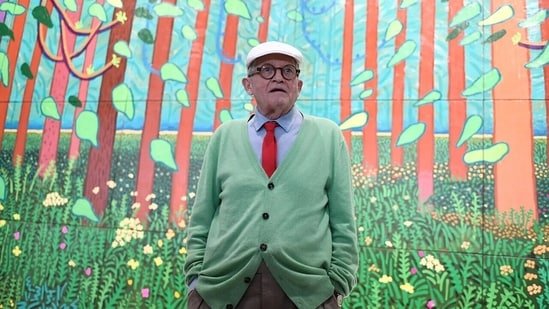
From California he travelled back to Yorkshire, his inexhaustible native place. There, after his mother died, he bought a house of his own. The attention he once paid to painting water he now gave to gigantic murals of the stands of trees he’d known as a child. Soon he would swap paints for pixels, becoming just as adept at painting portraits and landscapes first on his phone, then on an iPad, using a special app. In 2012 he covered four walls of the Royal Academy with iPad paintings of one particular bend of one lane in east Yorkshire, on every day of the year and in every sort of light. Just before covid-19 struck in 2019 he moved to Normandy, and posted digital pictures of the emerging spring. He painted a new scene every morning, even on Christmas Day. At the turn of the year, while waiting for his first jab, he embarked on yet another project: to convert his spring paintings into a massive galleria, a cathedral of green, enough to fill the Orangerie in Paris. If his poolside painting of the man in the pinky-peach jacket was a snapshot of a moment when he was 35, he described his final work as his Bayeux tapestry, a long walk through a whole life.