





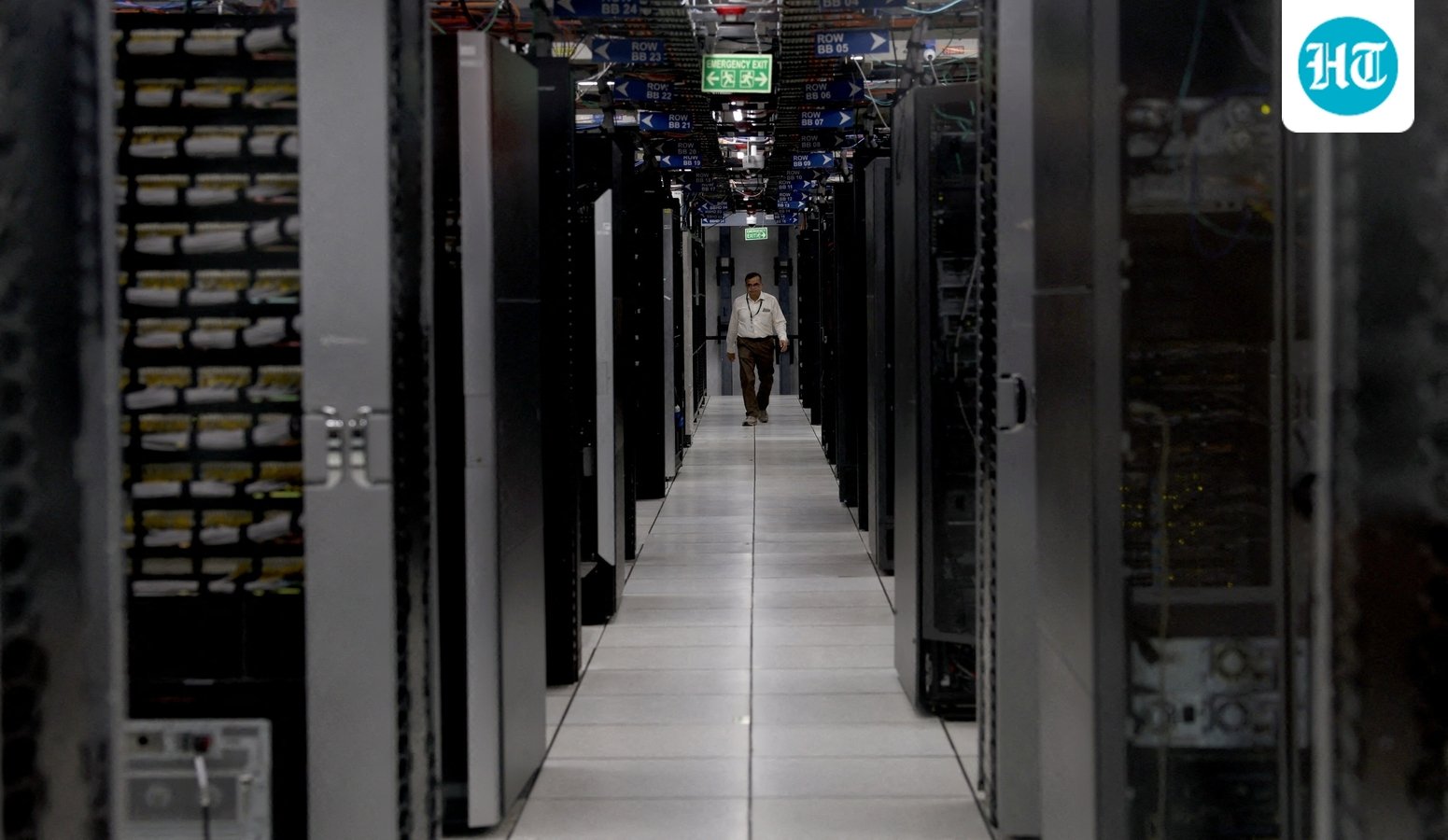
After New York’s recent moratorium on large artificial intelligence (AI) data centres, American senator Kirsten Gillibrand issued a statement saying, “New Yorkers aren’t convinced these massive facilities benefit them. Before we move forward, our communities need ironclad guarantees that their energy bills won’t spike, their water will be protected, and their air will remain clean.”
Do Indians deserve similar guarantees?
Around the world, protests are erupting against AI and its data centres. Young people feel especially disadvantaged; looking at the layoffs and tepid hiring across white-collar industries, it’s hard not to sympathise. Setting aside questions about the future of humanity, AI’s feet of clay — its data centres — exact tangible, if more mundane, costs across electricity, heat and water. Against this backdrop, the key question for India is not whether it should host these centres, but what it gets for doing so.
Let’s start with power. A 100MW site can draw more than two million units a day. The International Energy Agency puts data-centre electricity consumption at 415 TWh in 2024 — enough to meet the annual needs of 353 million Indian households. In India alone, one projection sees data centre demand climbing from 10 TWh in 2025 to 191 TWh by 2040. Remember, this is near-constant loading, with periodic spikes that the grid must cope with. Hyperscalers report buying vast quantities of renewables, but that does not give the full picture: Wind is seasonal and the sun sets. Something must do the balancing, and someone must pay for it. As states dangle incentives for data centres, the factories in other sectors already employing millions may fairly ask: Why them, not us?
What water is provided, predictably, does not even appear in the listed benefits. Depending on the cooling system deployed and the local climate, a 100MW centre can consume almost no onsite water — or more than two million litres a day. Globally, the electricity and cooling needs of data centres had an estimated water footprint of some 4.5 trillion litres in 2025.
India’s centres will cluster where the undersea cables terminate: mainly Mumbai and Chennai. Neither city is known for water resilience. Where will this water come from?
Heat, spoken about the least, may matter the most.
Almost all the electricity a server draws becomes heat, which must be pushed out.
A recent preprint of a research study tracking two decades of temperatures across thousands of data centres, found temperatures in the vicinity of a data centre rose by about 2°C once it began operating. Temperatures stayed about 1°C higher upto 4.5km away and remained detectably higher at 10km — potentially exposing over 340 million people globally to the added heat.
In India’s sweltering cities, in an El Niño year, that deserves far more attention than it is getting. And what is India actually getting?
“Jobs” is often the first response. True, construction brings hundreds, perhaps thousands, of jobs briefly, but most of those flow to migrants rather than the locals; once built, a 100MW centre may employ just 30 to 60 people onsite. The highly paid engineers who run it often work from remote locations, while the local roles — facilities, power, cooling, security — are low-skilled.
Then, is India making the chips, servers, storage and memory, or building the AI models—or merely bolting together the racks and servers?
Are we the librarian basking in the glory of books other people wrote? India should not conflate hosting the data centres with owning the AI economy. The former is subsidised real estate, the latter represents geostrategic power.
Back to those costs. The hyperscalers are socialising a private cost — your prompt is cheap because someone else pays for the water and power. In America, where both are priced, a $30 water bill can become $250, sparking protests. In India, unpriced water sits in invisible aquifers; no one knows how much is drawn until they run dry.
The irony is that the innovation to mitigate some part of the data centres’ environmental impact already exists. Renewable energy and storage have made great strides in the last decade. Water efficiency has improved as centres adopt closed-loop cooling and dispense with cooling towers; what little water they need, can be drawn from treated sewage.
Heat can be tamed too: In Denmark, Meta’s wind-powered centre pipes its waste heat into the city’s district-heating network. In India, waste heat emerges at 25-40°C, which a heat pump can lift it to 90-120°C. But without a nearby industrial user or a centralised grid, what becomes of it?
Subsidies and opacity blunt the need to innovate while transparency and constraints supply it. The alternative is not to turn away data centres but to make them earn their welcome.
Singapore’s PUB helped unleash water innovation. Indian cities could do the same: Roll out the welcome mat for data centres on the condition that they transparently disclose and pay a fair price for the resources they consume, even fund a hub for cooling, heat recovery, water reuse, and grid management.
An industry that treats innovation as both virtue and God should not need cheap water, unpriced heat and unquestioned grid support.
A bargain that subsidises electricity and scarce water, and absorbs the heat with no guarantees on enduring AI capability beyond data centres is not development. It is subsidising somebody else’s intelligence.
(Mridula Ramesh is a climate-tech investor and author of The Climate Solution and Watershed, on X as @mimiramesh, Instagram @mridula.ramesh. The views expressed are personal.)


