



Dagestan is among the few regions in Russia with a name recognized globally, thanks largely to a quote-turned-meme by UFC champion Islam Makhachev: “Send him two, three years to Dagestan and forget.”
The phrase has become a shorthand for the North Caucasus republic’s online image as a spartan training ground — a place defined by a grueling, hyper-masculine wrestling culture that turns boys into world-class fighters.
But as Dagestan now grapples with the catastrophic impact of the worst flooding in over a century, the limits of that internet fame are being laid bare.
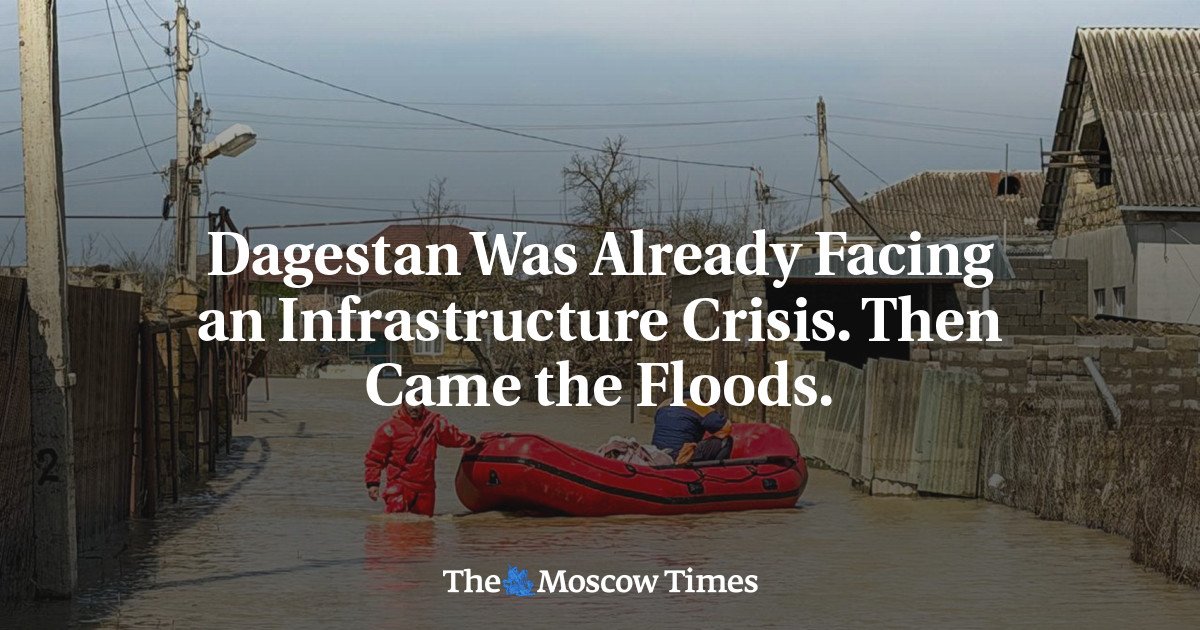
Two weeks of heavy rainfall have triggered rockfalls, bridge collapses and a catastrophic breach at a reservoir. In some parts of Dagestan, water rose so quickly that homes were submerged within hours. At least five people have been confirmed dead, according to volunteers, and thousands have been displaced.
“The same bloggers who actively used ‘Two, three years in Dagestan’ in their content have not been equally attentive to this disaster…But this is not new,” said Zarema Gasanova, a researcher from Dagestan.
For Gasanova, the muted response recalls the 1999 earthquake in the region that displaced more than 1,500 people. “Do you really think anyone knew or talked about it?” she asked in an interview with The Moscow Times. “We all should understand what kind of place we live in. It never gets coverage.”
Dagestan is a kaleidoscope of more than 100 ethnic groups, primarily Sunni Muslims, packed into a territory roughly the size of Slovakia. It is a land of extremes — jagged peaks rising 4,400 meters in the south, cascading down to the shores of the Caspian Sea in the east.
But that same stunning geography has become a liability in the current crisis. And some locals argue that the devastation was made worse by years of systemic neglect.
“The Gedzhukh dam… had cracks in it for a long time,” a woman in one of the worst hit parts of Dagestan told the independent outlet From the Republics, referring to the reservoir breach.
“They didn’t pay any attention. There were a few overflows, too, but they didn’t pay any attention,” she added.
In Dagestan, “they” refers to a government often viewed as a distant, almost colonial-style administration.
The current head of the republic, Sergei Melikov, is an ethnic Lezgin, a Northeast Caucasian group native to Dagestan. However, he was born and made his career in Moscow. He had no ties to Dagestan or its local elites before President Vladimir Putin appointed him in 2021.
Melikov is what political analysts in Russia call a “Varangian,” a term dating back to the Middle Ages that today is used to describe Kremlin-appointed outsiders whose main task is to break local patronal networks.
His tenure has been marked by a shake-up of local government and the arrival of federal management companies in Dagestan. Melikov notably paved the way for Russia’s state-owned energy monopoly, Rosseti, to take control of the republic’s electric grid.
Yet Dagestan remains notorious for its crumbling infrastructure. Paved roads are rare, power outages are a daily occurrence and housing is often built with little safety oversight.
“The situation with infrastructure… has significantly worsened under General Melikov,” said a local political analyst, speaking on the condition of anonymity for fear of reprisal. “The federal authorities chose to forget about modernizing regional energy infrastructure,” he said.
Gyanzhevi Gadzibalayev / TASS
Melikov has maintained a low profile throughout the recent floods.
When he did finally appear in public on Sunday, the optics were more suited to a war zone than a disaster relief site. He visited a collapsed building in Makhachkala flanked by masked, heavily armed security. Melikov blamed the destruction on “reckless” real estate development, a comment that ignited a firestorm of condemnation on social media.
This week, pro-Kremlin media cited anonymous sources claiming Melikov could be forced to step down. However, experts caution that his potential removal is unlikely to be immediate.
“Dagestan, due to its strategic position in southern Russia and its fragmented ethnic and local elite landscape, is a potentially problematic region where the appointment of a new head would need careful orchestration,” said András Tóth-Czifra, an expert on Russia’s domestic politics and political economy.
“Even though it is obvious that Melikov’s tenure has not solved underlying issues in the republic, the Kremlin would likely only dismiss Melikov when it can ensure that the transition is smooth and does not destabilize the region,” Tóth-Czifra told The Moscow Times.
The Kremlin, he noted, rarely fires governors in the immediate wake of a disaster, preferring to wait months to avoid the appearance of bowing to public pressure.
Putin has also been slow to act, holding his first public meeting on the crisis in Dagestan only this Tuesday. And on Thursday, authorities in Moscow finally issued a federal-level state of emergency for Dagestan, as well as for the neighboring republic of Chechnya, which has also faced severe flooding.
Dismayed by this official inertia, residents have turned to one another.
“Local businesses, from small entrepreneurs to large companies, joined in to support the victims. Car repair shops provided free repairs, restaurants provided food, large companies sent money,” the anonymous expert from Dagestan told The Moscow Times.
“Outside help is coming mainly from predominantly Muslim regions,” he said.
While Dagestan’s government offered meager one-time payments of 16,000 rubles ($200) to flood victims, the local charity Nadezhda has raised more than 500 million rubles ($6.4 million).
President.e-dag.ru
Popular figures from Dagestan have also stepped up.
Global social media star Hasbulla Magomedov, better known as Hasbik, traveled to the village of Mamedkala to assist volunteers and reportedly donated 1.2 million rubles ($15,400) to Nadezhda’s fundraiser. Others have speculated that Dagestani martial arts champion Khabib Nurmagomedov may have also made a contribution.
“Muslims are taught to do good privately, meaning Khabib won’t say how much he donated,” Gasanova told The Moscow Times.
As Russia’s state weather service warns of a potential third wave of flooding this weekend due to more heavy rainfall in the forecast, the sense of abandonment in the republic is palpable.
“Melikov is saying that everything in the republic is under control, but they didn’t even declare a state of emergency” when the flooding first started in March, Gasanova said. “The only thing that is saving people is the community.”
“People in Dagestan were always distrustful of the authorities, but ongoing repressions have created an atmosphere of fear,” she said. “Instead, they pour their rage into Instagram reels.”
A Message from The Moscow Times:
Dear readers,
We are facing unprecedented challenges. Russia’s Prosecutor General’s Office has designated The Moscow Times as an “undesirable” organization, criminalizing our work and putting our staff at risk of prosecution. This follows our earlier unjust labeling as a “foreign agent.”
These actions are direct attempts to silence independent journalism in Russia. The authorities claim our work “discredits the decisions of the Russian leadership.” We see things differently: we strive to provide accurate, unbiased reporting on Russia.
We, the journalists of The Moscow Times, refuse to be silenced. But to continue our work, we need your help.
Your support, no matter how small, makes a world of difference. If you can, please support us monthly starting from just $2. It’s quick to set up, and every contribution makes a significant impact.
By supporting The Moscow Times, you’re defending open, independent journalism in the face of repression. Thank you for standing with us.
Continue
Not ready to support today?
Remind me later.
×
Remind me next month
Thank you! Your reminder is set.


