



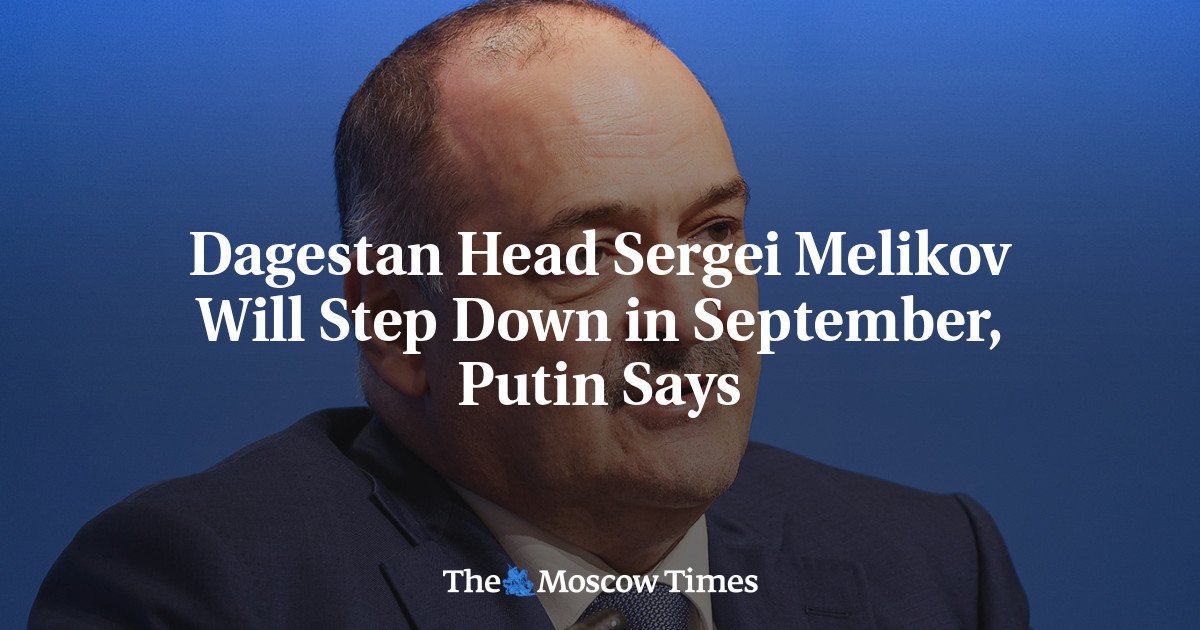
President Vladimir Putin announced Thursday that Sergei Melikov, the head of the republic of Dagestan, will step down later this year to transition to a new position, coming weeks after deadly floods ravaged the North Caucasus region.
“He has accomplished a great deal, and we are grateful to him for that. But he is moving on to another job, and life moves on,” Putin said during a televised meeting with Dagestani officials at the Kremlin. He did not specify Melikov’s next role.
Melikov, who was not present at the Kremlin meeting, did not immediately comment on the announcement.
Senior Dagestani officials, including regional parliament speaker Zaur Askenderov, proposed Fyodor Shchukin, Chairman of the Supreme Court of Dagestan, to replace Melikov. Putin said he would nominate Shchukin as one of three candidates to head the region.
The head of Dagestan is not elected by popular vote. Instead, the selection follows a multi-stage process that involves the president presenting a list of three candidates to Dagestan’s regional parliament for a vote. To take office, a candidate must secure a simple majority of votes from regional lawmakers.
“The most important thing here is that the republic is led by someone who can solve the problems at hand, who knows how to build on what has already been achieved and, most importantly, who commands the respect and trust of the people,” Putin said Thursday.
A former army general, Melikov was appointed in 2021 to stabilize one of Russia’s most complex regions. However, he struggled to address Dagestan’s chronic infrastructure issues, and the region today remains notorious for frequent power outages and poor road conditions.
A series of high-profile security failures further tested his leadership. In October 2023, an anti-Israel mob overran the regional airport in an incident that local law enforcement failed to prevent. That was followed by attacks on religious sites in June 2024 that left 20 people dead.
The final blow to Melikov’s standing in the Kremlin appears to be the catastrophic flooding in late March and early April. At least five people were killed and thousands were displaced after heavy rain triggered rockfalls, bridge collapses and a breach at a reservoir.
Melikov, who appeared slow to react to the initial flooding in March, later blamed part of the destruction on “reckless” real estate development, a comment that ignited a firestorm of condemnation on social media.
Pro-Kremlin media had reported at the time that he might be forced to step down over his handling of the flood disaster.
To many, Melikov’s departure will unlikely come as a surprise. However, some observers expected an announcement would come later, as the Kremlin often delays firing governors in the immediate wake of a disaster to avoid the appearance of bowing to public pressure.


