



If your workday revolves around a laptop, chances are you’ve experienced neck stiffness, back pain, rounded shoulders, or tight hips. According to Cult Fit co-founder Rishabh Telang, incorporating a few simple exercises into your routine can help counter the effects of prolonged sitting and improve overall mobility.
He wrote in his April 20 Instagram post, “Looking down on the laptop or smartphones all day can be the reason for your neck and shoulder pain and while we can’t really avoid working on the computer all day, because our work demands it, we can definitely use targeted exercise to fix that pain.” (Also read: Kangana Ranaut drinks water from silver glass for ‘pitta balance,’ nutritionist explains if the practice really works )
To help desk workers reduce discomfort and improve mobility, he went on to share four exercises that can help ease tension, strengthen key muscles, and offset the effects of prolonged sitting and screen time.
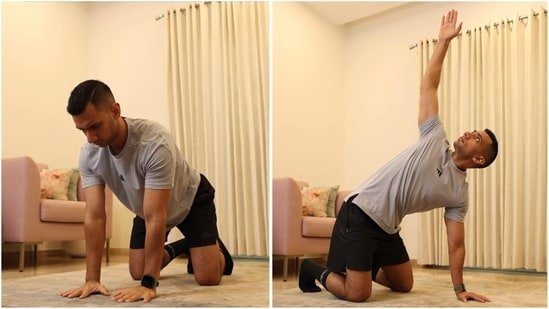
1. Thoracic rotation stretch
Starting on all fours, place one hand on the floor for support and the other behind or alongside your body. Slowly rotate your upper body, opening your chest and lifting the arm upward, then rotate back down in a controlled motion. This exercise helps improve thoracic spine mobility, opens up the chest, and relieves stiffness.
2. Thread the needle stretch
Starting in a tabletop position, slide one arm underneath the opposite arm, allowing your shoulder and upper back to gently rotate toward the floor. Then reverse the movement by opening the chest and extending the same arm upward toward the ceiling. This mobility exercise helps release tension in the neck, shoulders, and upper back while improving thoracic spine rotation—areas that often become stiff after hours of laptop work.
3. Open book stretch
In this exercise, lie on your side with your top knee supported by a pillow or cushion to keep your hips stable and aligned. Keeping your lower body still, slowly rotate your upper body and extend your top arm toward the opposite side, as if opening the pages of a book. The movement helps improve thoracic spine mobility, stretch tight chest muscles, and ease stiffness in the neck, shoulders, and upper back.
4. Y-T-W-I extensions
This bodyweight postural exercise involves moving through a series of arm positions while lying face down on the floor. Starting with the arms extended overhead in a “Y” shape, the movement progresses into a wide “T,” followed by a bent-elbow “W,” before returning to the starting position in a controlled manner. The exercise targets the upper back, shoulders and postural muscles, helping strengthen the rhomboids, lower trapezius and rotator cuff.
Note to readers: This article is for informational purposes only and not a substitute for professional medical advice. Always seek the advice of your doctor with any questions about a medical condition.
This report is based on user-generated content from social media. HT.com has not independently verified the claims and does not endorse them.


