



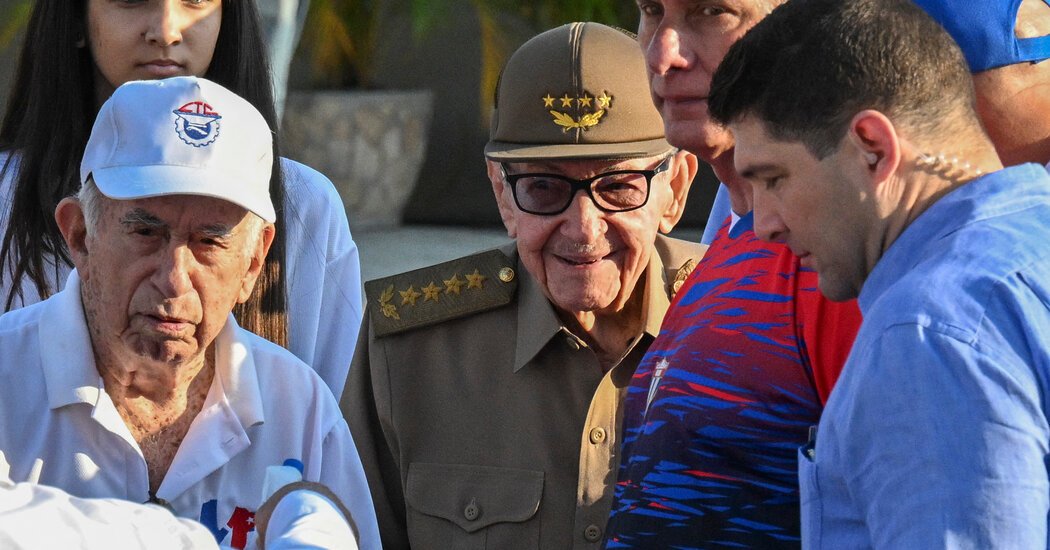
A day after Raúl Castro, the Cuban government’s revolutionary hero and former president, was indicted in Miami for murder, officials and state-run media closed ranks, turning to social media to project an image of a nation rallying around a revered elder statesman.
An avalanche of posts from state-run newspapers and high-ranking Cuban government officials showed photographs of Mr. Castro as a young soldier, greeting children, chuckling with his brother Fidel, waving the Cuban flag and meeting outdoors with teenagers. The posts included gushing messages about his honor and integrity.
“He’s like a father to me,” Cuba’s president, Miguel Díaz-Canel, said in a video posted on X.
Mr. Castro, who turns 95 in two weeks, was indicted Wednesday on four counts of murder for the shooting down in 1996 of two civilian aircraft that were in international airspace just north of the island. The charges levied by the United States are a major late-life test for the former guerrilla who served as defense minister for nearly 50 years.
Although he is no longer head of state or leader of the armed forces, Mr. Castro remains a key figure in Cuba who wields considerable power.
While the indictment was likely aimed at forcing Cuba’s government to buckle under pressure from the Trump administration, the criminal charges against Mr. Castro could also serve as a rallying cry that makes the country’s officials dig in and resist any pressure from the United States, experts said.
Negotiations between the United States and Cuba appear to have yielded little fruit so far, and people who have met and studied Mr. Castro say threatening to drag him to Miami in handcuffs is unlikely to make his comrades capitulate.
Even Secretary of State Marco Rubio wasn’t optimistic.
“The president’s preference is always a negotiated agreement,” he told reporters Thursday. “That remains our preference with Cuba. I’m just being honest with you. The likelihood of that happening, given what we’re dealing with right now, is not high.”
Mr. Castro was born in Birán, a small community in Holguín Province, in eastern Cuba. His father, Angel Castro, was a Galician immigrant who came to Cuba as a calvary quartermaster for the Spanish colonial army, paid by a rich man to take his place on the front lines. He established a large rural estate and dabbled in various business ventures that made him wealthy.
His second marriage was to Mr. Castro’s mother, Lina, a household servant several decades his junior. The couple had seven children. Fidel Castro was their third child, and five years later, Raúl was born.
In an interview with his biographer, Fidel Castro described his little brother as a rambunctious child, whom he introduced to Marxism. Raúl was a member of socialist youth groups, and together the brothers became rebels who led a revolution to topple Cuba’s U.S.-aligned dictator, Fulgencio Batista.
Mr. Castro was just 27.
Fidel Castro described his brother as a skilled and serious “trainer of men.” He named his brother minister of defense in 1959, a position he kept until Fidel stepped down from the presidency in 2008 because of illness.
The younger Mr. Castro lacked his brother’s charisma but was feared and respected as a man who earned his stripes on the battlefield. He was credited with building the armed forces into a battle-ready force that fought in Angola and beat back U.S. invaders during the 1961 Bay of Pigs invasion.
Federal prosecutors say that in 1996, Mr. Castro ordered MiG fighter jets to shoot down two Cessna airplanes belonging to the exile activist group Brothers to the Rescue, killing four men.
In 2006, the newspaper el Nuevo Herald in Miami reported that Mr. Castro had bragged in a meeting about ordering the attack.
The Brothers to the Rescue organization had for years been antagonizing the Cuban government by flying over Cuba and dropping political leaflets and religious medallions. After dozens of complaints to Washington, Raúl Castro had enough.
“I said ‘try to shoot them down over the territory,’ but they would enter Havana and leave,” he said in an 11-minute recording purported to have been taped at a communist party meeting. “Of course, with one of those rockets, plane-to-plane, what comes down is a fireball that will fall on the city.”
The recording was taped by a Cuban government radio station and leaked to journalists in Miami, el Nuevo Herald said.
The U.S. Attorney’s Office in Miami investigated Mr. Castro’s role in the episode at the time, but had only sought criminal charges against the MiG pilots, as well as several Cuban spies who had infiltrated Brothers to the Rescue.
The episode was disastrous for U.S.-Cuba relations, but Raúl Castro continued serving as minister of defense and then as president.
He led the country for 10 years, a period that seemed headed toward a period of economic restructuring. Mr. Castro was quick to criticize inefficient state bureaucracy. Shortly after taking office, he once described the absurdities of the many miles a gallon of milk had to travel, crisscrossing the countryside, to be pasteurized and brought to Cuban households.
But as president, he was also criticized for failing to enact the kinds of economic overhauls he had suggested were coming. His priority, experts say, was always to safeguard the regime’s hold on power. If an economic opening threatened that, Cuban government officials would quash it.
Former Secretary of State John Kerry said he recalled a moment during President Obama’s historic visit to Havana in 2016 when it was clear how much Mr. Castro not only preferred to remain behind the scenes, but was visibly uncomfortable with “the genie he feared he was letting out of the bottle.”
“You could see his discomfort with tackling questions from a free media,” he said in an emailed response to The New York Times. “It was an expression of, ‘what did I just sign up for?’”
Mr. Obama tried to convince the government to open up business opportunities.
“He struggled to trust. He was more reluctant to invest in the idea that a different relationship with the United States could benefit Cuba,’’ Mr. Kerry said. “He believed they could micromanage the pace of economic change and that he had latitude to go slow in testing the limits of the bilateral relationship, and he didn’t see a harder-line American administration on the horizon.
“We needed more time to lock in proof of concept and we ran out of time.”
The Cuban government slow-walked the economic changes promised during the Obama years, and then Mr. Trump dismantled whatever was left of the deal during his first term.
After Raúl Castro left office in 2018, Cuba’s economy started to crumble. Its tourism industry never fully recovered from the Covid-19 pandemic, and sanctions by the Trump administration deprived the nation of cash and tourists.
Venezuelan oil subsidies started declining just as the oil grid began collapsing. Then this year, Mr. Trump, in his second term in office, cut off oil shipments all together, plunging Cuba into a desperate economic free fall marked by prolonged power outages.
Negotiations are underway between the Cuban government and the Trump administration to resolve the crisis, but Washington’s list of demands is long, and the Cubans have so far refused to concede.
Washington has demanded Mr. Díaz-Canel step down, that Americans be compensated for property confiscated by Cuba’s government and that Russian and Chinese listening posts be shut down.
Mr. Castro’s grandson and bodyguard, Raúl G. Rodriguez Castro, has been a key figure in the talks, though experts say his grandfather is surely consulted.
Celebratory event held in Miami to announce the indictment, filled with hundreds of jubilant exile activists and Republican politicians, sent the wrong message, said Ricardo Zúñiga, a former Obama administration official who helped lead secret talks that led to the restoration of diplomatic relations between the two countries.
“If you were sitting in Havana and saw what happened in Miami, why would you negotiate?” Mr. Zúñiga said.
“What they have told you is: ‘We are going to come get you.’”
Cuban diplomats tasked with handling media inquiries did not respond to a request for comment.
The Cuban government released a statement denouncing the indictment, arguing that the United States lacks the jurisdiction and moral authority to bring such charges.
“The people of Cuba stand with Raúl!” wrote Manuel Marrero Cruz, Cuba’s prime minister.
Arturo Lopez-Levy, a former political analyst for Cuba’s intelligence agency who is now a research associate at the University of Denver, said the indictment was an ideal fit for the Cuban government’s favorite story line.
“The indictment plays well into the narrative of someone who never stopped fighting,” he said, referring to Mr. Castro. “They’ll make him a martyr. The more things like that happen, the more they shape the revolutionary narrative of someone fighting and dying in his boots.”


