



Mumbai: Cricket took a giant leap into the unknown two years ago by expanding the T20 World Cup to 20 teams. For a sport used to the drill of having a handful of serious contenders for the top prize, where upsets are less common, this was a major step toward spreading its global footprint.
USA-West Indies were far from ideal venues to test such an experiment. The USA was a completely new market, and the West Indies is one where the sport has been in terminal decline. The tournament still created enough buzz thanks to India’s unbeaten run to end their 17-year T20 title drought. More than half the 190,000 people who took seats at stadiums in the USA came for India matches.
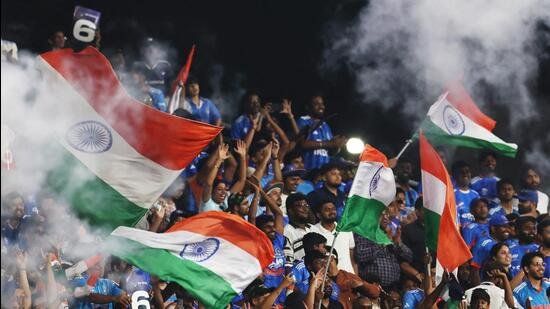
Contrast that to the crowds we are seeing in India for the ongoing World Cup and there is a marked difference. Around 5,60,000 people have checked through the turnstiles over 26 league matches in India. 1,28,000 of them came for India matches. In co-host country Sri Lanka, the crowd response has been mixed, barring matches featuring the home team and the India-Pakistan clash.
Close to 20,000 people on average for non-India matches is a substantial number for neutrals who have no skin in the game.
But, in a way, they do.
World Cups offer context to every match with results having a bearing on the home team’s fate. On a hot Ahmedabad afternoon, a sizable crowd came to cheer South Africa against West Indies on Thursday, hoping it would boost India’s semi-final qualification hopes.
It may also be one reason why 23,000 spectators turned up at the Wankhede stadium to watch West Indies play Zimbabwe in the Super 8s. They were treated to some sublime ball striking by the West Indies, who pummelled 19 sixes under the Mumbai night lights to blow Zimbabwe away.
“Wankhede again reflected Mumbai’s deep-rooted cricketing culture and immense love for the game. The vibrant energy in the stadium made it memorable,” said Ajinkya Naik, Mumbai Cricket Association president. “If you see, our crowds have always shown true sporting spirit, appreciating quality cricket, regardless of the team.”
Evening T20 matches work perfectly, opposed to the day-long loyalty that an ODI demands. The Narendra Modi stadium saw 54,923 people come to watch New Zealand play South Africa for a 7pm match. Whereas, the tournament’s most nail-biting of contests played over two Super Overs, here, between South Africa and Afghanistan was sparsely attended.
That gives an insight into how crucial scheduling is for World Cups to be well attended. When world events are staged around the world, the primary consideration is not local timings, but India’s television prime time.
The economics of a cricket World Cup are vastly different from football. The upcoming FIFA World Cup is budgeted to reportedly earn $3 billion from hospitality and ticket sales, which is about 30% of the estimated revenue.
Fans turning up for cricket in person work like an ancillary asset. Tickets for non-India matches are moderately priced, with the idea of inviting people to create an atmosphere for television views – mostly Indian eyeballs, who account for 85 % of market share.
The choice of metro cities as host venues has been a crucial factor that has drawn neutrals toward cricket. Traditionally, Chennai and Mumbai crowds have earned the reputation of being the most informed. It is reflective of the atmosphere created by spectators at the Wankhede and Chepauk.
“Absolutely incredible for a game like USA versus Namibia to have this much of a crowd was incredible,” said USA batter Sanjay Krishnamurthi, when a 20,968-strong crowd turned up for an afternoon match in Chennai. “You know, like in Associate cricket, you don’t necessarily get this kind of crowd. So it’s really special to take it in.”
The Nepal fanbase
On the face of it, having plenty of Associate nations play the early rounds was expected to be a challenge. But Indian crowds have defied all preconceived notions by turning out in big numbers. Mumbai, the home base for Nepal, saw a swarm of supporters packing the stands to cheer for the Himalayan nation. There were Nepali fans in Dallas two years ago. This time they came to Mumbai from around the globe speaking of cricket’s biggest emerging market in fan base.
“This was very different to what we are used to for India matches and the IPL. But the Nepali crowds were so good that the entire stadium joined the chorus with them,” said Vineet Gharge, one among the bunch of cricket crazies in the North Stand Gang.
A 41,000-strong crowd in Kolkata for England-Scotland provides ample evidence of the insatiable appetite for the sport in the country. These are venues that stage around 8 IPL matches annually, other than the odd bilateral or a Test match. Yes, India has a complimentary ticket culture, but in which other market do people take out time for cricket with such fervor? Where else would you find demand beat supply at such giant sized stadia?
Appetite for multi-nation action?
While the T20 World Cup is spread around the globe – this one has come to India after 8 years – it begs the question if the youngest format can be used to revive tri-nation or quadrangular series. Of the kind which were so famous in the 80s and the 90s. Jonty Rhodes’ five flying catches in the 1993 Hero Cup at the Brabourne stadium came in one such non-India match, against West Indies. A buzzing crowd came out at the Eden Gardens to watch Pakistan play West Indies in the 1989 Nehru Cup final.
Such ideas have been debated in cricket boardrooms before, but won’t pass muster until they are vetted by prospective broadcasters. Outside World Cups, bilateral matches involving India have been a safe bet, but for how long will they fetch the same value? The encouraging crowds in the ongoing World Cup are instructive of the relish with which nation versus nation cricket is still consumed in India.


