






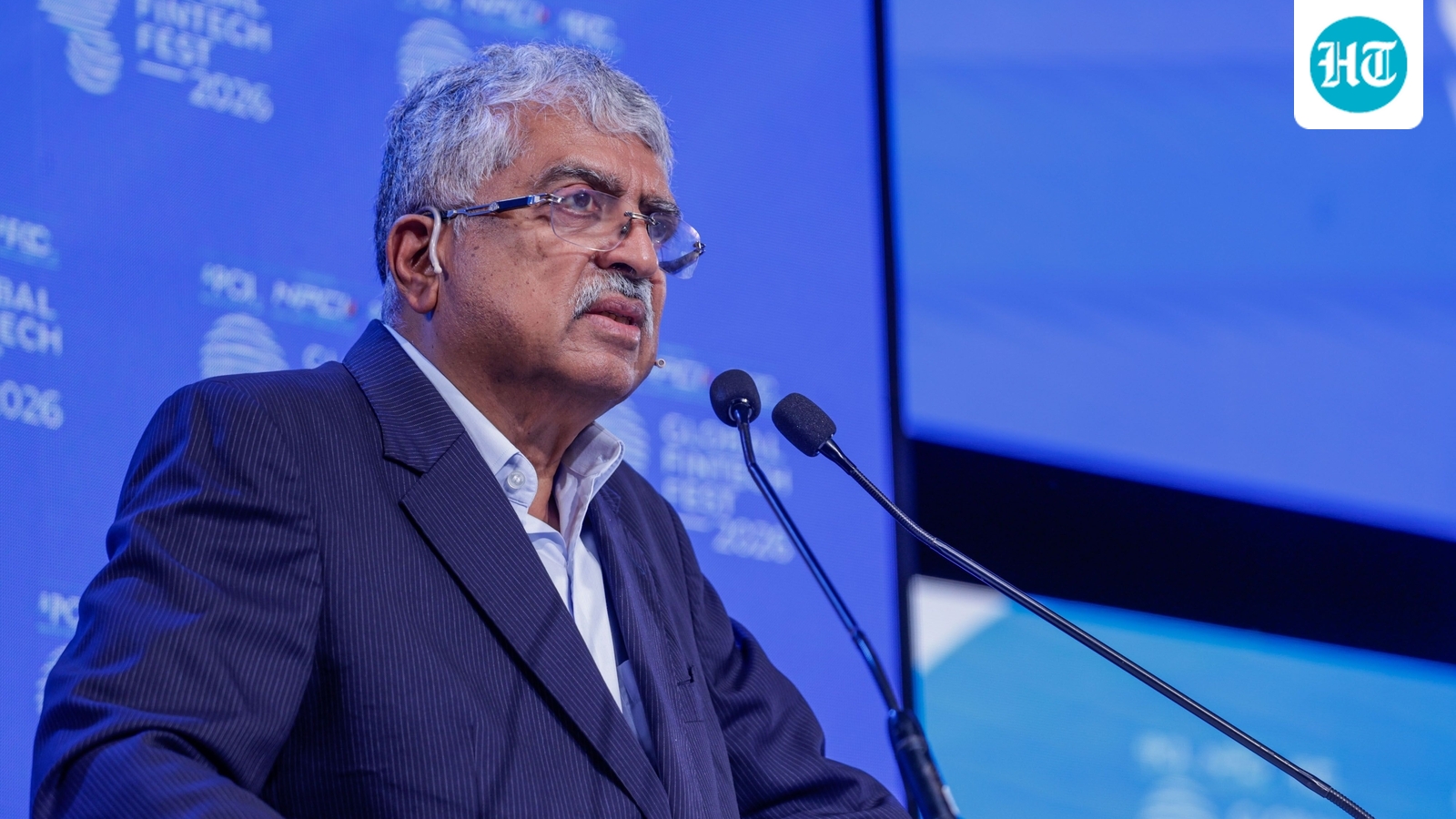
Generating examination papers at the last minute from a “massive question bank” will eliminate the “economic incentive” behind paper leaks, Infosys chairman and head of the high-powered task force (HPTF) on examination reforms Nandan Nilekani said on Tuesday. He also suggested expanding the computer-based testing (CBT) infrastructure across the country.
“The moment you have a question paper then that creates an economic incentive for that to be sold. So the way to do that is to really have a massive bank of questions and only at the last minute generate the question paper for that day and therefore then the question of having a question paper goes away and there is no economic incentive for that,” he said while addressing the Bloomberg New Economy Forum in New Delhi.
Also Read I Government, NTA officials may not be named in CBI charge sheet over NEET-UG paper leak
To be sure, the Central Bureau of Investigation (CBI), in its first charge sheet filed in a Delhi court in May in the NEET-UG 2026 paper leak case, said question papers for the May 3 examination were sold and purchased by the accused for amounts ranging from ₹25,000 to ₹25 lakh.
Six-member task force
Nilekani added that expanding the network of testing locations was another priority. “We have 150,000 locations (of CBT centres) where a young boy or girl can take a test that needs to be expanded. So I think these are all systemic issues, which we will address in our committee,” he said.
When asked if he could envision a future where AI spontaneously creates examination papers on the actual day of the test, Nilekani responded with affirmation. He further said that using technology and looking at the root causes of exam leaks and irregularities systematically could solve the problem. “They are solvable issues.”
The government-appointed six-member HPTF, constituted on July 27 with a three-month mandate, was set up after the cancellation of NEET-UG 2026 on May 12 by National Testing Agency (NTA). At least 120 questions in a guess paper — a compilation of suggested questions based on previous trends and patterns — were found to match the May 3 examination paper, triggering widespread protests and eventually the resignation of then education minister Dharmendra Pradhan on July 25.
An October 5 affidavit filed by the Department of Personnel and Training in the Supreme Court said the panel had held about 18 meetings and more than 40 consultations including one with Union health ministry on whose behalf NTA conducts the test for admission to UG medical courses, and remained “on track” to submit its report within the prescribed timeframe.
The debate over shifting NEET-UG from pen-and-paper testing (PPT) to CBT has, however, exposed significant infrastructure and policy hurdles.
Also Read I ‘Why do we need a question paper’: Infosys co-founder Nandan Nilekani on ways to combat exam leaks in India
More than 2.2 million candidates registered for the 2026 examination currently held in pen and paper mode, requiring question papers to be printed, packed, transported under security, stored in vaults and distributed to examination centres. The lengthy supply chain, involving printers, transporters, storage facilities, centre coordinators and invigilators, creates multiple potential vulnerabilities for paper leak.
In CBT, encrypted questions are electronically distributed to examination infrastructure under strict access controls, reducing dependence on physical transportation. The format is already used for JEE-Main, CUET and UGC-NET.


