



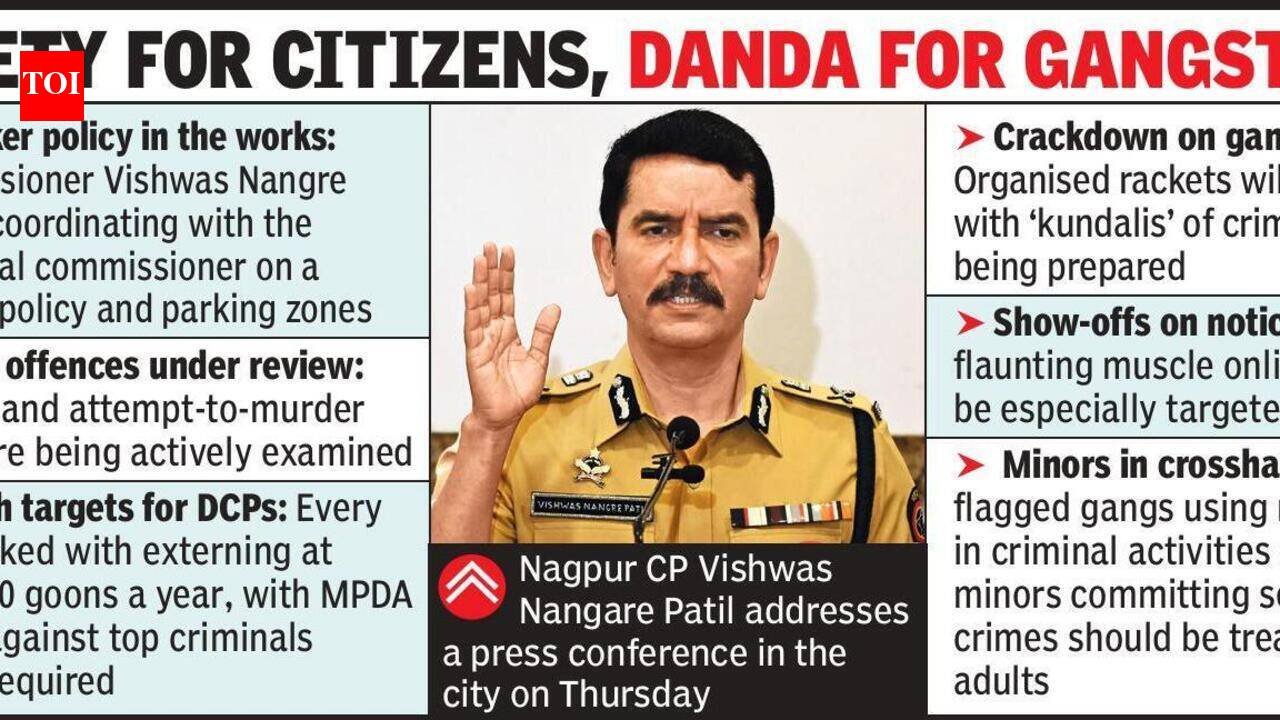
Nagpur: Calling himself a rural boy who rose to become an IPS officer, city police commissioner Vishwas Nangre Patil on Thursday said he wants evidence-based policing in Nagpur, shaped by the city’s topography and local requirements rather than an alien model.Addressing a meet-the-press interaction at Patrakar Club, the CP said three months of study had shown him that Nagpur requires urban, proactive policing, not the need-based style of rural areas. “Proactivity is the crux. Police at the doorstep, police at every nook and corner, is the mantra,” he said.Nangre Patil said senior citizens were being duped on a huge scale through digital fraud, and women’s security was a challenge of a similar nature. Awareness and education, he said, were essential.In some slum pockets, youths were being drawn to drugs. Preventive detention powers under the PIT-NDPS Act have been delegated to unit in-charges, allowing peddlers, syndicate members and racketeers to be detained for up to a year. “Such racketeers have to be dealt with an iron hand,” he said.Nangre Patil drew a clear line on protests. Morchas are a right, he said, but only if they are lawful and held after taking permission. “The impromptu staging of morchas and taking law into one’s own hands would not be allowed,” he said.A plan of action is now in place from his study, said the CP, underlining that about 20% of energy will be spent on major issues, 80% on general policing.The force has about 8,500 police personnel and 1,000 ministerial staff. He is pushing skill-based, training-led policing. “Beat policing will be the local arm of that plan. Each area will have a beat system, treated as additional branches of the police station, with one officer and ten personnel so that smaller disputes can be settled at the nearest chowki,” said Nangre Patil.About 130 police vehicles will carry mobile tracking devices, backed by round-the-clock beat marshals.Three-layered patrolling will be put in place, including bikes, four-wheelers and foot patrols inside slums and narrow lanes.Crime mapping will decide where and when cops sweep an area, with QR-code swipes on mobile phones recording their visits.Intelligence, he said, remains the main crux. One special branch person has been deputed at each station to work with the station’s khufia (intel) cell on overt and covert local information.The CP is also taking a 90-point data set from each police station — crime types, preventive action, profiles of criminals, locations, calls received and attended — to map each station’s strengths and weaknesses.On traffic, he said units should man key roads and highways, not as detached divisions.About 170 integrated traffic management points with CCTV are planned. The city already has 2,800 CCTV cameras, but about 600 are, on average, non-functional. Around Rs 10 crore has been sanctioned and work has started to restore the defunct ones. Another 1,500 new cameras will be installed, while 28 nagar palikas are spending about Rs 150 crore on CCTVs in the periphery. Once this network is fully live, he said, the security scenario will witness a change.Nagpur has about 600 traffic cops and 400 home guards. He has also suggested that the municipal corporation induct Maharashtra Security Force (MSF) personnel, on the Mumbai pattern, for civic enforcement support.The CP stated he was discussing a hawker policy with the municipal commissioner. Once parking zones and the hawker policy are finalised, local police and the civic body will implement them jointly. “We will not chase hawkers out of their livelihood, but we have to discipline them,” he said. Footpaths must not be taken over by shopkeepers stacking goods, and carriageways must stay clear.Body offences, especially murder and attempt to murder, remain a real challenge and are under review. He has tasked every DCP with externing at least 100 goons a year, along with MPDA action against top criminals wherever required.Gangs and organised rackets will be hit systematically and “kundalis” of criminals are being prepared. Under the Adhan Pradhan process, police stations are taking criminals for interaction and updating records twice a week. He warned that goons flaunting muscle on social media — cake-cutting with swords or similar displays — will be especially targeted. He also flagged the use of 16-18-year-olds by gangs in criminal activities, and said minors committing serious crimes should be treated as adults.
