



From shaping narratives to deciding candidates and booth-level outreach, these professionals have moved far beyond their initial role as communication and crisis managers. Increasingly, election victories are seen not merely as political triumphs but as proof of the consultant’s strategic genius.
Their growing influence, however, has also sparked resentment within sections of the political class. The recent defeats of the Trinamool Congress (TMC) and the Dravida Munnetra Kazhagam (DMK), both of which had the Indian Political Action Committee (I-PAC) steering their campaigns, have triggered a backlash from seasoned leaders who accuse these consultants of “hijacking” the party apparatus and weakening its organic roots.
Speaking to PTI, Praveen Chakravarty, chairman of the Congress’s in-house data analytics department, said he finds it “bizarre” that parties are outsourcing important decision-making to people “with no skin in the game”.
“Unlike party functionaries, these consultants do not share in the pain and the glory in equal measure. They bask in the success but face no consequences for defeats,” said Chakravarty.
More crucially, he said, the involvement of such consultants has darker implications for Indian democracy, a view echoed by political analysts.
Daniel Francis, partner at Fifth Pillar – a political consulting firm based out of Mumbai, told PTI that today every major party feels compelled to hire consultants, which operate as “part strategy room, part war machine, part perception factory”.”They are the “Mercedes” of electoral politics – premium, expensive, sophisticated, and requiring privileged space within the party structure.
“This has pushed traditional party structures to the background. Consultants are often trusted more than karyakartas who have spent years building local relationships. Inside the party, many resent them as outsiders with too much influence and no ideological investment,” Francis said.
In West Bengal, for instance, the I-PAC has been accused by senior TMC leaders such as Kalyan Banerjee, a four-time Lok Sabha member, of hollowing out the party’s organisational network by centralising its chain of command through diktats from “Camac Street”, an apparent reference to the office of TMC national general secretary Abhishek Banerjee who was instrumental in bringing in and gradually expanding the ambit of the I-PAC’s role.
Former TMC Rajya Sabha member Jawhar Sircar told PTI that Abhishek used I-PAC to seize control of the party, turning the consultancy firm — initially entrusted with field surveys to gauge ground sentiment — into a “pseudo political organisation”.
Sircar said Abhishek, unlike his aunt and TMC supremo Mamata Banerjee, had little command over the party’s grassroots network as he was not involved in its growth.
“Abhishek used I-PAC to undercut Mamata Banerjee by creating a vast database of the party’s organisation. A parallel structure of a shadow government was built at every level. For every district magistrate, there was a shadow I-PAC district magistrate, for every sub-divisional magistrate, there was one from the I-PAC to shadow,” said Sircar, a former top bureaucrat who resigned from the TMC in the aftermath of the 2024 protests over the rape and murder of a doctor at Kolkata’s RG Kar Medical College and Hospital.
IPAC did not respond to queries sent over email.
Speaking on the condition of anonymity, the founder of a top consultancy firm confessed that the managers of these companies are often driven by the belief that they are effectively the nerve centres of governments run by parties they have worked with.
“We make parties make promises, guarantees, and draft policies. And once a party forms a government, they heavily rely on us to make good on those promises and get beholden to us in a way,” the person said.
Political researcher and columnist Asim Ali said the declining fortunes of both the TMC and the DMK could be traced to the nature of their organisational model — what he described as the “electoral-professional party”.
“Parties are now organised around the professional apparatus of campaign managers, consultants and pollsters, as opposed to ideologically motivated cadres, with its primary focus revolving around electoral competition. The leader of a party now seeks to connect with its constituency bypassing the local organisations through consultants. They also function as vehicles of communication and feedback,” Ali said.
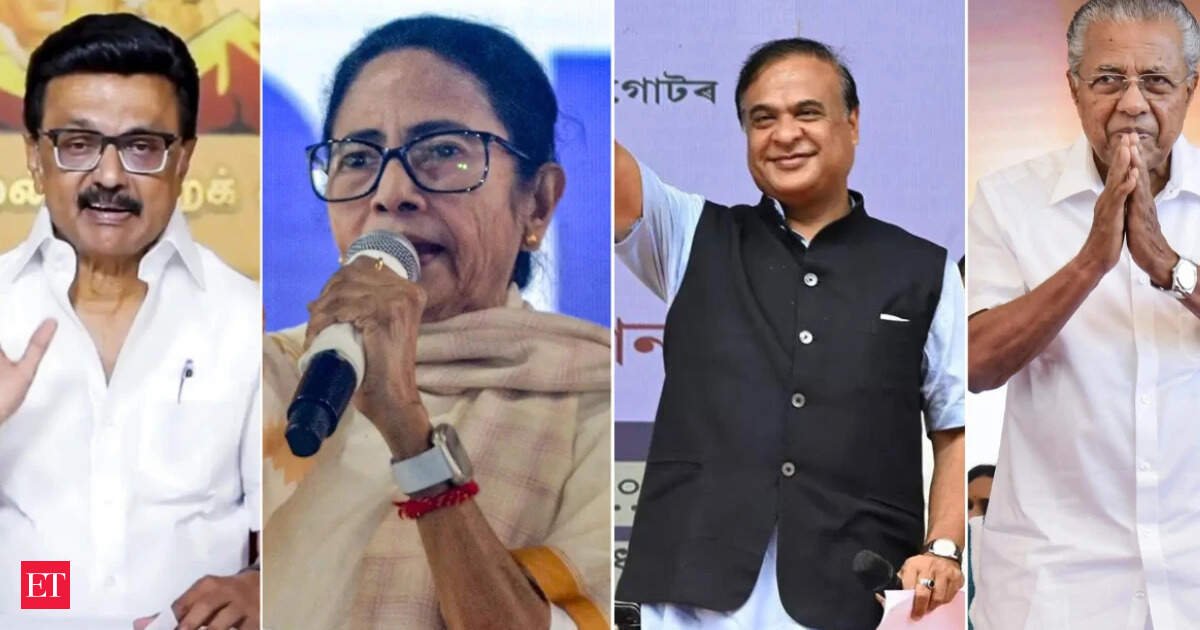
While leaders such as DMK’s M K Stalin, CPI(M)’s Pinarayi Vijayan and TMC’s Mamata Banerjee initially found electoral success after turning cadre-based parties into professional campaign machines, Ali argued that the shift also concealed deeper organisational weaknesses.
“It is part of a larger story of the depoliticisation of the electorate,” he said, adding that such conditions often push voters either towards “outsider populist” alternatives — such as Vijay’s Tamilaga Vettri Kazhagam in Tamil Nadu.
Chakravarty said outsourcing activities such as cadre-building and messaging essentially makes a party redundant.
“Consultants can be helpful in areas where newer skills such as AI are required. But if you start outsourcing your core tasks, what are political parties for? What if Mahatma Gandhi had hired a consultant to communicate his message of swaraj to the people,” Chakravarty asked.
Francis pointed out data and analytics are the biggest strength of consultants which help parties in figuring out caste equations, booth mapping, sentiment tracking, and digital behaviour.
“Numbers carry authority. But it often overpowers the instinct of the old political worker who says, “ground pe hawa alag hai”,” said Francis.
Be that as it may, there is also recognition that the heightened influence of consultants is partly a result of the growing disconnect between parties and the ground.
Chakravarty said the growing dependence on consultants showed that more and more leaders were becoming less trusting of their party leadership and lacked confidence in traditional organisational structures.


