






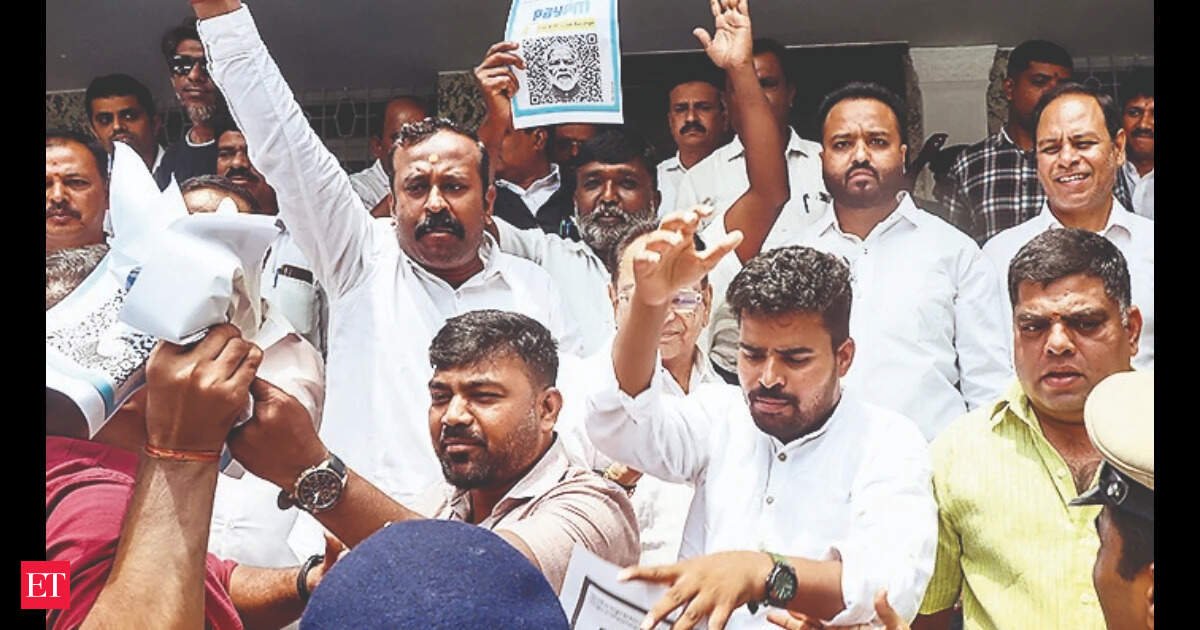
The Opposition party took a swipe at Prime Minister Narendra Modi, saying he had “redefined NOTA — Narendra’s Ongoing Trump Appeasement”. Congress demanded that this “anti-national” decision should be immediately withdrawn, and UPI should be kept free of charge as before. Congress general secretary in-charge communications Jairam Ramesh also asked whether the government move on MDR was done to enable the US card companies to compete with UPI. He said that the US House of Representatives will vote on a bill that introduces 100% tariffs on India. The US Senate has already approved this draconian law, he pointed out.
“Here, the Modi government has given in to a US demand to get rid of zero MDR and charge for UPI. The US Trade Representative earlier this year criticised UPI for being free and having driven out Visa and Mastercard,” Ramesh said. “Why 0.4% MDR? Is it because debit card MDR is also 0.4%? Is this being done to enable US card companies to compete with UPI?” he said. Noting that the estimated cost of running the entire UPI ecosystem is around ₹20,000 crore annually, Ramesh said this is less than 10% of what the RBI has been transferring to the Union government in the past few years so as to show healthy public finances for the Modi government.
The comments came a day after the National Payments Corporation of India (NPCI) announced that a 0.4% MDR would apply from October 15 to specified person-to-merchant UPI transactions above ₹2,000. Karnataka chief minister DK Shivakumar said the issue should not be viewed as a Congress matter and called for a nationwide campaign against the move. Shivakumar said, “This is not the issue of just the Congress party, but an issue concerning the entire nation.”
AICC general secretary Randeep Surjewala alleged that the widespread adoption of UPI and RuPay was hurting the business of Visa and Mastercard in India. He claimed the two companies charge transaction fees of 1-1.5% and questioned whether pressure from the US had influenced the Centre’s decision to permit MDR on some UPI transactions. He also questioned the government’s rationale for introducing charges, citing NPCI’s financial position and the costs incurred by banks and the digital payments ecosystem.
NPCI had reported a pre-tax operating profit of ₹1,900 crore and held ₹6,119 crore in cash, while the government collected about ₹1,000 crore in tax from NPCI in the previous year, Surjewala said, while arguing that these figures weakened the case for imposing charges on UPI transactions.


