



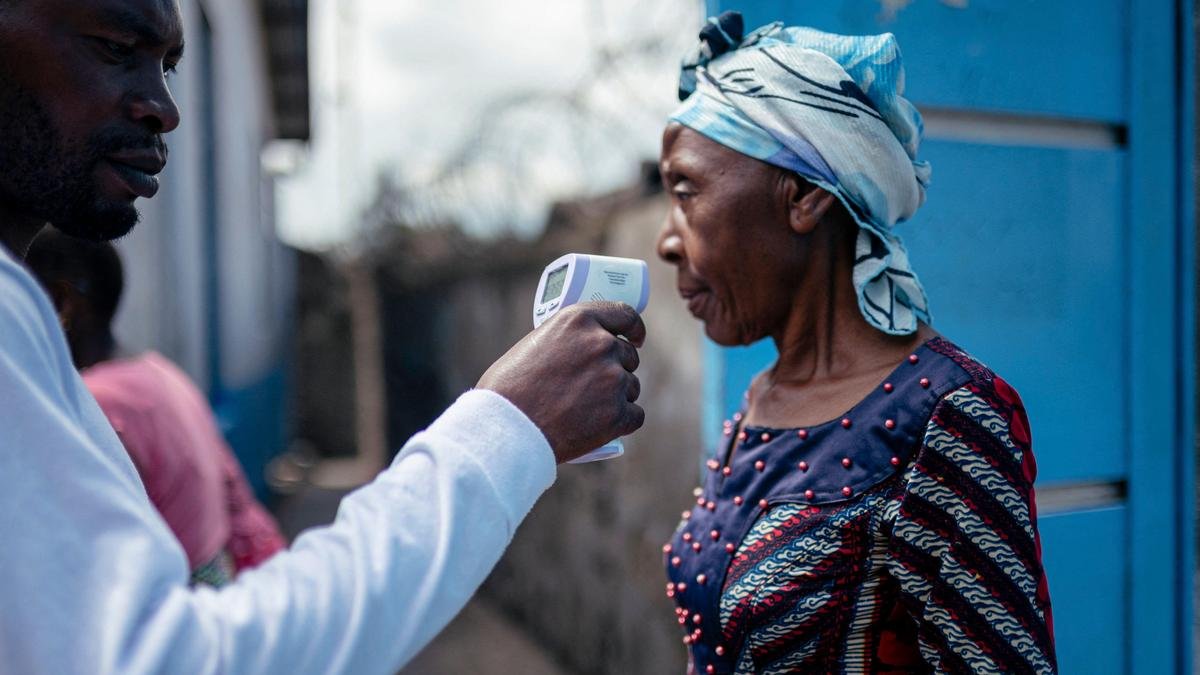
A staff member of the CBCA Virunga Hospital checks a visitor’s temperature using a a contactless infrared thermometer, before allowing her access to the hospital in Goma on May 17, 2026. File
| Photo Credit: AFP
The Congolese Health Minister announced the opening of three treatment centres in the Ituri region in eastern Congo on Sunday (May 17, 2026) evening as he visited the region amid the ongoing Ebola outbreak.
“We know that the hospitals are already under stress because of the patients,” said Samuel Roger Kamba, the Health Minister, while visiting Bunia, the capital and largest city in Ituri. “But we are preparing to have treatment centers at all three sites in order to be able to expand our capabilities,” he further added
The World Health Organization declared the Ebola disease outbreak a public health emergency of international concern on Sunday (May 17, 2026), after more than 300 suspected cases and 88 deaths in Congo and two in neighboring Uganda. Although the outbreak is centered in Ituri, cases have been reported in the capital, Kinshasa, and in Goma, the largest city in eastern Congo.
In a separate statement on X on Sunday (May 17, 2026), the World Health Organisation (WHO) Regional Office for Africa said that a team of 35 experts from the WHO and the Congolese Ministry of Health had arrived in Bunia, the capital of Ituri province, along with 7 tons of emergency medical supplies and equipment.
Ebola is highly contagious and can be contracted via bodily fluids such as vomit, blood, or semen. The disease it causes is rare, but severe and often fatal. WHO’s emergency declaration is meant to spur donor agencies and countries into action. By WHO’s standards, it shows the event is serious, there is a risk of international spread and it requires a coordinated international response.
Jean Kaseya, Director-General of the Africa Centre for Disease Control and Prevention, told Sky News on Sunday (May 17, 2026): “Currently I’m on panic mode because people are dying, I don’t have medicines, I don’t have vaccine to support countries. Yesterday I called for a meeting of all partners, we have some candidate vaccine, some candidate medicine, we are pursuing this route. We hope that we can have something in the next coming weeks.”
Health authorities say the current outbreak, first confirmed on Friday (May 15, 2026), is caused by the Bundibugyo virus, a rare variant of the Ebola disease that has no approved therapeutics or vaccines. Although more than 20 Ebola outbreaks have taken place in Congo and Uganda, this is only the third time that the Bundibugyo virus has been detected.
The Bundibugyo virus was first detected in Uganda’s Bundibugyo district during a 2007-2008 outbreak that infected 149 people and killed 37. The second time was in 2012, in an outbreak in Isiro, Congo, where 57 cases and 29 deaths were reported.
Published – May 18, 2026 06:07 pm IST


