



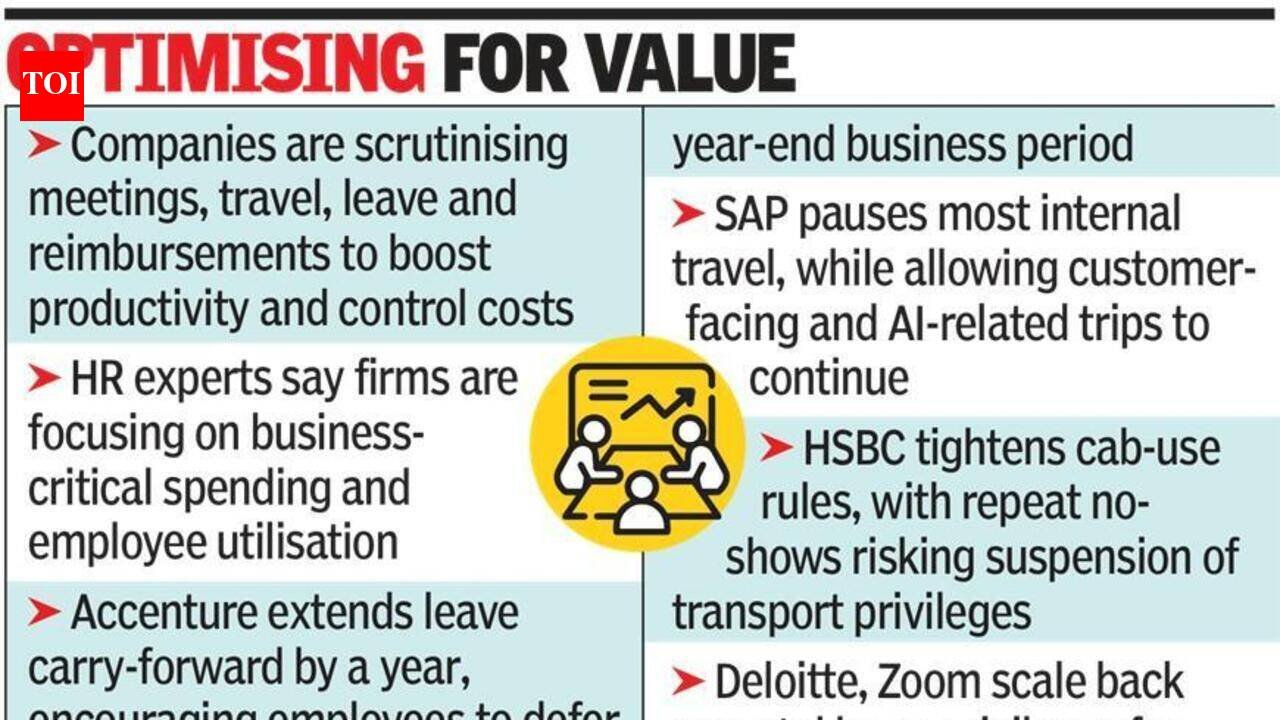
Bengaluru: IT services and technology companies are putting employee benefits and even meetings under the microscope, as they push for higher productivity and tighter cost control in an environment where business is under pressure.At Accenture India, employees are being asked to defer vacations this year. To facilitate that, they are being allowed to carry forward their earned leave into the next financial year. The technology services company is trying to ensure employees remain available during the crucial final weeks of its fiscal year ending August.In a note to employees reviewed by TOI, Lakshmi Chandrasekharan, senior managing director and CHRO at Accenture in India, said, “As we approach the critical year-end period, your focus on client delivery can make all the difference. We are giving you the flexibility this year to carry forward your earned leaves balance until August 31, 2027 (instead of expiring on Aug 31, 2026). So, plan for your time off when it works best for you, after this busy Q4 period at work.”Sources told TOI that Accenture employees have also been asked to avoid any unproductive meetings, for that would be a drain on productivity and working hours.At German software major SAP, internal travel has been paused across the company as part of a broader spending squeeze. Customer-facing travel, trips linked to its `All in on AI’ programme and mission-critical AI training will continue. SAP is also reintroducing its Spend Council process through its procurement organisation to tighten oversight of external spending. Bengaluru hosts SAP’s largest R&D centre globally, with 17,000 technologists contributing around 40% of the company’s worldwide R&D activities.At HSBC India, employees who record three consecutive cab no-shows can reportedly lose access to the cab-booking facility, with reinstatement requiring managerial intervention. The measure is aimed at curbing repeated bookings where employees fail to turn up. The controls are intended to promote responsible use and ensure fair access.The trend is also playing out globally. According to a Business Insider report, Deloitte plans to scale back several employee benefits in the US from January 1, 2027, for a segment of its workforce. Paid family leave will be reduced to eight weeks from 16 weeks for employees in functions including administrative services, IT and finance. Deloitte also plans to eliminate its $50,000 reimbursement benefit for adoption, surrogacy and IVF treatments. These changes, however, do not apply to employees in India and South Asia.The same report said that Zoom has reduced parental leave for US employees. Leave for birthing parents has been cut to 18 weeks from 22-24 weeks earlier, while non-birthing parents will receive 10 weeks instead of 16 weeks.HR executives say these changes reflect a broader shift towards productivity-led cost management rather than blanket cuts.“In 2026, companies are taking a more deliberate approach to employee-related spending, with greater focus on business relevance, governance and workforce productivity,” said Karishma Parikh, VP-HR, Adecco India. “Travel is being looked at more closely based on business criticality, while fuel reimbursements are being reviewed based on business needs. At the same time, there is a sharper focus on how effectively employee time is being utilised.”Anjali Raghuvanshi, chief people officer at Randstad India & Global Capability Centre, said companies were moving from blanket cost-cutting to “productivity-led efficiency”. The focus, she said, should be on reducing low-value activity and improving utilisation while protecting the flexibility, development and support employees value. “The organisations that navigate this well will move from a ‘cost-cutting’ mindset to a ‘value optimisation’ mindset,” she said.


