



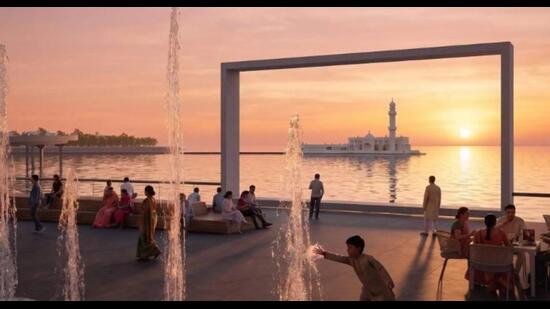
MUMBAI: The Brihanmumbai Municipal Corporation (BMC) will unveil the final master plan for the Mumbai Coastal Road Gardens within the next three days, after Reliance Industries incorporates the changes mandated by the Supreme Court to reduce the extent of ticketed recreational areas.


This area has been envisioned as one of the largest urban open spaces spread across 70 hectares along the waterfront.
In the revised plan, ticketed spaces should be 15% of the area of each zone, said a civic official from BMC’s coastal road department. While Reliance Industries proposed the plan for the gardens, Reliance Foundation will execute the task.
The rolling green space, divided into six thematic zones, includes nature parks, sports precincts, cultural spaces, event venues, children’s attractions, cycling and walking trails, and gardens and public plazas stretching from Priyadarshini Park to Worli.
However, the master plan’s access-controlled clause has surprised and drawn criticism from several architects and urban planners, who have expressed that introducing paid attractions undermines the objective of creating an open public waterfront.
Rahul Kadri, principal architect at IMK Architects, said the original Expression of Interest issued by the BMC invited corporate participation through Corporate Social Responsibility (CSR) funding without indicating that any part of the reclaimed land would become ticketed.
“Our primary concern is that BMC’s CSR invitation omitted the mention of ticketed entries. This was meant to be an open space for citizens at all times, with the selected company maintaining it for 30 years. We are surprised to see that 15% of each zone which are some of the nicest parks will be ticketed spaces,” Kadri said. Essentially, Kadri argued, roughly 25 acres of public land would be off-limits to the general public. “That is a huge chunk of land effectively being privatised. We also don’t know the ticket prices,” he said.
Kadri further questioned the accessibility of several proposed attractions, noting that visitor movement within the park remains poorly defined in the conceptual drawings. “There are so many food outlets and premium attractions. We need simple places where the poorest child can come and play. The plan seems to cater to a section of the elite rather than the general public. Moreover, what has been shown is only a sketch plan. The committee overseeing these gardens has neither citizens nor landscape professionals, and BMC itself has no landscape architect, driving its dependence on a corporate,” he added.
Echoing similar concerns, architect PK Das said while ticketing was not anticipated, it was an expected outcome once a private organisation was asked to finance the project.
“When private agencies invest in developing public open spaces, they naturally look for a revenue model. That defeats the very idea of CSR,” Das said.
“It’s surprising that while BMC spends thousands of crores constructing roads, it cannot develop and maintain gardens. Compared to the Coastal Road project, that expenditure is marginal.”
Like Kadri, Das also pointed out how ticketing would draw a line between the haves and have-nots. “No everyone can afford to pay and the plan limits access. There is no clarity on who will regulate ticket prices as it isn’t government ticketing at subsidised cost.”
On the other hand, architect Alan Abraham questioned the rationale behind entrusting long-term management of the reclaimed land to a private entity. “The gardens are being presented as a CSR gift to the city, which has spent ₹14,000 crore on the road but says it cannot afford about ₹400 crore to build and maintain the public spaces that justified reclaiming the sea,” he said, adding that the city must decide whether it wants “its own Central Park or its own Jio World Garden”.
The project’s legal framework was laid down by SC. In its January 2026 order, the court held that the reclaimed land must remain a primarily public open space, prohibiting residential or commercial real estate development while allowing limited recreational attractions.
On June 11, 2026, the court accepted Reliance’s undertaking that at least 85% of each zone along the waterfront would be freely accessible to public and that ticketed recreational facilities and access-controlled spaces would be restricted to only 15% of the area, clearing the way for BMC to process the final master layout.


