



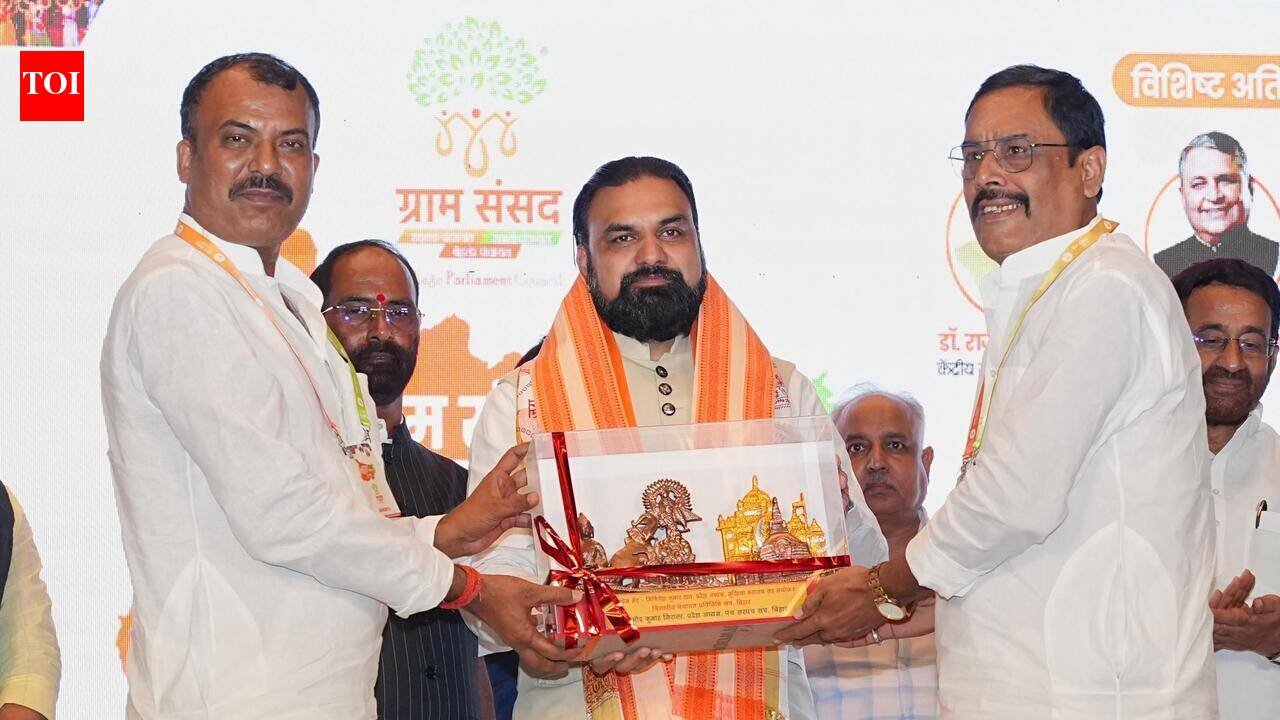
Patna: Chief minister Samrat Choudhary on Monday suggested that gram panchayats in Bihar begin collecting taxes from mobile towers, brick kilns, private schools and other commercial and industrial activities operating in villages, saying such revenue could help make local bodies financially self-reliant.Addressing the “Gram Sansad – Mukhiya Samvad” programme here, Choudhary clarified that poor families would not be taxed. He asked representatives of the three-tier panchayati raj institutions to suggest modalities for levying and collecting charges from revenue-generating establishments in rural areas. The money raised locally, he said, could be used to improve basic services, including waste management and safe drinking water.Choudhary said Bihar’s panchayati raj institutions currently have no tax system, unlike those in several other states where gram panchayats raise funds at the local level. Referring to neighbouring West Bengal, he said a mukhiya there receives as much as Rs 1 crore through taxes collected by the gram panchayat.He also announced that the next panchayat elections in Bihar would be conducted only after completion of the delimitation exercise. State Election Commission has started the process, he said, adding that delimitation of urban local bodies would be taken up next year. He urged elected representatives of panchayati raj institutions to offer suggestions for village development.Govt, Choudhary said, plans to reorganise panchayats so that one gram panchayat broadly covers a population of around 7,500. Many existing panchayats have large populations and include several linked villages, he said. Citing his own (Manikpur-Lakhanpur) gram panchayat, he said it has a population of nearly 20,000 and three associated villages, showing the need to strengthen panchayat structures and systems.He said an engineering cell would be set up in the panchayati raj department to provide technical support for development works.Choudhary also said govt would ensure that at least 30% of products purchased under govt schemes, including steel rods and cement, are manufactured in Bihar.Declaring ‘mukhiya’ (village head) as the most powerful authority in the country’s democratic structure, Choudhary said, “People often claim that power resides only with the Prime Minister, the chief minister, and the district magistrate. However, I believe that the mukhiya holds the actual, grassroots authority because they handle the most intensive development work and directly impact citizens’ daily lives.”
