



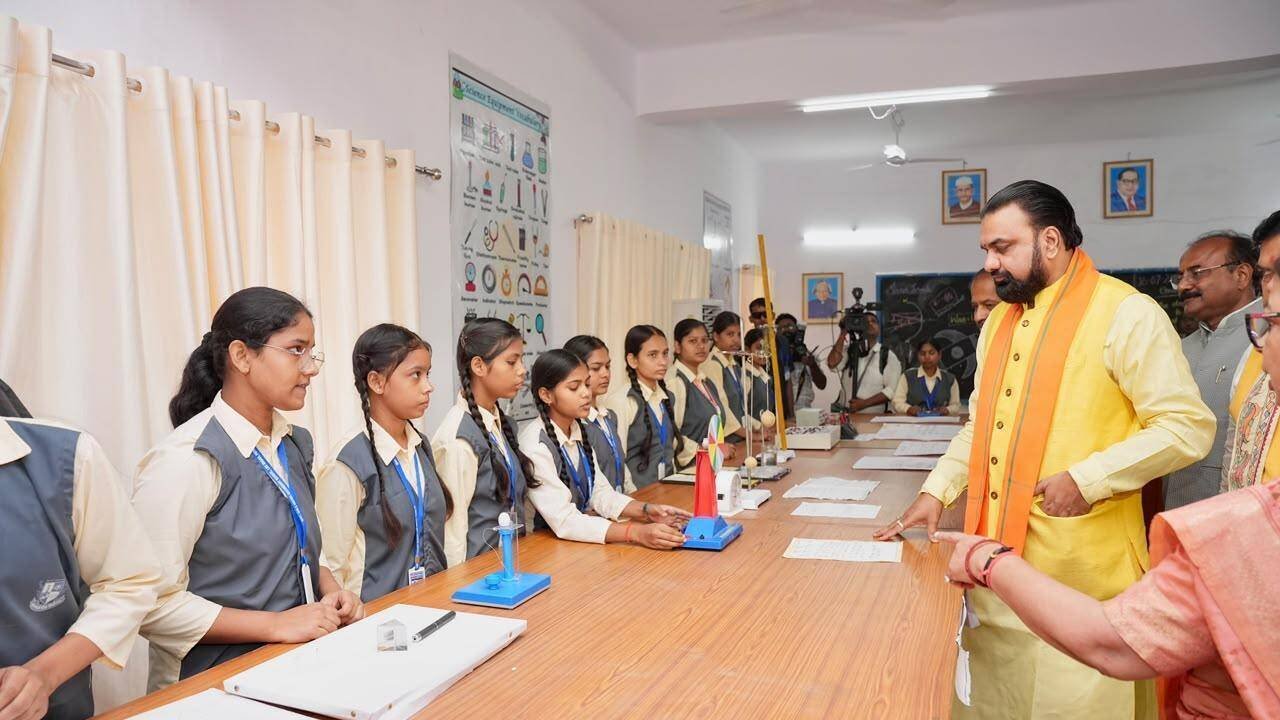
Patna: Marking the launch of an innovative teaching initiative in the higher secondary school system, CM Samrat Choudhary on Thursday inaugurated Bihar School Live Classes (BSLC) for students of govt higher secondary schools from Rajkiya Kanya Uchcha Vidyalaya at Shastrinagar in Patna. He also unveiled the logo of the Smart Live Classes Room (SLCR).From the same venue, Samrat launched coaching classes for JEE and NEET aspirants in 10 Saraswati Vidya Niketan model schools. The programme will be conducted under the aegis of the Bihar School Examination Board (BSEB).“The aim and objective of the state govt is to provide quality education and modern techniques for the benefit of students studying in its schools,” Samrat said.Earlier, Patna district magistrate Kundan Kumar explained the concept behind the SLCR project and demonstrated the functioning of BSLC. Students of the selected 10 model schools were connected to the live classes and began attending sessions through the new system.Samrat inaugurated two state-of-the-art smart classrooms and an interactive teaching panel designed to make classroom learning more effective, engaging and student-centric. He also inspected the biology, physics, integrated science and mathematics (ISM), and information and communication technology (ICT) laboratories, besides rooms meant for sports, music and other activities, and interacted with students.On the occasion, Samrat felicitated students who had excelled in examinations conducted by the BSEB and distributed hockey kits among students of the host school, whose team had performed well in competitions.To strengthen quality education and promote innovation in the state’s school education sector, the education department signed memoranda of understanding with seven non-governmental organisations in the presence of the CM. The partnerships aim to provide students with free educational inputs and training in various fields.Under these collaborations, reforms will be introduced in areas such as artificial intelligence, foundational literacy and numeracy (FLN), STEM education, leadership training, computational thinking, coding, design thinking, project-based learning, teachers’ capacity building, AI-based assessment and data-driven teaching management.Officials said the initiative would help bridge educational gaps and ensure that students in govt schools receive the same learning opportunities as their counterparts elsewhere. Senior officials of the education department, representatives of the NGOs and school students were present on the occasion.


