






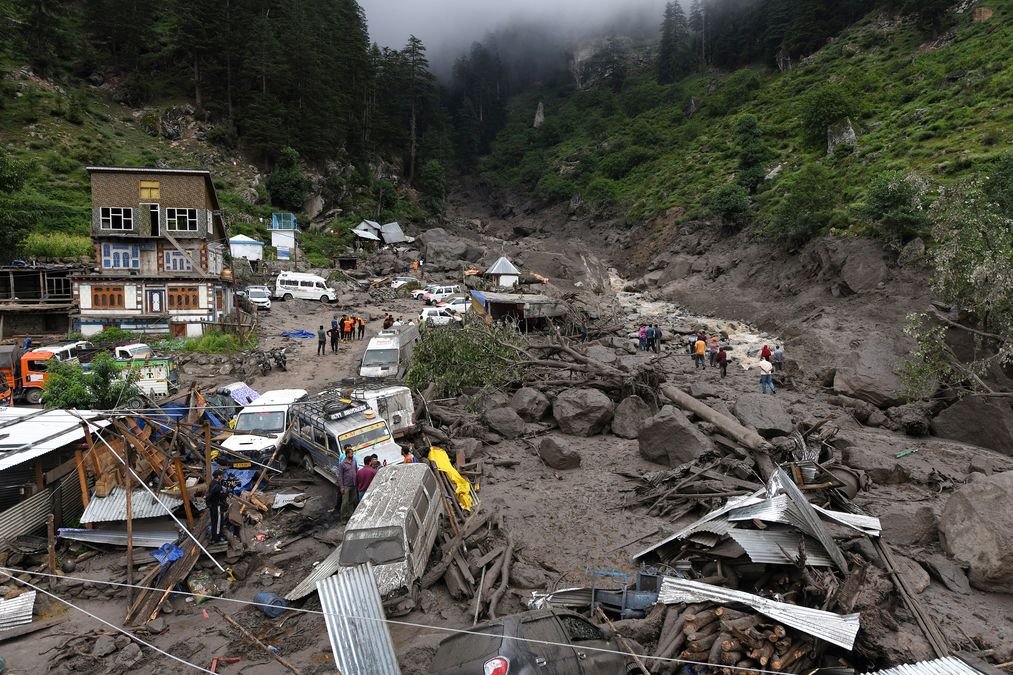
Srinagar, Sep 25: Jammu and Kashmir has suffered extensive damage to public infrastructure, homes, crops and livestock due to cloudbursts and flash floods over the last two financial years, with official figures placed before the Legislative Assembly showing 3,959 roads, 5,597 water-supply schemes and 24,416 residential structures affected across the Union Territory during 2025-26 and 2026-27.
The government data, tabled in response to a starred question by Doda West MLA Shakti Raj Parihar, also shows that 1,06,322.255 hectares of crop area were affected, while 5,244 livestock deaths were recorded across Jammu and Kashmir during the two years.
The figures underline the growing scale of extreme-weather damage confronting the region, with the Jammu division accounting for the bulk of the reported losses.
According to the data, Jammu division recorded 3,670 road damages, 5,084 disrupted water-supply schemes, 23,470 damaged residential structures, 99,300.29 hectares of affected crops and 5,207 livestock deaths during 2025-26 and 2026-27.
Kashmir division reported 289 damaged roads, 513 water-supply schemes, 946 residential structures, 7,021.965 hectares of affected crop area and 37 livestock deaths over the same period.
The figures cover both 2025-26 and the ongoing 2026-27 financial year, with the latter recording fresh damages from cloudbursts and flash floods in several districts.
Among Jammu districts, Jammu reported the highest number of damaged roads at 1,692 across the two years, followed by Rajouri with 413 and Udhampur with 308. Jammu also reported 3,063 damaged water-supply schemes across the two years.
The scale of residential damage was particularly significant in Jammu district, where 2,718 structures were affected in 2025-26 alone, while Udhampur reported 7,025 structures across the two years. Rajouri recorded 5,205 residential structures damaged over the period.
The crop losses were also substantial. Jammu district alone reported 30,728 hectares of affected crop area in 2025-26, while Udhampur reported 20,446.5 hectares across the two years. Ramban reported 33,780 hectares, including a massive 18,690 hectares in 2025-26 and 15,090 hectares in 2026-27.
Kishtwar reported 6,019.8 hectares of affected crops over the two years, while Doda reported 3,117 hectares.
Rajouri recorded 760 livestock deaths across the two years, while Udhampur reported 1,468 and Ramban 1,362.
The Kashmir division, while recording comparatively lower overall damage, also witnessed significant losses in several districts. Kulgam reported 3,472 hectares of affected crop area in 2025-26, besides 94 damaged roads and 63 water-supply schemes across the two years.
Budgam reported 279 damaged roads and 51 disrupted water-supply schemes, while Anantnag reported 37 damaged roads and 247 disrupted water-supply schemes during the two years.
Pulwama reported 33 damaged roads and 60 disrupted water-supply schemes, with 289 residential structures damaged in 2025-26. Bandipora reported 29 damaged roads and 27 water-supply schemes in 2025-26.
The government, however, said restoration work had been taken up and that affected infrastructure was being brought back in phases.
“Necessary measures have been taken,” the Disaster Management Department said in its reply, adding that roads and water-supply schemes affected during 2025-26 had been temporarily restored, while permanent restoration works were under process.
For damages reported during 2026-27, the department said roads and water-supply schemes had been partially restored, with permanent restoration works under process in all affected districts.
On the question of a dedicated rehabilitation package, the government said no special package or relief had been sanctioned for rehabilitation purposes.
Instead, relief was being provided to affected persons under the admissible norms of the State Disaster Response Fund (SDRF).
There have, however, been additional interventions through the Chief Minister’s Relief Fund for structural damage.
For the 2025-26 Chishoti cloudburst in Kishtwar, the Chief Minister’s Relief Fund provided Rs 1 lakh each to 16 affected households, besides Rs 0.25 lakh each to three partially damaged houses.
For 2026-27, Rs 108 lakh was released for 87 beneficiaries in Poonch, while Rs 281 lakh was released for 377 beneficiaries in Rajouri for structural damage.
The response comes amid repeated episodes of intense rainfall, cloudbursts and flash floods across J&K, which have increasingly put pressure on roads, water infrastructure, homes and agricultural land.
The Assembly data also highlights the uneven nature of disaster impacts: while several districts reported limited or no fresh damage in 2026-27 under some categories, others saw significant increases in damaged roads, water schemes or residential structures.


