



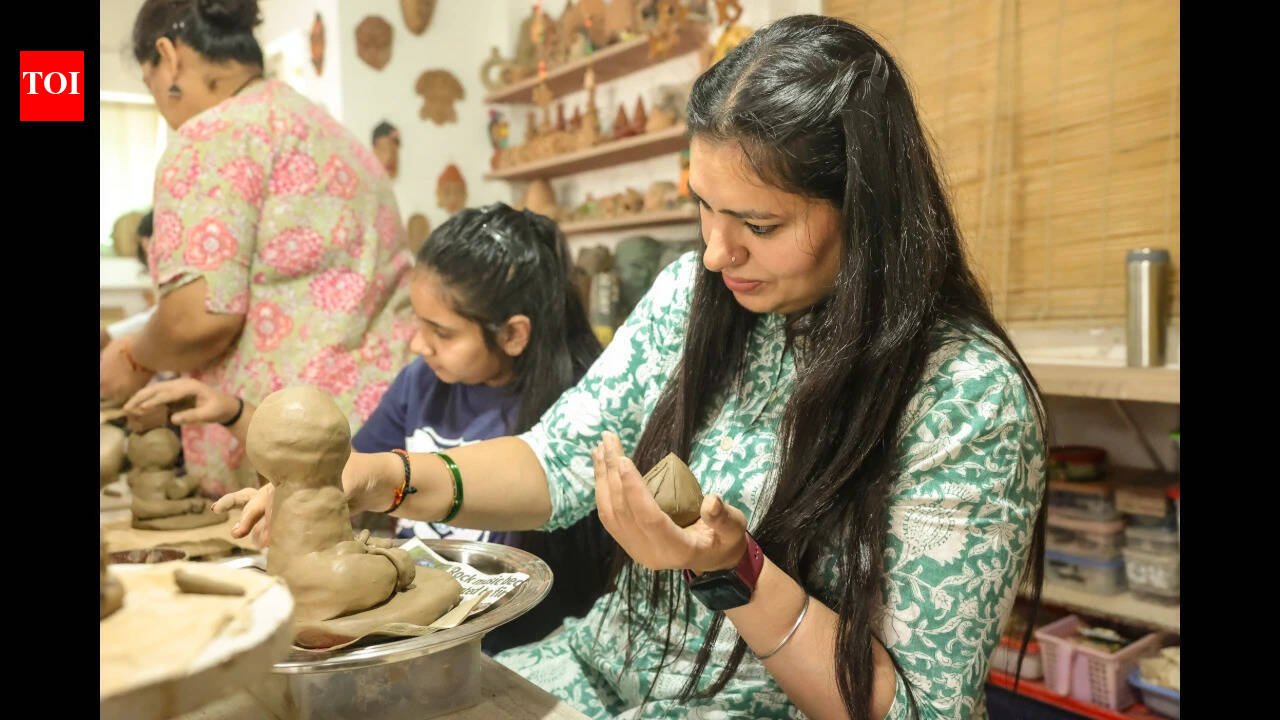
A lump of clay sits on the table. Slowly, it takes shape – a rounded belly here, a trunk there, two ears, a pair of hands, and, eventually, it takes the form of Ganpati.Pottery studios and artists have been conducting Ganpati-making workshops for the past few years, attracting children, families, pottery students and even first-timers. This weekend, experience the joy of making your own Bappa.
Pottery experts Anshu Aswal (L) and Pooja Verma (R) conduct a Ganpati-making workshop in Noida
‘Buying from the market is easy, but making it yourself is another level of satisfaction’For some, it is a conscious alternative to buying a plaster of Paris idol; for others, it is simply the joy of creating something with their own hands. There is an added emotional connection to their DIY Ganpati idol. Abha Maheshwari, a retired teacher based in Noida, started making the idol herself two years ago, after having bought Ganeshas from the market for years. Today, creating Bappa has become an annual ritual. “I enter a trance-like state while making the idol. I look up online how I want my Ganpati to look, but it turns out different,” she says with a laugh. “I rejoice in the process anyway.”Manya Joshi, a Ghaziabad-based student, came to the workshop with her friend Urvi Sharda. A pottery lover, Manya decided to use the opportunity to make a Ganesha with a giant ladoo in his hand. Urvi, meanwhile, enjoys the freedom to improvise. She says adding spontaneous details brings an element of fun to an otherwise calming experience. “I plan to keep my self-created Ganpati forever,” she says.
Pottery lovers Navya Sharma and Manya Joshi
‘Be mindful of what goes into and onto the idol’The decision to make one’s own Bappa also ties into a more conscious approach to celebrating the festival. Sona Srivastava, who runs a pottery studio in Gurgaon, says the experience is often less about making a perfect idol and more about the joy of working with one’s hands. “People come in with very different levels of confidence, and it’s quite lovely to see how their Bappas slowly take their own shape and character,” she says.For those making an idol at home, she advises looking beyond just the clay. “Use natural, untreated clay and be mindful of everything that goes into and onto the idol – paints, colours, varnishes, glitters, adhesives and decorations can all affect how eco-friendly the final idol really is,” she says.
L-R: Tanvi Saraiya taking a workshop at Jamghat Pathshala, Sona Srivastava at her pottery studio, Pooja Verma demostrating Ganesha making at a workshop in her Noida studio
Noida-based artist Tanvi Saraiya has been conducting eco-friendly Ganesha workshops for 15 years. “My advice to anyone making a Ganesha at home is to keep it simple and natural, avoid Plaster of Paris, chemical colours and plastic decorations, and colour them with geru,” she says.Pooja explains that the material used for these idols is different from ordinary garden soil. It is fine-grained and elastic enough to retain the shape given to it, even as it dries. The clay is generally sourced from areas around Khurja and Bahadurgarh, where it is sorted, processed and made suitable for pottery.As Sona puts it, “The beauty of making your own Bappa is that it carries something of you.”
A participant commissioned a baby Ganesha holding a microphone and a flag that read Gen Alpha (Pics: @clayingthoughts)
Making Bappa’s idol is about connectionFor pottery expert Pooja Verma, who conducts Ganesha-making workshops at her Noida studio, that process is about more than simply working with clay. “Making Bappa’s idol is about connection,” she says. Unlike other clay workshops, where participants may make a cup, bowl or sculpture, a Ganesha idol is built part by part. Pooja points to the familiar story of Parvati creating Ganesha. “You feel that you’re creating a creator,” she says. is visible in the details participants choose to add. Divya Burman, a certified nutritionist who attended the workshop with her daughter Maisha. Both made a Ganesha each. “Last year, my Ganpati idol was reading a book; this year he is eating an ukadicha modak,” she says. Divya used to bring POP idols home but has been making her own for the past few years. The family immerses the idol at home and uses the water for their plants.For Class XI student Navya Sharma, who has been learning pottery for 12 years, the process is calming. “I find the process therapeutic,” she says.
Participants enjoy the freedom to improvise
Don’t be in a rush: Tips for the first-timersAnshu Aswal, a student-turned-pottery teacher, shares tips for making your first Bappa
- Visualise first: Have an idea of how you want your Ganesha to look.
- Don’t go too slow: Work with the clay while it is pliable.
- Stay calm: Don’t rush the process.
- Enjoy the making: Focus on the experience, not just the finished idol.
- Don’t seek perfection: Let your Bappa take its own shape.


