



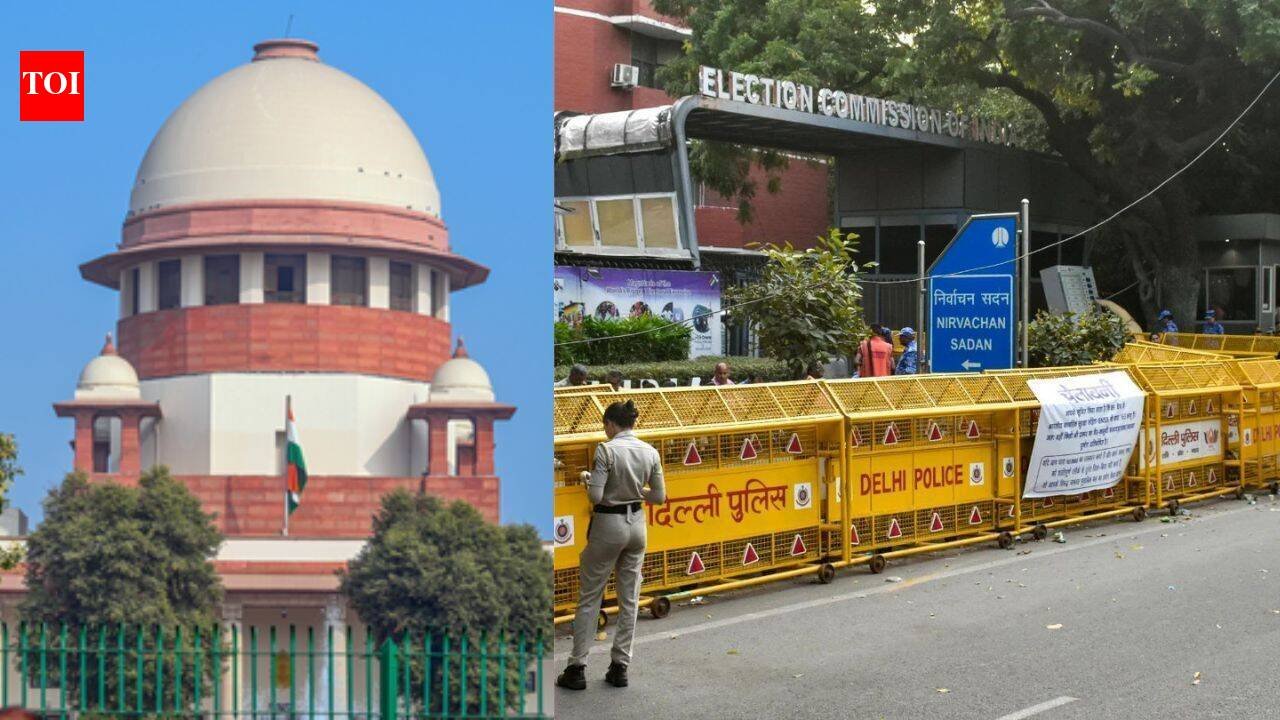
The Supreme Court on Friday pushed back against sweeping transport restrictions in Delhi ahead of the Cockroach Janata Party (CJP)’s October 10 protest, observing that security measures should not bring the city’s public transport network to a standstill.The bench cautioned that an entire city cannot be shut down in the name of managing a protest, warning that blanket curbs on metro and train services could cause severe hardship to ordinary citizens.A bench led by Chief Justice of India Surya Kant, with Justices Joymalya Bagchi and V Mohana, was hearing petitions challenging the proposed closure of 57 metro stations and the cancellation of long-distance trains to the capital, Bar and Bench reported.Here are 10 key takeaways from the proceedings and the court’s directions:
1. No complete shutdown of metro services
The court made clear that metro trains cannot be completely stopped. “There shall be no complete prohibition on the movement of metro trains,” it said in its order.
2. Authorities must reconsider restrictions
Solicitor general Tushar Mehta told the bench he would urge the authorities to allow metro and other railway services to operate in a suitably regulated manner.
3. Public convenience must be protected
The bench highlighted the impact on students, employees, senior citizens and other commuters who rely on public transport to reach Delhi from neighbouring areas. “Exercise caution. Exercise an abundance of caution. There is nothing wrong with that. You are responsible for maintaining law and order. But that responsibility is not merely about protecting State property”, it said.
4. Security measures must be proportionate
Chief Justice Surya Kant said authorities could restrict unruly movement but should not deprive ordinary citizens of transport facilities.
5. Court invokes proportionality
“One very important principle that we follow for every citizen is the principle of proportionality. You have to prevent certain things. Take measures only to the extent necessary to prevent them. But that does not mean you should use a hammer to kill a fly. That principle must be kept in mind,” the CJI said.
6. Train cancellations raised in court
Senior advocate Kapil Sibal flagged the cancellation of long-distance trains, arguing that passengers scheduled to arrive during the notified period would be unable to reach Delhi.
Share your thoughts in the comments
Be respectful · TOI community guidelines
7. Road restrictions also need review
The bench said authorities should examine which areas required regulation and which did not, stressing that “there should be a free flow of traffic”.
8. Traffic advisory ordered
The court directed Delhi authorities to issue a traffic advisory for people travelling within the city by road.
9. Revised decisions must be publicised
Authorities were directed to give wide publicity to decisions on regulated metro and railway operations to minimise further inconvenience to commuters.
10. Centre asked to consider an alternative protest venue
The court asked the Union government to consider identifying a suitable location with adequate facilities for peaceful and lawful protests.The CJP protest is scheduled for October 10 at Jantar Mantar, with organisers demanding the resignation of Chief Election Commissioner Gyanesh Kumar over alleged electoral roll irregularities.
