



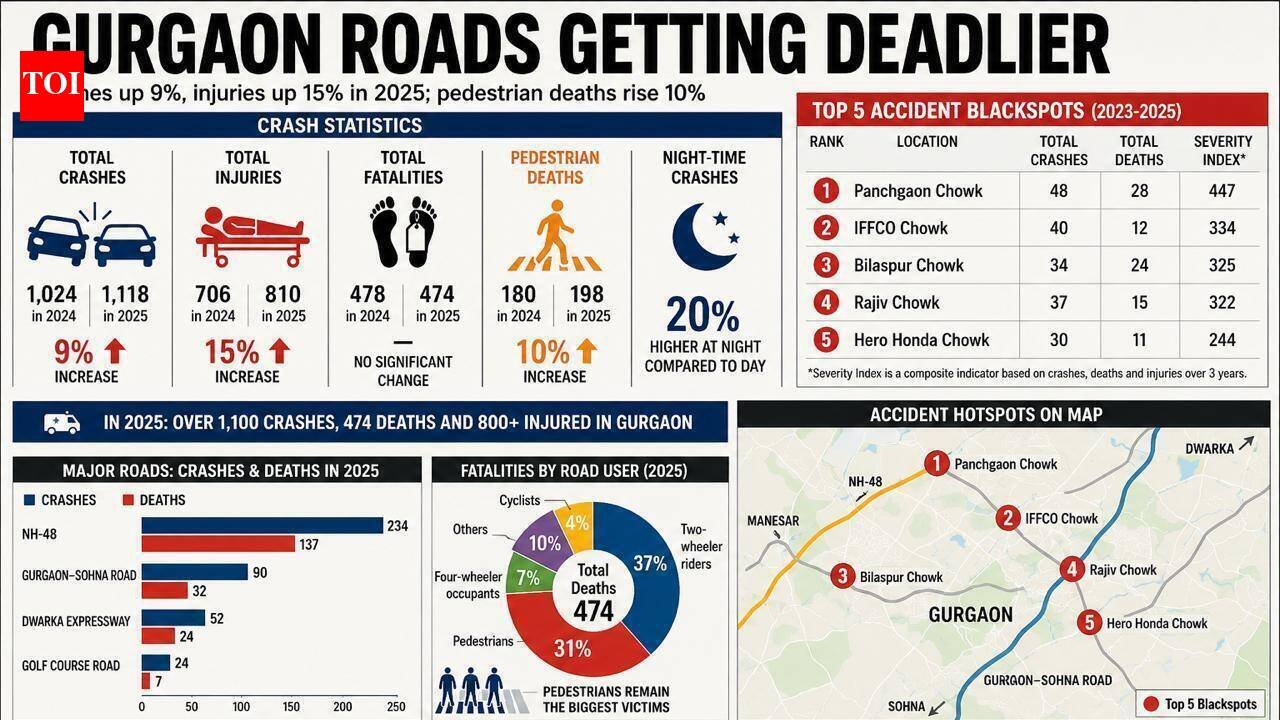
Gurgaon: Road accidents in the city rose 9% in 2025 despite sustained safety campaigns and infrastructure upgrades, official data presented before district road safety committee showed.Data indicates that, on average, three road crashes were reported every day in the city last year, leaving more than two people injured daily. Officials estimate that the district recorded over 1,118 crashes last year, up from 1,024 in 2024, while injuries climbed nearly 15% from 706 to 810. Pedestrian deaths also rose by 10%, from 180 to 198.The city’s busiest transport corridors continued to account for a disproportionate share of accidents. An official from the committee said NH-8 remained the worst-performing road with 234 crashes and 137 deaths, followed by Gurgaon-Sohna Road with 90 crashes and 32 fatalities. “Dwarka Expressway recorded 52 crashes and 24 deaths, while Golf Course Road witnessed 24 crashes and seven fatalities,” he said.The committee also identified 36 accident blackspots across the district based on crash severity over the past three years. Panchgaon Chowk emerged as the most dangerous location, recording the highest severity index, followed by IFFCO Chowk, Bilaspur Chowk, Rajiv Chowk and Sidhrawali stretch. Several locations, including Manesar Bus Stand, Gamroz Toll Plaza, SPR Cloverleaf, and Manesar Ghati, saw an increase in crashes.According to officials, night-time driving continued to pose a greater risk, with crashes during night hours estimated to be about 20% higher than daytime levels. “Overspeeding, wrong-side driving, unsafe pedestrian crossings, poor road discipline and inadequate road infrastructure were identified as the leading causes of accidents at several high-risk locations,” said the official.The data also highlights that pedestrians and two-wheeler riders remain the most vulnerable road users. Pedestrians accounted for the largest share of fatalities, followed by two-wheeler users, indicating that the absence of safe crossings, footpaths and traffic-calming measures continues to expose commuters to significant risks.Concerned over the trend, deputy commissioner of Gugaon Uttam Singh directed road-owning agencies, police and civic authorities to accelerate rectification of accident blackspots under the Zero Fatality District initiative. “Agencies have been asked to improve road markings, signage, lighting, pedestrian facilities, speed-calming measures and enforcement at identified locations. They have to submit regular progress reports,” he said.The committee also discussed strengthening school zone safety, improving trauma care response, intensifying action against drunk driving and overloaded vehicles, and ensuring faster execution of infrastructure work aimed at reducing fatalities.However, the latest figures suggest that while planning and enforcement efforts have intensified, their impact has yet to translate into safer roads. With crashes and injuries continuing to rise despite multiple interventions, road safety experts say the focus must now shift from announcing projects to ensuring timely execution, engineering corrections at blackspots, and stricter enforcement of traffic laws.


