






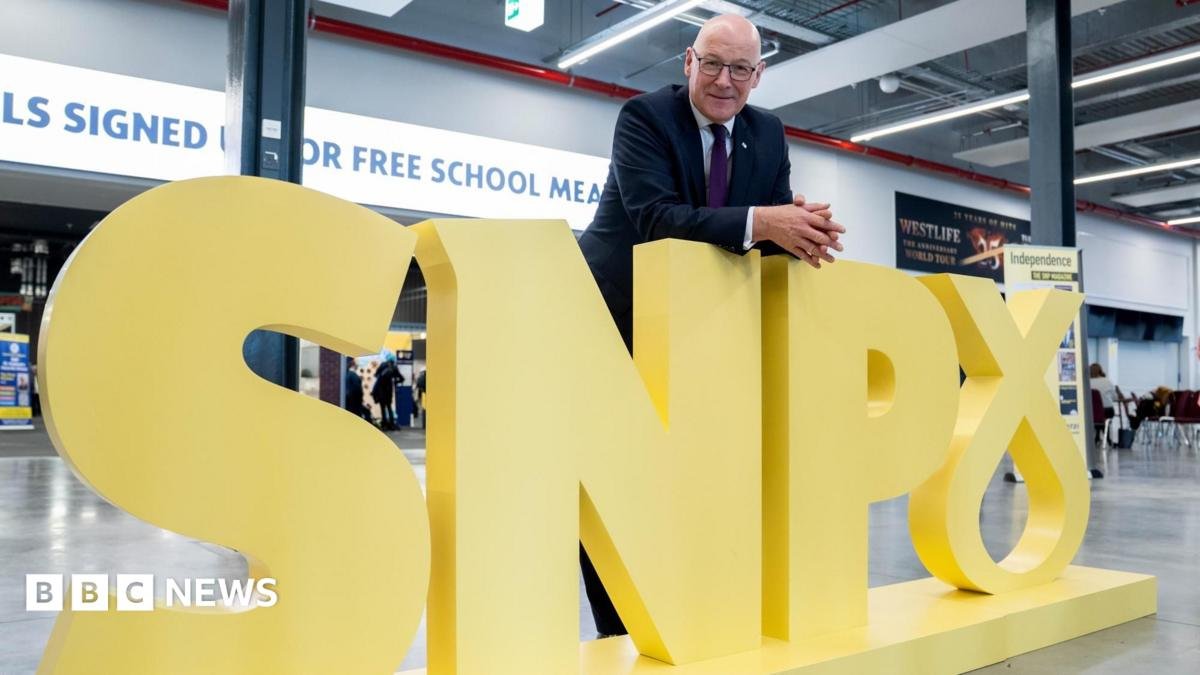
UK political debate has had a distinctly Scottish feel these last few days.
As the Scottish National Party has gathered for its annual conference at the Event Complex on the outskirts of Aberdeen, the Conservative leader Kemi Badenoch has been in Paisley and Edinburgh and the prime minister has been in Motherwell.
The SNP is buoyant, its activists gathering for the first time since it won, in May, a fifth consecutive Scottish Parliament election, albeit with fewer seats than they won in 2021.
Next year will mark the moment the party has been in devolved power at Holyrood for 20 years.
It is quite the contrast with where the SNP found itself just two years ago, pulverised by the landslide at the general election in 2024 where Labour gained 36 seats from the SNP.
As I wrote a year ago, the SNP’s critics point to what they see as a dismal domestic record, on the NHS and the number of deaths among drug addicts, for instance.
The SNP counter Scotland has more police officers per person than England and Wales and the highest spend per school pupil in the UK.
No matter the arguments, the result in May was clear – the SNP leader and First Minister John Swinney has his own mandate. Little wonder, given the state of the party when he took the job, that the conference brochure has a front page photo of a smiling Swinney cradling a glass of whisky.
And remember it wasn’t just an electoral pummelling the SNP was dealing with, but the jaw dropping details which culminated in the jailing of Peter Murrell, the party’s former chief executive – and estranged husband of the former First Minister Nicola Sturgeon – for embezzling more than £400,000 from the party.
Swinney now looks ahead to a parliamentary term with all that behind them and a new prime minister to deal with in Downing Street.
Burnham and Swinney share a diagnosis that Westminster has failed to deliver and political power is better administered closer to people than it ever has been.
But, crucially, the prime minister sees the “drama” of the constant questions around Scottish independence as a distraction.
For Swinney, independence has been and remains his lifelong political goal.
We have had a glimpse this week as to how that dynamic between the two men may play out.
Burnham’s critics, including the SNP, have seen this former Mancunian mayor’s devolutionary instincts as having a distinctly English flavour. The prime minister, on his trip to New College Lanarkshire, sought to counter that.
“I do want a good growth in every postcode here, and in the rest of the UK, and I want to work with the first minister to deliver it. We won’t agree on everything, but we can agree on something,” he said.
“I want us to design a new model together of regional economic empowerment across Scotland, one that puts control in the hands of local people.”
Burnham has offered to devolve powers on localised employment support, currently held by the Department of Work and Pensions.
Both he and the Secretary of State for Scotland, Douglas Alexander, said Scotland was “one of the most centralised nations in Europe”, an assertion flatly rejected by Swinney.


