



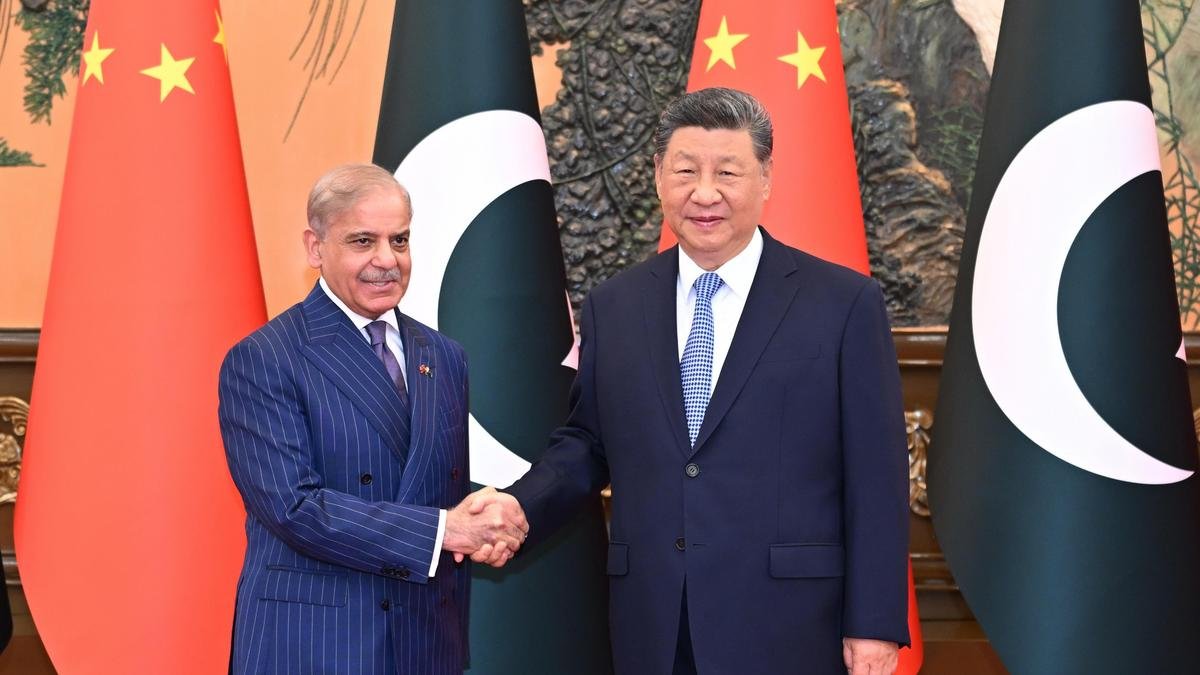
Pakistan and China have agreed to “unswervingly safeguard” and develop their bilateral relations by working closely to build a shared future, according to a joint statement issued on Tuesday (May 26, 2026).
The statement was issued at the end of Prime Minister Shehbaz Sharif’s official visit to China from May 23-26 at the invitation of Premier Li Qiang. During his visit, the two sides signed a number of cooperation documents in various fields.
President Xi Jinping and Premier Li separately held talks with PM Shehbaz, and the two sides reached a new broad consensus on further deepening the China-Pakistan All-Weather Strategic Cooperative Partnership and on international and regional issues of mutual interest.
PM Sharif also attended the ceremony to commemorate the 75th anniversary of the establishment of diplomatic relations between the two countries and visited Hangzhou, Zhejiang Province.
Both sides reiterated opposition to any unilateral actions and reaffirmed the significance of maintaining peace and stability in South Asia and resolving all outstanding disputes through dialogue and diplomacy, the statement said.
Like in the previous joint statements after Pakistan leaders’ visits, the new statement also said that the Pakistani side briefed the Chinese side on the latest developments on the situation in Jammu and Kashmir. China, for its part, reiterated that the Jammu and Kashmir dispute is left over from history, and should be properly and peacefully resolved in accordance with the UN Charter, relevant UN Security Council resolutions and bilateral agreements.
The two sides expressed readiness to conduct trans-boundary water resources cooperation under the principle of equality and mutual benefit, it said, without specifying any details of collaboration as the rivers emanating from China that flow to Pakistan pass through India.
India has kept the Indus Waters Treaty in abeyance until Pakistan takes credible and irreversible steps to end support for terrorism.
China reiterated its “unwavering support” for Pakistan in defending its national sovereignty, independence, and territorial integrity, and firmly supported Pakistan’s efforts to safeguard its national security, stability, development and prosperity.
Both sides were determined to “unswervingly safeguard” and develop their bilateral relations, maintain high-level exchanges, and make significant progress, the statement said, the joint statement said.
Throughout the 75 years of diplomatic relations, this friendship has remained rock solid, no matter how the international and regional situations evolved, and the two countries have always trusted, respected and supported each other and stood by each other in times of difficulties and challenges, the statement stated.
Both sides are determined to “deepen mutual trust, practical cooperation, defence and security cooperation, and keep close coordination on international and regional issues,” it stated.
Pakistan reaffirmed its strong commitment to the one-China principle, saying that it firmly supports all efforts by China to achieve national reunification and resolutely opposes any form of “Taiwan independence.” The two neighbours agreed to advance high-quality Belt and Road cooperation, hold the meeting of the China-Pakistan Economic Corridor (CPEC) Joint Cooperation Committee and promote the high-quality development of the upgraded version of CPEC 2.0.
They agreed to advance the Karakoram highway (Thakot to Raikot) realignment project in a phased and orderly manner and agreed to leverage the potential of the Gwadar Port and build it into a regional connectivity hub.
The two sides also welcomed third parties to participate in the development of the CPEC under the model agreed upon by China and Pakistan.
Pakistan has assured to take targeted steps to strengthen measures and cooperation to ensure the safety of Chinese personnel, projects and institutions in Pakistan.
China supports Pakistan in its continued and firm fight against terrorism, it said. Both sides called on the international community to enhance counter-terrorism cooperation and reaffirmed their firm opposition to applying double standards on politicising and instrumentalising counterterrorism.
They agreed to jointly promote an equal and orderly multipolar world and a universally beneficial and inclusive global economic order.
The two sides also reiterated opposition to any unilateral actions and reaffirmed the significance of maintaining peace and stability in South Asia and resolving all outstanding disputes through dialogue and diplomacy.
They expressed readiness to conduct transboundary water resources cooperation under the principle of equality.
Pakistan also expressed support for the four propositions by President Xi on safeguarding and promoting peace and stability in West Asia, even as China appreciated Pakistan’s efforts in facilitating the temporary ceasefire between the U.S. and Iran and holding the Islamabad Talks.
Both sides reiterated the early implementation of the five-point initiative for restoring peace and stability in the Gulf and West Asia. The two countries also agreed to stay in close communication and coordination on the issue of Afghanistan.
The two sides stressed the need not to allow any individual, group or party, including the Tehreek-e-Taliban Pakistan (TTP) and the Eastern Turkistan Islamic Movement (ETIM), to use the territories to harm and threaten regional security and interests, or conduct terrorist actions and activities.
Published – May 26, 2026 10:59 pm IST


