



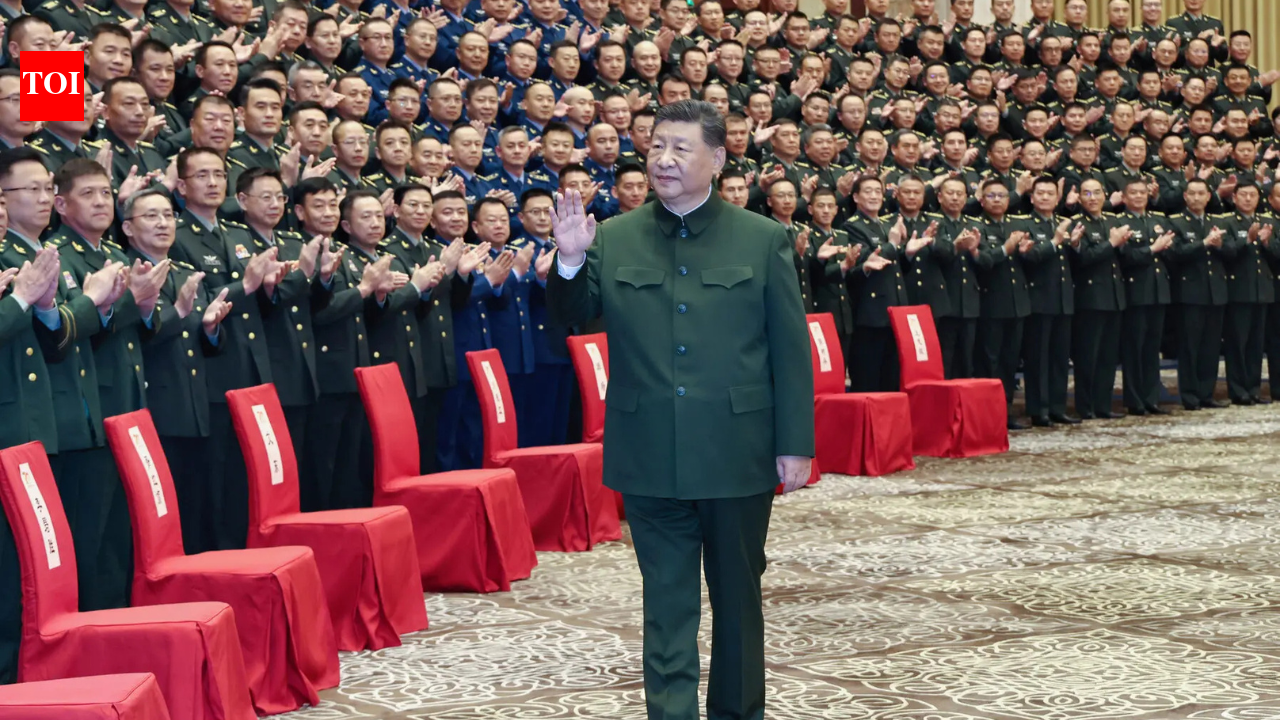
China on Thursday announced a 7% increase in its defence budget for 2026, as it continues to step up its military capabilities to counter the United States and strengthen its claims over Taiwan and the South China Sea. The hike will take the country’s defence spending to about 1.9 trillion yuan, or $276.8 billion, according to a report released at the opening of the annual “Two Sessions” parliamentary meeting.China has been steadily increasing its defence spending in recent years, making it the world’s second-largest military spender, only after the United States. Last year, China increased its defence budget by 7.2% to $249 billion, almost $17 billion higher than 2024.With the latest increase, Beijing’s defence budget remains roughly a third of that of the US, which spent about $997 billion on defence in 2024, according to the Stockholm International Peace Research Institute. Where will the funds be used?Presenting the figures at the National People’s Congress (NPC), Chinese Premier Li Qiang said that over the next five years, the country would continue efforts to strengthen its armed forces and “carry out major defence-related projects.”Analysts cited in the report said that the additional funds are expected to support a range of activities including military salary increases, training programmes, manoeuvres around Taiwan, the development of cyberwarfare capabilities and the procurement of advanced equipment.The increase also comes as Beijing pursues an anti-corruption campaign within the military that has led to the removal of several senior officials, including top general Zhang Youxia earlier this year.Steady defence build-upOfficials from Beijing said that the country’s defence spending remains comparatively modest when compared against indicators such as its share of GDP. According to SIPRI data, back in 2024, China’s defence budget accounted for about 1.7% of its GDP, compared with 3.4% in the United States and 7.1% in Russia.China has maintained annual increases of around 7% to 8% in its defence spending since 2016 as it continues the modernisation of the People’s Liberation Army (PLA).Dragon aims to ‘fully restore’ Chinese jurisdiction Military commentator Song Zhongping, a former Chinese army instructor, said that strong defence capabilities are necessary for the country’s diplomatic independence.“China pursues an independent and self-reliant foreign policy. However, without robust military capabilities and technological prowess, our diplomatic stance would inevitably be subject to coercion or even dictated by certain nations, including the United States,” he told AFP.“China is unwilling to be a vassal state,” Song said, adding that Japan and South Korea “only submit to American dictates”.He also said the PLA must strengthen its capabilities to “fully restore” Chinese jurisdiction over the disputed Spratly Islands in the South China Sea, which are also claimed by the Philippines and are believed to hold vast natural resources.Despite Beijing’s assertion that its defence policy is focused on protecting its territory, including what it considers part of China such as self-ruled Taiwan, the country’s growing military capabilities have raised concerns among neighbouring states.China currently operates only one overseas military base in Djibouti, in contrast to the several hundred bases maintained by the United States worldwide.Niklas Swanstrom, director of the Stockholm-based Institute for Security and Development Policy, said China’s spending level was consistent with the size of its economy but still significant.“That is proportional to its economy and legitimate defence needs,” he said, while noting that “the absolute spending level (second globally) and rapid capability development concern neighbours”.Countering US influenceChina’s military expansion has also prompted countries in the region to deepen defence cooperation with Washington. In Taiwan, leader Lai Ching-te has called for increased military spending in response to Beijing, which has not ruled out the use of force to take control of the island.Philippines has granted the United States access to more of its military bases, while Japan has begun easing its long-standing pacifist stance, approving a record defence budget worth $58 billion in December for the coming fiscal year.Meanwhile, though the Chinese navy is believed to have more ships than any other country, it still trails the US Navy in terms of overall tonnage, nuclear-powered submarines and aircraft carriers.Swanstrom noted that Washington also holds several other advantages, including stronger global logistics networks, more advanced submarines and stealth technology, a larger nuclear arsenal, combat-experienced personnel and a wide network of alliances.He added that the balance could look very different closer to China’s coastline if the US Navy were to intervene militarily, for instance in support of Taiwan.“The US remains the world’s first-class armed forces both in terms of its military hardware and the hard operational experience of its personnel,” said James Char, a Chinese military specialist at Nanyang Technological University in Singapore.“Most critically, neither side could ‘win’ meaningfully,” he said, adding, that economic “devastation, casualties, and nuclear escalation risks would be catastrophic for all parties.”


