



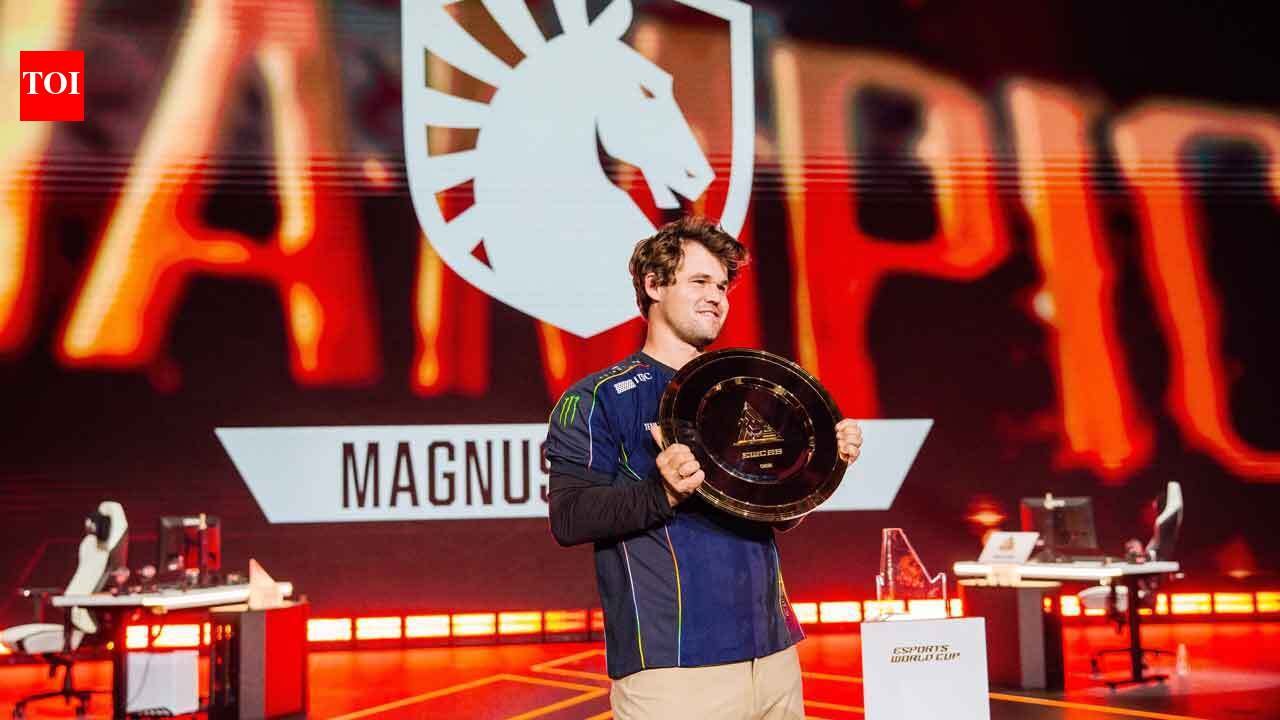
TimesofIndia.com in PARIS: Lucas had come to watch chess with his family. His wife was there, so was his young daughter and his 11-year-old son, Marius, who has been playing the game for only about a year.By the time they left the Esports World Cup arena at Paris Expo Porte de Versailles, Marius had something to take home – a signed autograph from Magnus Carlsen.Around the chess stage were giant screens, music, commentary, noise-cancelling headphones and a crowd watching alongside the other Esports World Cup titles. “The screening, the show, the ambience. It’s very nice,” Lucas said of the experience.Later on, Carlsen was back on that stage – this time with the trophy.The Norwegian defended his Esports World Cup Chess title, beating 19-year-old Denis Lazavik 2-0 in the grand final. Carlsen finished unbeaten and took home USD 250,000 and 1000 Club Championship points for Team Liquid. Lazavik earned USD 190,000 and 750 points.
(Image credit: Vineet Ramakrishnan/TimesofIndia.com)
Hikaru Nakamura finished third with USD 145,000 after a chaotic third-place match against Alireza Firouzja, who finished fourth with USD 100,000.
India leaves Paris with two players in the top eight
India’s campaign ended with two players in the quarterfinals. Arjun Erigaisi and Nihal Sarin finished in the top eight and earned USD 72,500 each. Arjun was eliminated by Nakamura after their match went to Armageddon, while Nihal lost to Carlsen. M Pranesh finished ninth with USD 52,500, and Aravindh Chithambaram, who qualified through DreamHack Atlanta, walked away with USD 23,000.For the organisers, though, the five days in Paris were about more than finding another winner. Chess was being tested in a setting where 24 titles are being played across other tournaments – VALORANT, League of Legends, Dota 2, Rocket League, Fortnite to name a few.
Carlsen sees chess and esports as a natural marriage
For Carlsen, there was no great need to decide whether chess had entered esports or esports had discovered chess.“I think regardless of the way you put it, I hope it can be a very happy marriage. That’s what I will say. And I think this format really has been waiting for chess for a while,” the 35-year-old said in reply to a query from Timesofindia.com in a press conference post his title win.He went back much further than the EWC when explaining why.“You can see even as soon as people started having Internet in their homes, they started playing chess online. Like a lot of the best chess players migrated to not recently, but partly as online play as early as 1995. So it’s certainly been coming, and I’m very happy that we’re here where we present chess at a very good excited about it for that like this.”Carlsen had also made the point that what is being played here is not quite the chess that most people grew up watching.“I think this is just a little bit different, and I think we should embrace that. This is not kind of traditional chess, but this is jazz as an esport with all that brings, and I think we’ve done a really good job here the last two years of doing that with chess. So definitely hope to see more of that in the future, and I think it’s serious,” he told reporters.
(Image credit: Vineet Ramakrishnan/TimesofIndia.com)
The difference is not only in the format. There is the crowd, the stage, the noise around the players and the way the matches are presented. For someone who has spent much of his career playing in very different settings, this change has its own appeal for the Norwegian.“I think it’s just in many ways better that you can have a little bit more, more of a fun experience. The way, the way it’s going here. It’s fast-paced and really demanding, but also fair for the players.”That was perhaps the interesting bit about watching the players here. Amid all the theatrics, the players themselves are still trying to do what they have always done – sit down and calculate the next move.
Chess gets the arena treatment its online community wanted
Arkus Fredriksson has worked on making chess an esport for years. At a roundtable during chess week in Paris, he was less interested in explaining why chess belonged in the arena than in describing what it felt like to finally see it there.‘It’s genuinely a dream come true’, said Fredriksson, adding, “We’ve wanted to be in arenas, screaming fans and all this, and it’s taken a long time until we’ve finally kind of gotten here.”There had been earlier attempts. Fredriksson mentioned an event in San Francisco in 2016 and other experiments after that, but said they did not have the same production, scale, or quality as EWC.“Even just last year, it was the first time we brought commentary in the venue. With the noise-cancelling, that’s something that we hadn’t really done.”And then you can actually have people cheering and screaming, and we saw that last year and we’re seeing that again this year, and I think more to come in the finals.”
(Image credit: Vineet Ramakrishnan/TimesofIndia.com)
The EWC wants to change how chess is experienced
Morten Holst, Director of Games Partnerships at Esports Foundation, has a slightly different way of describing what the production is trying to do. He was not talking about changing the moves or the game itself. It was about giving viewers more to see.“It’s not because we’re trying to change what chess is about. We’re not trying to invent digital chess, because the community already did that.”There is already a large online audience, he said.“They are growing up learning about chess, they are playing, they are watching, they are competing, and it’s all happening digitally. They follow the streamers, the stars, they watch online tournaments, and they compete on platforms such as Chess.com.”That is where the EWC comes in. “And that’s actually very similar to what you see across the board in many other games,” said Holst, citing the heart-rate monitor as one of the examples.“It’s something that is so exciting that you normally see them being very calm, and they look like they are really handling stress well. So the heart-rate monitor shows you what the camera doesn’t show.”And the players’ presentation has changed too. A chess player would otherwise walk into a venue, usually in formal clothing, take a seat, and get on with the game. At EWC, the entrance itself has become part of the production.
(Image credit: Vineet Ramakrishnan/TimesofIndia.com)
The fogger goes off. The music blares. The two players walk in from opposite sides and meet in the middle. Their faces appear on the giant screen behind them, the trophy sits between them, and they strike a face-off pose before taking their seats. The introductions are delivered at a pitch much closer to UFC’s Bruce Buffer than a traditional chess hall.It can feel theatrical. However, once the clocks start, the focus is still on the board with some added incentives for the live audience. They can see the players’ reactions, their feet, their small movements, the moments when the pressure starts showing.“When we build out the stage, the desk they sit behind, you can see the feet, for example. So if they’re tapping their feet or if they are doing other signs that they might be under pressure, we’re really trying to get that out to the audience and get them closer to the audience,” adden Holst.Fredriksson sees another part of the change away from the board.“A lot of these players don’t have big social media presences. They’re not doing a lot of content on their own. They’re very focused on the chess side.”Esports teams have now entered that space. “And now you have these esports teams with their existing fans and, you know, people are very curious about them, helping them create this content and build up their profiles and their presence.”He sees the movement going both ways. “So it is really, it’s amazing, right? And it’s bringing on all of these new kinds of fans to chess, which is great. And then vice versa, right? All these chess fans to these esports teams. And I think that’s where this magic happens.”
When the technology behind chess became the story
But, as much as technology is part of the attraction, there’s always a possibility of a hiccup. The third-place match between Nakamura and Firouzja was also a reminder that the technology is not foolproof.The two Team Falcons players were competing for third place when multiple disconnections disrupted the match. Nakamura was left waiting for around 20 minutes before officials told him the match would be recorded as a forfeit in his favour. Firouzja had left the arena.
Hikaru Nakamura (Image credit: Vineet Ramakrishnan/TimesofIndia.com)
Nakamura initially believed Chess.com was responsible. He had no phone or outside information while waiting and said the first thing he saw on his screen was a disconnection.After being taken for interviews, he criticised Chess.com. He later retracted those comments. He subsequently learned that the issue had come from the EWC and had affected other events too.For an event trying to sell the idea of digital chess inside a physical esports environment, it was an uncomfortable interruption. The players were sitting in the same arena, but the game was still dependent on servers and connections working as they should.
For EWC, chess is also about building professional careers
Despite that, the people behind the tournament remain bullish about chess’ place in the EWC.Fabien Scheuermann, the Esports Foundation’s Chief Games Officer, has been looking at the question from the other side – not why chess wants esports, but why esports wants chess.The Esports Foundation looks at viewership and attendance, an existing ecosystem for professional players, and cooperation with the platform or publisher when assessing games.“Chess is an absolute prime example of how to do it,” Scheuermann said at the roundtable.There is also a more practical reason for the EWC’s involvement. More than prize money, for Scheuermann, the professionalisation of chess is as important as the arena spectacle.“Solo-player sports make it very, very difficult as a person or as a professional athlete to be profitable, right? You’re running your own business. You are trying yourself to basically make sure that, as a professional athlete, make a profit and make a living out of this.”
(Image credit: Vineet Ramakrishnan/TimesofIndia.com)
The club system gives players another route.“And through the Club Championship, we actually create this additional layer where chess players get picked up by professional organisations and get a salary, right? So you’re not only competing for yourself and are not fully dependent on prize money, but actually with this you’re increasing the stability, and someone else pays your salary, which also decreases your personal risk in going into this venture.”Fredriksson adds that more than 30 players were signed to esports teams after the first year of the EWC. Holst sees the EWC as part of a year-round digital chess calendar rather than something that should appear for five days and disappear again.“We hope that our events will create opportunities for other tournaments to start doing like you guys are doing. So there’s opportunities all year long.”That is where the EWC’s involvement starts becoming more interesting for players outside the very top of the game.Carlsen can win USD 250,000. A wider group of players could potentially earn a salary, have an esports organisation behind them, and compete throughout the year.The EWC is still only in its second year of chess. But that part of the experiment is already underway.In a hall built around gaming titles, chess had its own corner at the EWC 2026 – a board, two clocks, two players, giant screens and live audience – and a game that does not need much explaining once the pieces start moving.It came into a week of Counter-Strike 2, Rocket League, BGMI, and the rest of the EWC lineup without changing the game itself.At the end of it, Carlsen had the trophy, Arjun and Nihal had made the top eight, Nakamura had survived a technical controversy to finish third, and the young boy Marius had gone home with the autograph of the man who won it all. For chess, the pieces are beginning to settle into place in the world of esports.


