


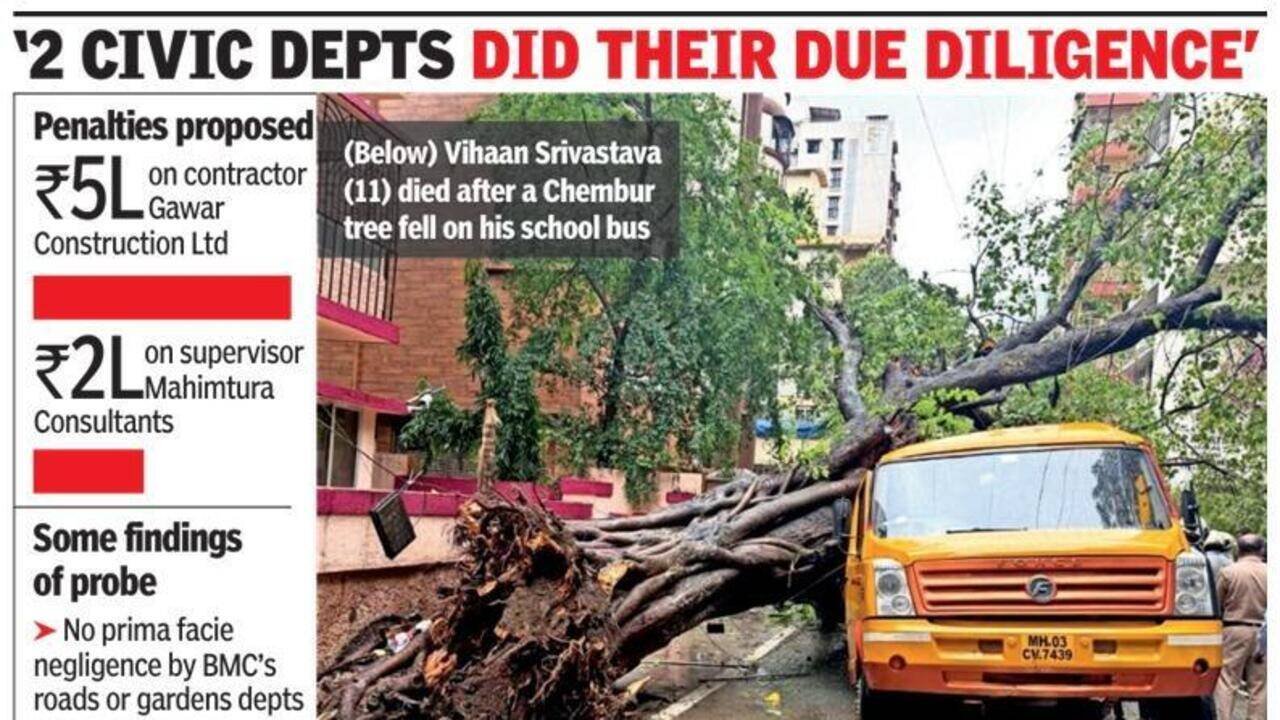
Mumbai: A three-member BMC committee set up to probe the June 30 Chembur tree crash, which killed an 11-year-old boy inside a school bus during incessant rain, gave a clean chit to the civic roads and gardens departments while recommending levying a collective penalty of Rs 7 lakh for negligence on the contractor and the consultant for stormwater drain works undertaken near the site.It said while several factors may have contributed to the tree fall, the contractor—Gawar Construction Ltd—did not take sufficient precautions even after being warned against damage during excavation and the supervisor—Mahimtura Consultants—should have exercised greater oversight. It, however, stopped short of holding the contractor solely responsible for the tragedy, saying over 1,000 trees fell during heavy rain and wind over eight days.The report said the gardens department had periodically inspected the tree, carried out pre-monsoon pruning wherever required, and alerted the roads department on multiple occasions about safeguarding the tree during the stormwater drain work. The roads department, noted the panel, altered the drain’s alignment to avoid disturbing the tree’s roots and instructed the contractor to exercise caution.An 11-year-old boy, Vihaan Srivastava, was killed and four other children were injured after a roadside peepul tree crashed onto a school bus in Chembur during continuous rain on June 30.The committee, comprising deputy municipal commissioners Purushottam Malvade and Shashank Bhore, and horticulture and landscape consultant Robert Fernandes, has proposed a fine of Rs 5 lakh on the project contractor and Rs 2 lakh on the project supervisor for failing to take adequate precautions.The committee’s report said 1,158 trees and branches fell across Mumbai between June 28 and July 5 during an exceptionally wet and windy spell. The Chembur site received 62.8mm of rain on June 28; 71.6mm on June 29; and 13.6mm till 3pm on June 30, when the tree collapsed, while wind speeds touched at 25.7kmph, it noted.Besides recommending penalties, the panel proposed sweeping reforms to urban tree management. These include preparing a policy-based standard operating procedure for inspection, maintenance, pruning and safety audits of trees, appointing registered arborists/tree experts to supervise pruning and infrastructure works, and carrying out periodic tree risk assessments before and after every monsoon.Other recommendations include creating a GIS-based inventory of all roadside trees, reducing excessive concretisation around tree bases, scientifically protecting tree roots during excavation, banning the use of heavy machinery such as earthmovers near roots, appointing nodal officers to coordinate between civic departments during infrastructure projects, and conducting immediate inspections of mature trees after heavy rain or storms.The committee also recommended encouraging native tree species suitable for urban roads, introducing audits of trees in private housing societies through empanelled experts, and launching a citizen-driven ‘Vrikshmitra’ initiative, supported by a mobile reporting mechanism, to flag potentially hazardous trees.
