



The 20th century has devised an impressive repertoire for humiliating its notorious dead. Benito Mussolini was captured fleeing Italy in disguise, shot by partisans, dragged to Milan and hung upside down from a petrol station in Piazzale Loreto, where his corpse became public entertainment. Muammar Qadhafi was hauled from a drainage pipe, beaten and killed, then deposited in a commercial freezer so Libyans could queue up for a look at their fallen dictator. Nicolae Ceaușescu and his wife Elena were captured during Romania’s 1989 revolution, subjected to a perfunctory Christmas Day show trial and executed by firing squad, their deaths subsequently broadcast to the country. Even Adolf Hitler, unwilling to surrender himself to the Red Army, died by suicide in his bunker and had his body doused in petrol and burned in a bomb crater, lest even his remains become a Soviet souvenir. But for all their grotesquerie, these political deaths still possessed the mercy of finality. The corpses could be desecrated, displayed, incinerated or otherwise subjected to the full vindictiveness of history, after which the spectacle exhausted itself.
But for Charlie Kirk, the late American far-right provocateur who was assassinated while addressing a university audience last September, death has proved to be an inadequate punishment. Some fates, it turns out, can be considerably more humiliating than mere desecration.
Kirk died once. The internet has since killed him by the thousand, resurrected him by the million, periodically canonised him, relentlessly caricatured him and fed his face back into its cultural maw as meme, martyr, AI hallucination, and political effigy. Twelve uninterrupted months of digital necromancy have steadily severed Kirk from the person he once was. What survives today is a Kirk-shaped homunculus assembled from all the relentless posthumous indignities that now drifts through the feed untethered from any recognisably human origin.
September 10 marks a year since the 31-year-old co-founder of the conservative youth organisation Turning Point USA, and one of the most conspicuous young operatives in American conservatism, was fatally shot while speaking at a campus event at Utah Valley University. His assassination instantly became a wound in the American right’s political mythology, with U.S. President Donald Trump and conservative leaders casting him as a martyr to free speech.
U.S. right-wing activist and commentator Charlie Kirk appears at a Utah Valley University speaking event in Orem, Utah, U.S. September 10, 2025
| Photo Credit:
Reuters
Through Turning Point USA, his podcast, and a punishing circuit of college appearances, Kirk had cultivated a youthful MAGA constituency around hard-line immigration politics, opposition to abortion and transgender rights, and a rhetorical style that treated outrage as both message and marketing strategy. His public record included a history of of blatant racism, sexism, xenophobia, homophobia and misogynistic remarks, as well as defence of “accepting some level of annual gun deaths” as the price of maintaining the Second Amendment.
His assassination consequently produced a dispute over the terms of grief. The American right largely canonised him. His critics questioned whether a person who had spent years displaying such contempt for his political enemies could reasonably expect universal tenderness after death. The internet, being the internet, very soon decided that the only appropriate response was to troll.
Thus began the era of Kirkification.
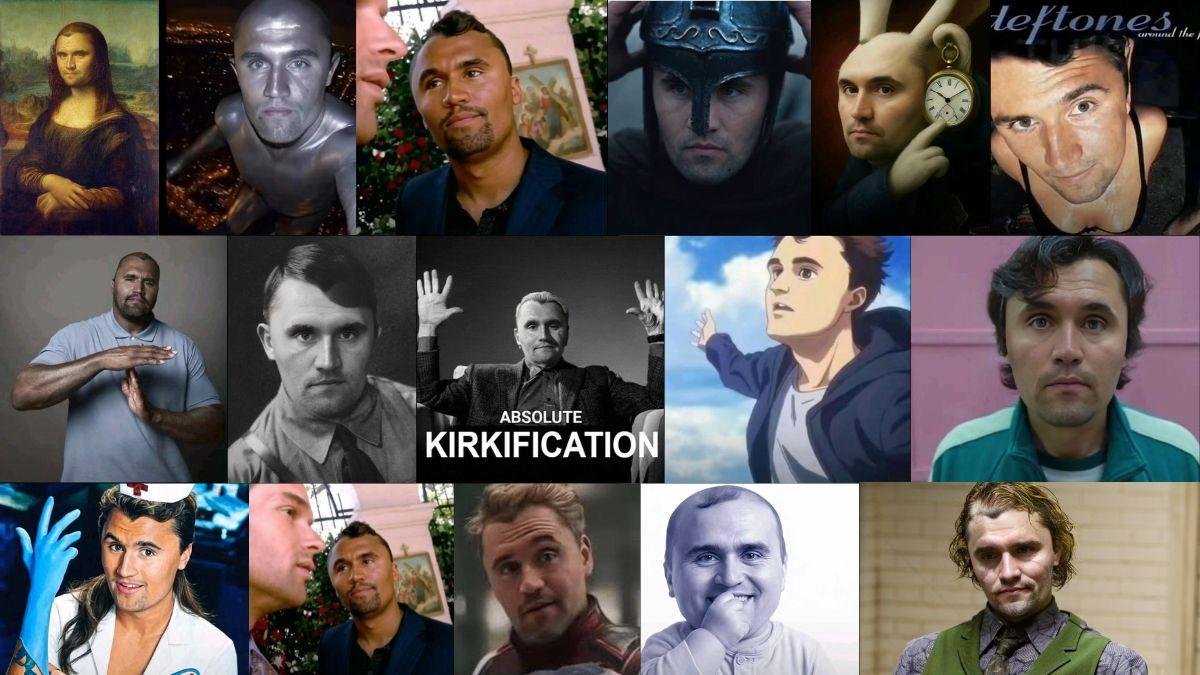
The internet-branded term is now used to describe a bizarre form of AI-generated cultural stencil in which Kirk’s face is grafted onto photographs, videos, GIFs and memes until the original subject becomes almost incidental. His likeness has been transplanted onto an ever-expanding menagerie of celebrities, political personalities, historical figures, fictional characters and reaction images; with each iteration carrying the same deadpan premise: somewhere, somehow, Charlie Kirk has turned up again.
Kirkification has effectively stripped the man down to a visual unit of cultural currency, a portable little emblem of posthumous absurdity that can be spent anywhere the feed permits, and a face that can now be affixed to virtually any cultural object the internet has decided to bully that day.
Even the language has begun metabolising him. “Kirked” has entered the meme lexicon as shorthand for being killed, while “A.K. (After Kirk)” has been floated as the internet’s answer to A.D.. His name has further been pulverised into compounds such as “lowkirk” and “lowkirkenuinely”, where the original meaning of the word is almost beside the point. His death anniversary has also been absorbed into the bit, christened “Kirkversary” online. Even “We Are Charlie Kirk”, the martyrdom slogan-song adopted by his supporters, has since been appropriated by his detractors, turning Kirk’s canonisation into ammunition against him.
There is something so Dantean about Kirk’s predicament. In Inferno, Dante’s first circle of Hell, Limbo suspends souls in an existence without theological resolution, and Kirk has acquired a secular, algorithmic version of the same predicament: he cannot quite pass into history because the internet keeps summoning him back, each resurrection producing another Kirk with another caption, joke or synthetic face until the historical man begins disappearing beneath the archive assembled in his image.
And if Dante gives us the architecture of this digital purgatory, the older mythologies supply its tortures. Tantalus, the Greek king, was condemned to perpetual deprivation; Sisyphus, the Corinthian king, to the Sisyphean indignity of repeating the same futile labour forever; Tithonus, the Trojan prince, was granted immortality after his lover Eos asked Zeus to spare him from death, only for her to forget the rather consequential matter of eternal youth. Kirk has received the Silicon Valley rendition of that bargain. His body is gone while his likeness has acquired infinite reproducibility, condemned to circulate through the internet unto eternity, which may be the most cyberpunk-ian form of damnation yet devised.
It is also cosmically undignified to become a historical source in the age of generative AI. A historian a couple hundred years from now trying to determine what Charlie Kirk actually looked like will have the photographs, television footage and speeches, then encounter an archaeological landfill of synthetic Kirk as a K-pop idol, cartoon character, historical potentate, saint, reaction GIF and other assorted human beings who have never met him but now apparently share his face. The archive will therefore contain an unprecedented abundance of evidence alongside an unprecedented quantity of evidence that never happened.
AI has introduced a postmodern problem for historical study. Falsification no longer needs to conceal itself as documented fact when it can proliferate as entertainment, parody and shitposting. The future historian’s task will involve separating the man from the Kirkesque sediment that accumulated around him, an exercise in epistemological archaeology for which several thousand years of historiographical methodology may prove woefully inadequate. Charlie Kirk may just survive the centuries as one of the most extensively documented figures nobody can quite remember accurately.
9/11 is around the corner, marking 25 years since the attacks, while the fourth anniversary of Queen Elizabeth II’s death also approaches. One would expect Kirk’s anniversary to possess no comparable historical magnitude to either. Yet online, the first annual “Kirkversary” has generated an almost absurd level of anticipation, with its looming arrival seemingly eclipsing both in sheer digital commotion.
Digital culture has developed a strange fixation for manufacturing communal fervour around events whose apparent significance begins to evaporate the moment they are removed from the hermetic little terrarium of the feed. The internet has little regard for historical proportion when attention itself becomes the unit of cultural value. All it requires is recognisable symbols for the algorithm and a sufficiently excitable audience with the attention span of a fruit fly. Which is why Kirk may find it considerably harder to extricate himself from the collective consciousness.
And so, after 12 months of watching Charlie Kirk transmogrify from political provocateur into meme, verb, synthetic face and infinitely recyclable internet detritus, the first Kirkversary arrives at the only question suitably calibrated to commemorate the occasion: “Counting or not counting gang violence?”
Published – September 10, 2026 12:04 pm IST
