



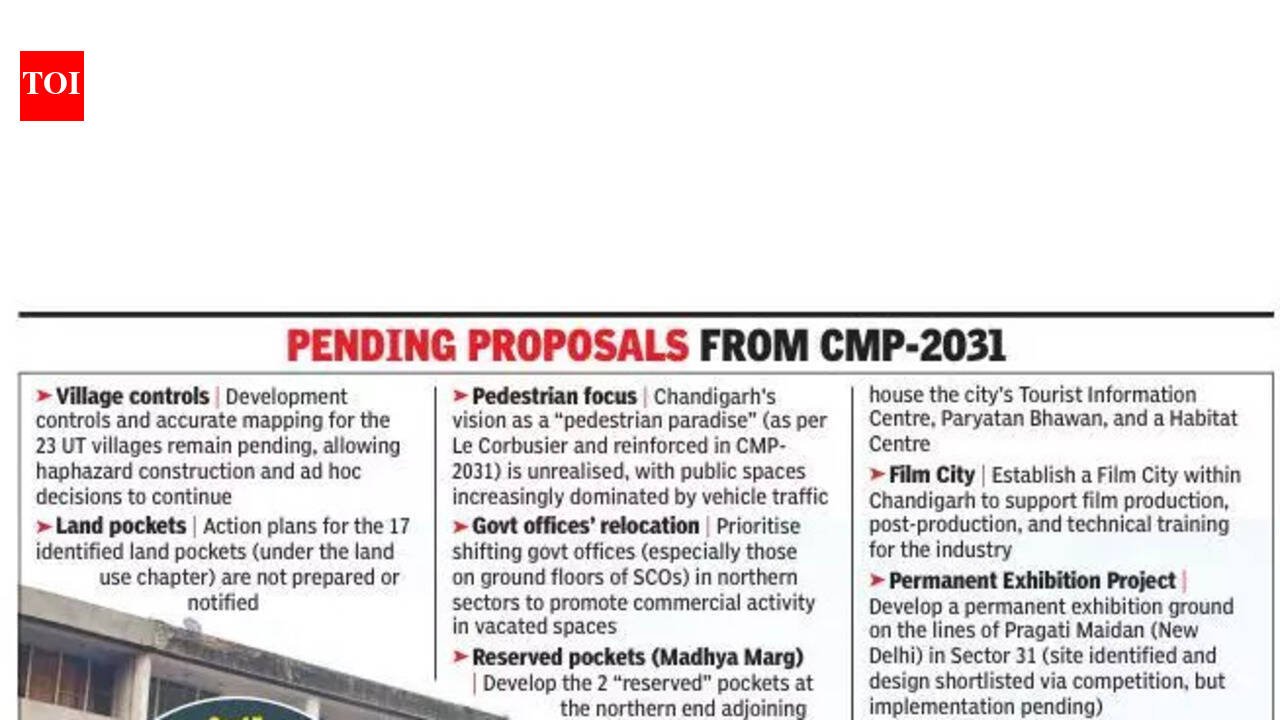
Chandigarh: Chandigarh, the iconic ‘City Beautiful’ designed by Le Corbusier, finds itself at a critical juncture, grappling with a chequered past and an increasingly uncertain future amid mounting urban pressures and stalled implementation of key safeguards.Notified over a decade ago in 2015, the Chandigarh Master Plan-2031 (CMP-2031) outlined ambitious recommendations to preserve the city’s planned character, promote sustainable growth, and address regional challenges. However, many of its core provisions remain unimplemented or only partially realised by the bureaucrat-led administration, leaving the Union Territory vulnerable to an existential crisis driven by uncontrolled regional sprawl.Sandwiched between Punjab and Haryana, Chandigarh spans just 114 sq km (with the broader planned area around 144 sq km) and is landlocked, making coordinated development with neighbouring Mohali and Panchkula — collectively known as the Tricity — essential. Unplanned and planned urban clusters in these satellite areas have intensified pressure on Chandigarh, exacerbating acute issues such as severe traffic congestion, parking shortages, and inter-city commuter strains.A central recommendation of CMP-2031 was the establishment of a Chandigarh Regional Planning Board — modelled on the National Capital Region Planning Board (NCRPB) — to oversee holistic Tricity planning under a dedicated Town and Country Planning Act for the UT. The plan reiterated central ministries’ calls for such a board and legislation to enable coordinated master plan formulation and revisions. Despite the need being recognised as far back as the 1970s, when a proposed “Tricity Planning Development Authority” was first mooted, no such unified body exists today.The Centre recently clarified in Parliament that no single master plan governs the coordinated development of Chandigarh, Mohali, and Panchkula, with each urban centre operating under its own frameworks. This fragmented approach delayed critical infrastructure projects, including metro connectivity, shorter routes to Mohali’s international airport, and an outer ring road, primarily due to inter-state coordination hurdles.Architect Shilpa Das Vermani, founder and convener of ‘Act! Chandigarh’, highlighted the interconnected nature of Tricity woes: “Several key problems are common and inter-linked. For instance, Chandigarh’s transport and traffic issues stem largely from high volumes of inter-city traffic from Mohali and Panchkula. Projects suffered inordinate delays because of these coordination issues.”Historical efforts, such as the 1984 creation of the Chandigarh Interstate Capital Region (CISCR) covering 2,431 sq km and the unapproved 1999 Chandigarh Interstate Metropolitan Regional Plan (CISMeR) expanding to a 50-km radius with satellite town concepts, failed to translate into statutory mechanisms or approved regional plans. CMP-2031 stresses prioritising such regional plans with statutory backing via a dedicated board.BOX: Pending proposals from CMP-2031Village controls | Development controls and accurate mapping for the 23 UT villages remain pending, allowing haphazard construction and ad hoc decisions to continueLand pockets | Action plans for the 17 identified land pockets (under the land use chapter) are not prepared or notifiedPedestrian focus | Chandigarh’s vision as a “pedestrian paradise” (as per Le Corbusier and reinforced in CMP-2031) is unrealised, with public spaces increasingly dominated by vehicle trafficGovt offices’ relocation | Prioritise shifting govt offices (especially those on ground floors of SCOs) in northern sectors to promote commercial activity in vacated spacesSector 17 integration | Integrate Sector 17 City Centre with the proposed Green CorridorReserved pockets (Madhya Marg) | Develop the 2 “reserved” pockets at the northern end adjoining Madhya Marg to house the city’s Tourist Information Centre, Paryatan Bhawan, and a Habitat CentreFilm City | Establish a Film City within Chandigarh to support film production, post-production, and technical training for the industryPermanent Exhibition Project | Develop a permanent exhibition ground on the lines of Pragati Maidan (New Delhi) in Sector 31 (site identified and design shortlisted via competition, but implementation pending)Construction of 11-storey building in Sector 17 | The tower acts as a landmark and invigorates the plazaDevelopment of sub-city centre Sector 34 | Planned in 116 acres, only 62 acres of land has been developed


