







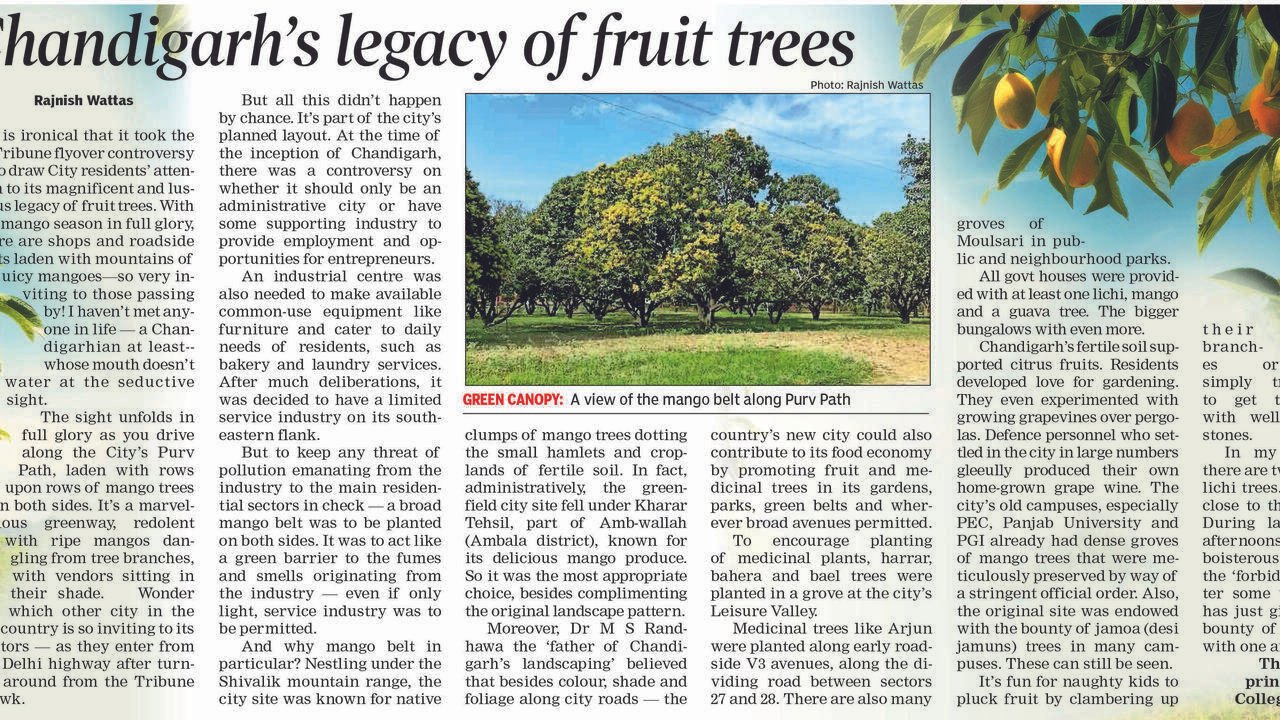
It is ironical that it took the Tribune flyover controversy to draw City residents’ attention to its magnificent and luscious legacy of fruit trees. With the mango season in full glory, there are shops and roadside carts laden with mountains of juicy mangoes—so very inviting to those passing by! I haven’t met anyone in life – a Chandigarhian at least — whose mouth doesn’t water at the seductive sight.The sight blooms in full glory as you drive along the City’s Purv Path, laden with rows upon rows of mango trees on both sides. It’s a marvellous greenway, redolent with ripe mangos dangling from tree branches, with vendors sitting in their shade.Wonder which other city in the country is so inviting to its visitors — as they enter from the Delhi highway.But all this didn’t happen by chance. It’s part of the city’s planned layout. At the time of the inception of Chandigarh, there was a controversy on whether it should only be an administrative city or have some supporting industry to provide employment and opportunities for entrepreneurs.An industrial centre was also needed to make available common-use equipment like furniture and cater to daily needs of residents, such as bakery and laundry services. After much deliberations, it was decided to have a limited service industry on its south-eastern flank.But to keep any threat of pollution emanating from the industry to the main residential sectors in check — a broad mango belt was to be planted on both sides. It was to act like a green barrier to the fumes and smells originating from the industry — even if only light, service industry was to be permitted.And why mango belt in particular? Nestling under the Shivalik mountain range, the city site was known for native clumps of mango trees dotting the small hamlets and croplands of fertile soil.In fact, administratively, the greenfield city site fell under Kharar Tehsil, part of Amb-wallah (Ambala district), known for its delicious mango produce. So it was the most appropriate choice, besides complimenting the original landscape pattern of the site.Moreover, Dr M S Randhawa the ‘father of Chandigarh’s landscaping’ believed that besides colour, shade and foliage along city roads — the country’s new city could also contribute to its food economy by promoting fruit and medicinal trees in its gardens, parks, green belts and wherever broad avenues permitted.To encourage planting of medicinal plants, harrar, bahera and bael trees were planted in a grove at the city’s Leisure Valley.Medicinal trees like Arjun were planted along early roadside V3 avenues, along the dividing road between sectors 27 and 28. There are also many groves of Moulsari in public and neighbourhood parks.All govt houses were provided with at least one lichi, mango and a guava tree. The bigger bungalows with even more.Chandigarh’s fertile soil supported citrus fruits, which were encouraged. Residents developed love for gardening. They even experimented with growing grapevines over pergolas. Defence personnel who settled in the city in large numbers gleeully produced their own home-grown grape wine.The city’s myriad old campuses, especially PEC, Panjab University and PGI already had dense groves of original mango trees that were meticulously preserved by way of a stringent official order. Also, the original site was endowed with the bounty of jamoa (desi jamuns) trees in many campuses. These can still be seen.It’s fun for naughty kids to pluck fruit by clambering up their branches or simply try to get them with well-aimed stones.In my own backyard, there are two fruit-bearing mango and lichi trees. One of them is planted close to the boundary wall. During hot and languorous summer afternoons — it’s tough to chase boisterous kids trying to taste the ‘forbidden fruit’ away. After some vain and exasperating attempts, one has just given up the futile pursuit and let the bounty of the soil be shared with one and all.The writer is former principal, Chandigarh College of Architecture


