



What began as student complaints regarding CBSE’s On-Screen Marking (OSM) system eventually drew the attention of opposition leaders, the Education Ministry and Parliament, culminating in the transfer of the Board’s two senior-most officials and a government-ordered probe into the project.
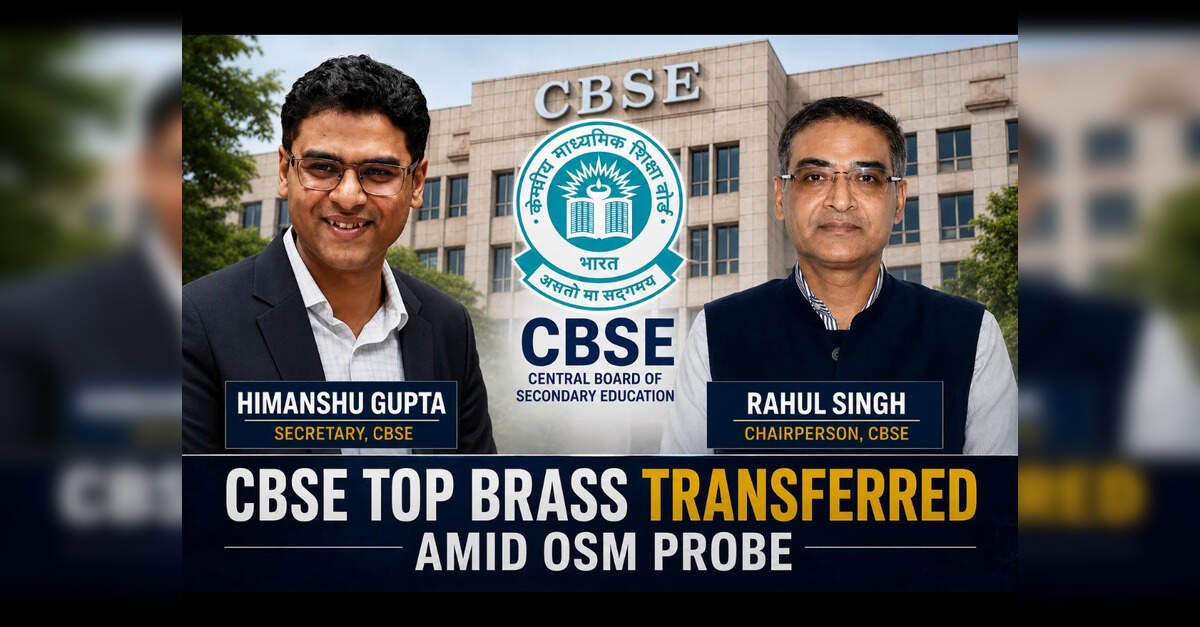
On Tuesday, the Centre transferred CBSE Chairman Rahul Singh and Secretary Himanshu Gupta and ordered an inquiry into the procurement of the Board’s controversial On-Screen Marking (OSM) services. The move came on the very day a Parliamentary Standing Committee examined the issue and heard representations from the student who first flagged alleged irregularities in the system.
The developments mark a dramatic escalation of a controversy that, within weeks, moved from student grievances to political attacks, judicial intervention, parliamentary scrutiny and finally administrative action.
A reform that turned into a crisis
OSM was introduced by CBSE as a major digital reform aimed at modernising the evaluation of Class 12 answer scripts. Instead of conventional manual assessment, answer sheets were scanned and evaluated digitally.
However, shortly after results were declared, students reported discrepancies in evaluated answer sheets, concerns over scanned copies, verification processes and alleged technical glitches. The controversy rapidly expanded beyond examination-related complaints to questions about the procurement process behind the OSM platform itself.
What was initially viewed as a technical issue soon became a governance issue.
The student who took the issue to Parliament
A turning point came when Class 12 student Sarthak Sidhant began publicly raising concerns about the OSM tendering process. After analysing multiple tender documents, Sidhant alleged that eligibility conditions had been altered over time and claimed there were discrepancies that appeared to favour a particular service provider. His findings gained national attention and were amplified across political and media circles.
On Tuesday, Sidhant appeared before the Parliamentary Standing Committee on Education, Women, Children, Youth and Sports, where members reviewed concerns related to OSM implementation, evaluation transparency and the procurement process.
The committee’s involvement transformed the issue from an administrative controversy into a matter of parliamentary oversight.
How politics entered the picture
The issue acquired a political dimension when Leader of Opposition Rahul Gandhi publicly questioned the tender process and sought explanations regarding alleged changes in procurement conditions. His intervention significantly amplified attention on the issue and increased pressure on both CBSE and the Ministry of Education.
Simultaneously, the issue reached the courts, with the student wing NSUI moving the Delhi High Court seeking a probe and fresh verification of answer scripts.
The controversy was no longer confined to examination halls and evaluation centres.
The Ministry’s patience appears to have run out
The Centre’s action suggests that the issue had reached a threshold where maintaining status quo became difficult. Just days ago, Education Minister Dharmendra Pradhan had acknowledged discrepancies in the OSM system and assured corrective measures.
By Tuesday evening, however, the government had gone much further, ordering a probe into OSM procurement and transferring both the Chairman and Secretary of CBSE.
While the government has not linked the transfers to any individual allegation, the timing leaves little doubt that the OSM controversy was the trigger.
Who are the two officers?
Rahul Singh
Rahul Singh, a senior IAS officer of the Bihar cadre, took over as CBSE Chairperson in March 2024 and became one of the key faces of the Board’s reform agenda. He oversaw implementation of several National Education Policy-linked initiatives, including digital assessment reforms and the rollout of OSM.
Himanshu Gupta
Himanshu Gupta, an AGMUT cadre IAS officer, served as CBSE Secretary and was closely involved in examination administration, board operations and implementation of technology-led reforms. He was among the senior officials steering the Board through one of the most ambitious phases of examination transformation.
Why the timing matters
The transfers come at a particularly sensitive moment. CBSE is currently preparing for a series of major reforms, including broader assessment changes linked to the National Education Policy, competency-based evaluation models and future examination restructuring.
Leadership continuity is generally considered critical during such transitions. The government’s decision to replace both the Chairman and Secretary despite these ongoing reforms underlines the seriousness with which it appears to be viewing the OSM controversy.
More than a transfer story
The significance of Tuesday’s developments lies not merely in the transfer of two senior officials. The larger story is how a grievance raised by students evolved into a national debate on examination governance, attracted political attention, reached Parliament and triggered one of the most significant interventions by the government in CBSE’s recent history.
The inquiry panel’s findings will now determine whether the controversy was primarily a case of implementation failures, procurement lapses or deeper systemic weaknesses in the Board’s digital transformation programme.
For the Ministry of Education, the challenge ahead will be twofold: restoring confidence in the integrity of board examinations while ensuring that one of India’s most ambitious education technology reforms does not become its biggest governance setback.


