



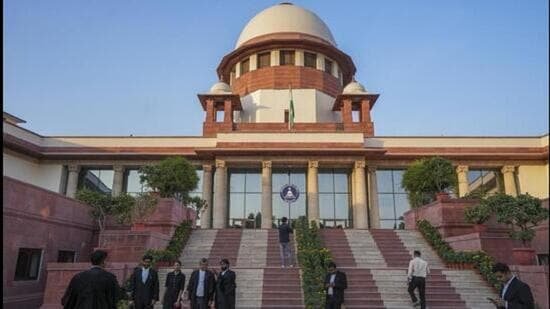
The Union government on Friday informed the Supreme Court that it has constituted an expert committee that includes two former top court judges and a former attorney general, to review the controversial NCERT Class 8 social science chapter on the judiciary, in compliance with the court’s earlier directions issued in the wake of the recent textbook row.


Solicitor General Tushar Mehta told a bench led by Chief Justice of India Surya Kant that the panel will comprise senior advocate and former Attorney General KK Venugopal, former Supreme Court judge Justice Indu Malhotra, and former Supreme Court judge and current National Judicial Academy director Justice Aniruddha Bose, along with a vice chancellor.
“We have appointed a committee… Mr Venugopal has accepted to be a member. Justice Indu Malhotra would be the judge. We have requested Justice Aniruddha Bose… and there will be one Vice Chancellor,” Mehta submitted, indicating that the panel brings together judicial, academic and professional expertise as envisaged by the court.
The development comes against the backdrop of a continuing controversy over an NCERT textbook chapter on “corruption in the judiciary”, which had triggered suo motu proceedings before the top court last month.
The bench, which also comprised justices Joymalya Bagchi and Vipul M Pancholi, was hearing a separate public interest litigation challenging a passage in an older Class 8 textbook stating that “recent judgments tend to view the slum dweller as an encroacher in the city”.
Declining to interfere, the court observed that the statement reflected a “viewpoint” on judicial decisions and did not warrant judicial intervention. “Everyone has a right to have a viewpoint about a judgment of the court,” the Chief Justice remarked.
The bench further noted that the issue had become infructuous since the textbook in question was being replaced. The petition filed by Pankaj Pushkar was accordingly disposed of.
The latest assurance by the Centre on the constitution of the expert panel follows a series of sharp observations and directions issued by the Supreme Court over the past month.
In February, the court had taken suo motu cognisance of a Class 8 social science textbook titled Exploring Society: India and Beyond, which contained references to alleged corruption and pendency in the judiciary. Terming the content potentially damaging to the institution’s dignity, the court ordered the immediate withdrawal of the book, including seizure of physical copies and takedown of digital versions.
Subsequently, the NCERT and the Union government tendered unconditional apologies, with the education body withdrawing the chapter.
However, the controversy resurfaced when the court was informed that a rewritten version of the chapter was proposed to be introduced in the upcoming academic session. Expressing concern over the lack of transparency in the rewriting process, the bench directed that no revised chapter be included in the curriculum without scrutiny by an independent expert committee to be constituted by the Centre.
The court had specifically indicated that the panel should ideally include a former senior judge, an eminent academician, and a distinguished legal practitioner — criteria that the Centre’s newly announced committee appears to meet.
Earlier, in a detailed order on March 11, the Supreme Court had come down heavily on the manner in which the controversial chapter was prepared and circulated.
The bench directed that Padma Shri professor Michel Danino, educator Suparna Diwakar and legal researcher Alok Prasanna Kumar — who were involved in drafting the chapter — should not be associated “in any manner” with textbook preparation or curriculum development for public institutions.
The court said it had “no reason to doubt” that the authors either lacked informed knowledge of the judiciary or had “deliberately misrepresented facts” to project a negative image before impressionable students.
It also flagged serious procedural lapses, noting that the chapter had not been placed before the National Syllabus and Teaching-Learning Material Committee (NSTC), a high-powered NCERT body responsible for curricular decisions. Instead, it was circulated selectively in digital form among a few members.
Describing the episode as an “eye-opener”, the court questioned how curricular material could be published without approval at any level and criticised the absence of institutional checks.
“If this is the casual way to publish curriculum for students in the country, what do you expect us to say?” the bench had remarked during the hearing.
The court had further directed the Centre to review the composition of the NSTC and consider including domain experts, particularly eminent jurists, if the judiciary is to be taught to students.
Notably, the March 11 order mandated that any reintroduction of the judiciary chapter — whether in Class 8 or other classes — must be preceded by evaluation by a committee of domain experts constituted by the Union government within a stipulated timeframe.
While underscoring the need for accuracy and balance, the court clarified that its intervention was not intended to stifle legitimate critique of the judiciary.
“If the judiciary, like any other institution, is suffering from deficiencies and an expert committee highlights them, it would be a welcome step,” the bench observed, while cautioning against “biased narratives” that could distort young minds.
The court had also suggested that institutions such as the National Judicial Academy could be associated in shaping legal education content.


