



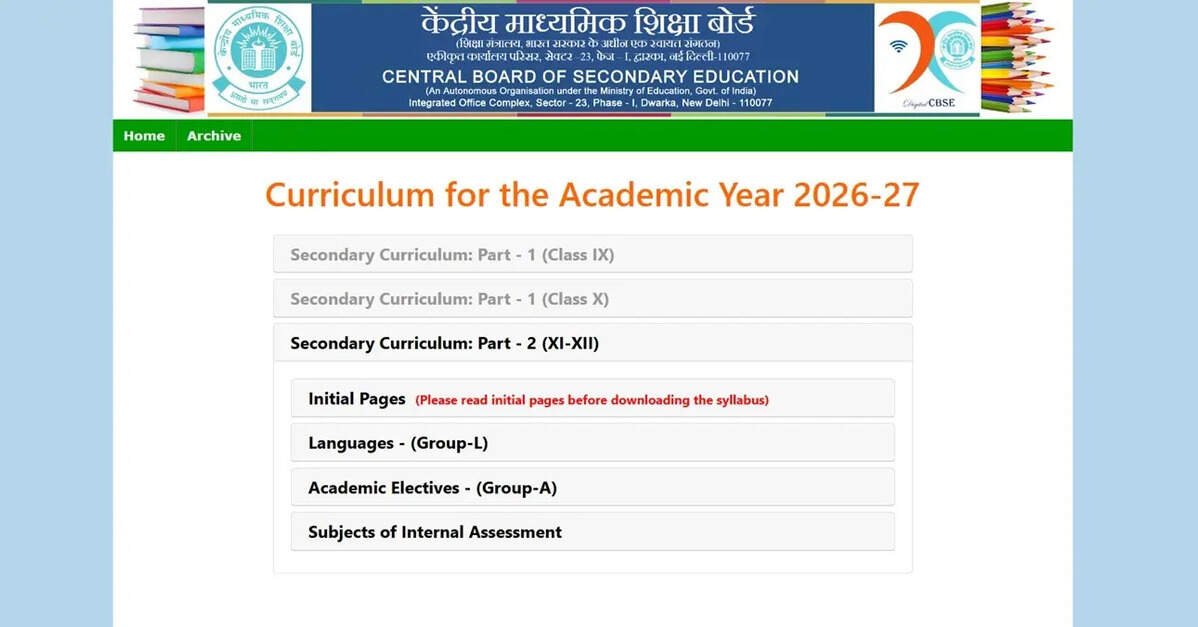
At a time when board exam outcomes like CBSE results and cbse 10th results continue to dominate conversations among students, parents, and schools, a far more transformative shift is quietly taking shape within India’s education system. The Central Board of Secondary Education’s revised curriculum for Classes 9 to 12 for the academic year 2026–27 signals a deeper rethinking of what learning should look like in a rapidly evolving world.
With an emphasis on competency-based education, experiential learning, and the gradual integration of an AI curriculum, the framework moves decisively away from rote memorisation. Alongside this, structural changes such as optional advanced Mathematics and Science modules, mandatory vocational education from Class 9, and renewed attention to arts and physical education indicate a broader push towards holistic development. Even core resources like the 9th class book and subjects such as class 9th Hindi are being reimagined to align with real-world application and conceptual clarity.
Multilingualism: Opportunity, identity, and implementation challenges
One of the most significant aspects of the revised framework is its continued emphasis on multilingual education. In a country as linguistically diverse as India, this approach is both relevant and complex.
Education leaders see multilingualism as an opportunity to deepen learning and cultural awareness, but also caution against the risks of overextension. Praneet Mungali, Trustee, Sankriti Group of Schools, situates the policy within India’s socio-cultural context, noting that multilingual education is less a policy choice and more a structural necessity, adding that exposure to multiple languages builds cognitive flexibility and, more importantly, a cultural openness that India needs. At the same time, he underscores that intent alone will not deliver outcomes, and that the success of this shift depends on the quality and consistency of content across languages, along with a phased implementation that avoids overburdening students.
From a pedagogical standpoint, Col Ajay Kumar, CEO, VidyaGyan School, highlights the cognitive benefits of learning in familiar languages, observing that when children learn concepts in a language they are emotionally and cognitively comfortable with, their engagement, confidence, and depth of understanding improve significantly. However, he also stresses that this must be balanced with meaningful exposure to English, which continues to play a critical role in higher education and global mobility.
Offering a broader perspective, Anju Soni, Principal, Shiv Nadar School, Noida, views multilingual learning as a key enabler of holistic education, pointing out that exposure to multiple languages enhances cognitive flexibility, strengthens problem-solving abilities, and fosters cultural sensitivity, ultimately preparing learners to engage effectively in a diverse and interconnected world.
Yet, the debate takes a more provocative turn with Poonam Kumar Mendiratta, Principal, The Manthan School, Noida, who questions the very framing of language policy. She argues that if English has been the language connecting India for over 300 years, it should be recognised as an indigenous language, adding that the moment this reality is acknowledged, much of the confusion around language policy, especially within the three-language framework, automatically resolves. Her perspective introduces a deeper layer to the discussion, challenging conventional definitions of linguistic identity in contemporary India.
English repositioned: Redefining value and assessment
The repositioning of English within the revised framework has sparked considerable debate, particularly regarding its implications for assessment and board examinations. Rather than diminishing its importance, many experts interpret this shift as an attempt to correct long-standing imbalances.
Praneet Mungali explains that repositioning English is less about reducing its relevance and more about ensuring that access to knowledge is not contingent on proficiency in a single language, while also acknowledging that English will continue to remain a critical link language in higher education, business, and global interaction. This dual reality makes the transition both necessary and complex.
From an assessment perspective, Col Ajay Kumar points out that the shift demands a fundamental rethinking of evaluation practices, emphasising that board examinations must move towards valuing comprehension, clarity of thought, and authentic expression, and warning that without systemic strengthening, disparities across schools could persist.
Anju Soni adds that the transition must be handled with care, noting that a phased and well-communicated approach will be crucial to maintaining academic rigour while aligning with evolving curricular priorities. These viewpoints highlight the central challenge – ensuring fairness and consistency in assessment while embracing a more flexible and inclusive approach to language learning.
Textbook reforms: Balancing inclusivity with academic depth
As the National Council of Educational Research and Training undertakes revisions of school textbooks, expectations extend beyond content updates to questions of inclusivity, accuracy, and intellectual depth.
Col Kumar reinforces the need for textbooks to move beyond static information, arguing that they should become tools that stimulate inquiry, debate, and critical reflection, exposing learners to multiple perspectives and contemporary realities. At the same time, he cautions that academic depth should not be diluted in the effort to avoid controversy.
Framing this debate by emphasising the evolving nature of education, Mungali noted that while curriculum changes, especially in subjects like history, often attract strong reactions, not all revisions can be viewed through a single lens. He highlights that India’s rich and layered history includes aspects that have not always received adequate attention, but stresses that the ultimate test of education is whether it fosters understanding rather than hatred, adding that the purpose of education is not to produce blind agreement, but to build mental frameworks that can hold complexity.
Echoing a similar sentiment, Soni highlights that textbooks must present accurate and up-to-date content while encouraging critical thinking and inquiry-based learning, ensuring that students are equipped with the analytical and ethical skills required in today’s world.
From vision to reality: The implementation challenge
While the revised curriculum reflects the aspirations of a more learner-centric and globally aligned education system, its success will ultimately depend on execution. Teacher training, infrastructure readiness, digital access, and alignment in assessment systems will be critical in translating policy into practice.
The inclusion of elements such as an AI curriculum further underscores the need for continuous adaptation within the education ecosystem. Schools and educators will need to evolve alongside these changes to ensure that students are not just exposed to new ideas, but are able to meaningfully engage with them.
The CBSE curriculum 2026–27 represents a significant step toward reimagining Indian education. It shifts the focus from outcomes like CBSE results and CBSE 10th results to deeper questions of learning, capability, and preparedness for the future.
However, the true measure of its success will lie not in policy announcements, but in classroom realities. In the end, the reform is not just about changing what students study, but about redefining what it means to learn and to be prepared for a world that is constantly evolving.


