



Last Updated:
Instead of employment-driven prosperity, Bengal increasingly operates on state-supported consumption including cash transfers, subsidised food, pensions and grants
By rebranding traditional unemployment relief as a stipend of Rs 1,500 per month, Didi is now effectively buying time against a growing youth restlessness over the state’s stagnant industrial sector. (PTI)
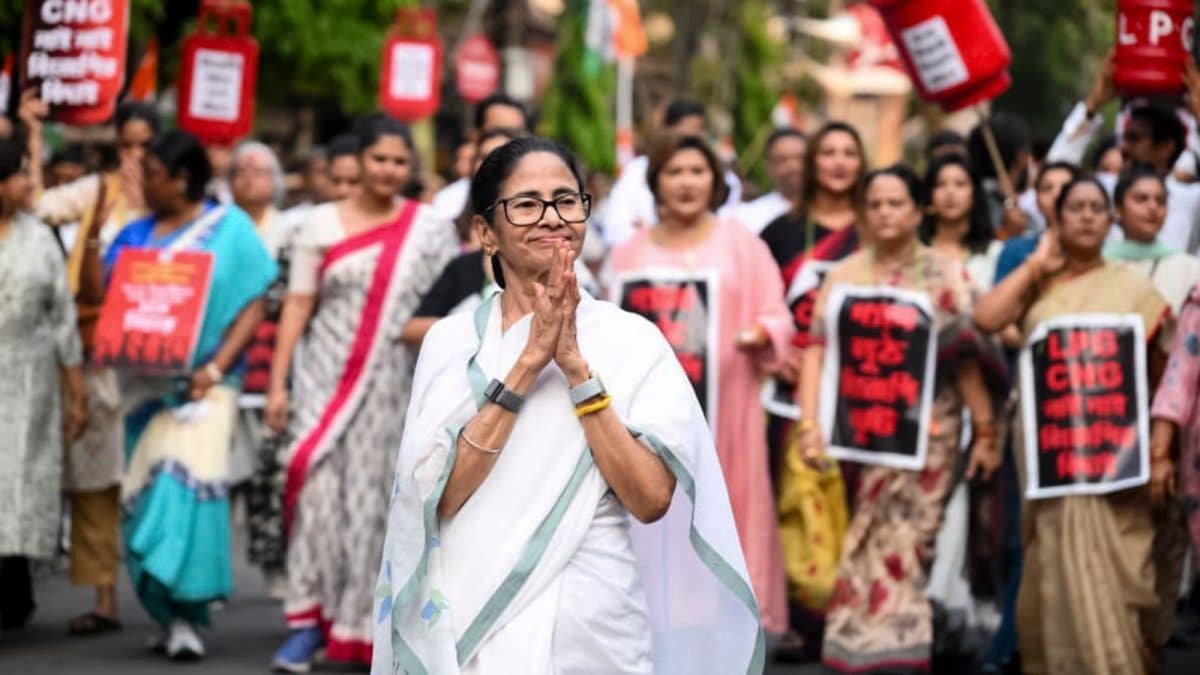
In West Bengal today, welfare is just a polite word. Cash politics may be the more accurate and appropriate phrase. TMC chief Mamata Banerjee’s last-minute hike for purohits is of course a mentionable exercise in pre-emptive populism, timed to beat the Model Code of Conduct (MCC) by a mere 80 minutes. Her announcement through social media shows a governance style that prioritises tactical survival over sustainable policy, only by stretching the state’s fiscal bandwidth.
By bypassing the spirit of the MCC through a technicality, Banerjee has effectively weaponised the state treasury to create a last-mile patronage network among the religious clergy, who hold significant sway over local voting blocs. However, this decision also brings the lens back on Banerjee’s politics of cash doles before elections.
Increase in allowance for religious clergies is a calculated pre-emptive strike to neutralise the BJP’s communal narrative while simultaneously placating her own minority base. However, using public funds to secure the loyalty of religious intermediaries just hours before an election reflects a deepening dependency on populist doles rather than systemic economic reform.
For over a decade, the chief minister has built an elaborate network of financial assistance schemes that touch almost every household in the state and her party machinery as well. The government proudly advertises nearly 100 schemes, with over eight to nine crore beneficiaries in a state of around 10 crore people. On paper, it looks like one of the largest welfare architectures in India. But behind the impressive numbers lies a deeper political reality.
Bengal’s economy has not kept pace with its welfare expansion. The centrepiece of the state’s political economy today is direct cash transfers while the government failed to build infrastructure and generate employment across the state.
When Free Money Meets Election Math
In February, the Banglar Yuva Sathi or Yuvashree scheme was announced by Banerjee’s government. It is another high-stakes attempt to pivot from ‘dole politics’ to ‘aspiration management’ just as the demographic dividend threatens to become a political liability.
By rebranding traditional unemployment relief or ‘Bekar Bhata’ as a stipend of Rs 1,500 per month for survival, Didi is now effectively buying time against a growing youth restlessness over the state’s stagnant industrial sector. This ‘allowance’ is a transparent admission of industrial paralysis, where the state swaps genuine job creation for a meagre fiscal sedative.
Schemes such as Lakshmir Bhandar, which sends monthly money to women, now cover more than 2.2 crore beneficiaries. Other programmes like Kanyashree, Rupashree, Jai Bangla, farmer support through Krishak Bandhu, subsidised food under Khadyasathi, housing under Banglar Bari, and health insurance through Swasthya Saathi, collectively ensure that the state government is financially present in the daily lives of millions.
Lakshmir Bhandar, for instance, launched in 2021 just before the elections, now provides monthly direct cash transfers to women voters. According to the state’s official data, women aged 25-60, as of February 2026, get Rs 1,500 per month for SC-ST category and Rs 1,000 for general category households. Around 2.21 crore women have been financially empowered with an annual budget allocation of Rs 26,700 crore. The government has spent a total of Rs 74,000 crore since its inception. Politically, the logic is simple and effective. If the government’s money reaches the household every month, loyalty follows. But the bigger economic question remains uncomfortable.
Cash vs Reform
Cash schemes have expanded dramatically, yet employment generation and industrial growth have not kept the same pace. Large industries remain scarce, investment inflows are limited, and job creation has lagged behind neighbouring states that have aggressively pursued manufacturing and infrastructure expansion.
This imbalance has created a peculiar political economy. Instead of employment-driven prosperity, Bengal increasingly operates on state-supported consumption including cash transfers, subsidised food, pensions and grants. Welfare cushions households, but it does not necessarily create long-term economic mobility.
According to NITI Aayog’s published report—Fiscal Health Index 2026—West Bengal faces persistent fiscal stress due to rising debt, sustained deficits, and modest revenue growth. Another published report by the NITI Aayog, A Macro and Fiscal Landscape of The State of West Bengal, stated that Bengal’s real GSDP has grown at an average rate of 4.3 per cent during the period from 2012-13 to 2021-22 compared to the national average growth of 5.6 per cent. The state’s share in the national GDP has decreased from 6.8 per cent in 1990-91 to 5.8 per cent in 2021-22. Its per capita income is 20 per cent below the national per capita income, as of 2021-22.
The Opposition, like the BJP and the CPM, argue that the model is fiscally risky and economically shallow. They claim it discourages investment while expanding the state’s subsidy burden. Supporters counter that welfare is essential in a state where poverty and informal employment remain widespread.
Kolkata [Calcutta], India, India
March 17, 2026, 09:20 IST
Read More


