



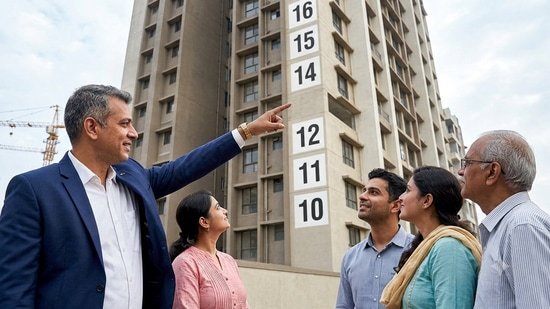
Can a real estate developer skip the number 13 because it is considered unlucky? Not after the building plans have been sanctioned, observes Maharashtra Real Estate Regulatory Authority (MahaRERA).


The regulator recently addressed a complaint from a housing society near Mumbai, alleging that the developer had renumbered the apartments on the 13th floor as 1401, 1402, and so on, effectively erasing the number 13 from the building. According to the society, the change created a mismatch between the sanctioned plans and the on-site numbering, leading to discrepancies in official records and property tax documents.
MahaRERA’s observations
MahaRERA observed that if the developer believed the number 13 was inauspicious, it should have factored that into the building design before seeking approval of the plans.
“If the Respondent (developer) knew that the 13th floor is considered unlucky, the Respondent could have taken steps to avoid constructing flats on 13 th floor by preparing a plan accordingly. After getting approval from the concerned authority on plan, the Respondent cannot take stand that 13 th floor is unlucky hence, flat numbers are not numbered in 13 series,” the MahaRERA observed.
The regulator further observed that the developer is bound to adhere to the sanctioned plans under Section 14(2) of the Real Estate (Regulation and Development) Act, 2016. It added that if residents of flats above the 13th floor face any future issues due to the numbering discrepancy, it would be the developer’s responsibility to rectify them.
However, MahaRERA noted that, since the project had already been completed, there was no question of restraining the developer from implementing the revised numbering by a permanent or temporary injunction. It also clarified that the RERA Act does not empower the authority to award compensation in such cases.
The authority observed that if the housing society believed the project had not been constructed in accordance with the sanctioned plans, it should approach the competent authority that issued the Occupation Certificate, as that authority is responsible for certifying that the project conforms to the approved plans.
Accordingly, MahaRERA rejected the complaint and passed no order as to costs.
Also Read: MahaRERA dismisses investor’s refund claim, says RERA applies only to genuine homebuyers
The case
Among several allegations against the developer, a housing society near Mumbai told MahaRERA that although the sanctioned plans showed a 13th floor, the developer numbered the apartments on that floor as 1401, 1402, and so on, effectively skipping the number 13. The society alleged that this amounted to a deviation from the sanctioned plans and violated Section 14(2) of the Real Estate (Regulation and Development) Act, 2016.
How did the housing society discover the missing 13th floor?
According to the housing society, the issue came to light when residents received property tax bills from the municipal corporation and found that the addresses of flats on the 14th floor and above did not match the numbering used in the building.
The society told MahaRERA that the apartment physically numbered 1401 on the 13th floor was reflected as Flat 1301 in the property tax bill, while the apartment numbered 1501 on the 14th floor was recorded as Flat 1401. Similar discrepancies, it said, existed across all buildings in the complex.
The society alleged that, upon approaching the municipal corporation, it learned that the property tax bills had been issued in accordance with the sanctioned building plans. It alleged the developer had unilaterally skipped the number 13 while numbering the floors and apartments, resulting in a mismatch between the sanctioned plans and the numbering used on-site.
According to the society, the discrepancy has affected more than 300 residents, causing inconsistencies between the sanctioned plans, on-site flat numbers, registered property documents and municipal property tax records.
Developer’s defence
The developer informed MahaRERA that skipping the number 13 is a common industry practice because it is widely considered inauspicious.
‘It is common industry practice for developers to skip the number 13 as it is widely considered inauspicious and therefore, while the 13th floor exists from an approval and structural perspective, it has been labelled as the 14th floor in the building’s numbering scheme,” the developer submitted before MahaRERA.
The developer also contended that the property tax bills issued by the municipal corporation reflect the same nomenclature used in the building.
MahaRERA’s observations
MahaRERA observed that since the housing society had raised the issue of the missing 13th floor along with several other grievances, the matter could not be adjudicated as part of a common complaint. The authority held that the issue involved an individual relief, which cannot be decided in a complaint filed collectively by the housing society on behalf of all its members.
“The said allegation of the Complainant (housing society) does not pertain to the common area hence, society cannot agitate its violation. Hence, no relief in this behalf can be passed in this behalf,” the MahaRERA observed.


