



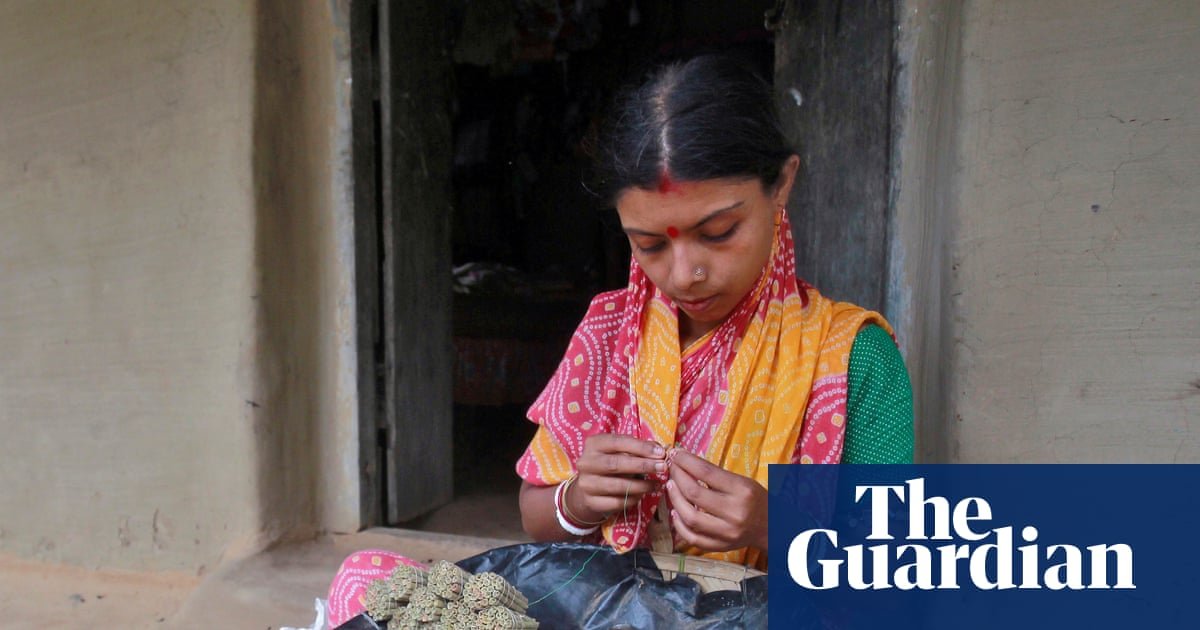
I first spoke to Shazia Khanum for a report I was writing on adolescent girls in informal jobs. The 16-year-old’s fingers moved swiftly as she talked, rolling bidis – tobacco in tendu leaves tied with string. She told me she rolls about 300 to 500 thin cigarettes daily, earning a little more than £1 on a good day (roughly 250 rupees for 1,000 bidis is the rate).
In the cramped workshop where she works in rural Yarab Nagar, in India’s Karnataka state, dozens of other girls do the same job. There are no toilets or sanitary facilities. When asked how she manages her period, Khanum just pointed to a makeshift curtained space where she changes and reuses cloth rags.
Last week, about 6,000 miles away, world leaders and advocates came together in Australia to launch the Melbourne declaration for gender equality, a framework that promises gender-responsive funding, policy reform and a fundamental shift in how power and resources flow towards those most affected by injustice.
Inside the conference halls, the mood was one of urgency but also solidarity. Women and queer leaders spoke about power, funding and rights with an openness that felt both overdue and fragile. The document itself is, by any measure, an ambitious document. But for girls such as Khanum working in India’s informal sector, its promise is a distant one.
That is not a criticism but rather a diagnosis of the problem the declaration must confront.
The Melbourne declaration holds governments and political actors accountable, and explicitly points to their “obligation” to “ensure local civil society is adequately resourced, politically protected, globally connected and locally rooted”.
It calls for the “priorities, knowledge, language and political aims of those most affected by injustice” to shape the work of people across the gender-equality ecosystem.
Khanum is not an outlier but a statistic that the system has chosen not to count. One of the 61% of female workers in India’s non-agriculture sector employed informally, she is among the 80% of south Asian women who work outside formal protections.
She has no contract, no payslips and no access to the welfare schemes through which government money flows. As far as the state is concerned, she does not work at all.
The declaration is explicit about this gap. It holds governments accountable for ensuring that civil society is adequately resourced, politically protected and locally rooted. It calls for the priorities and lived realities of those most affected by injustice to shape the work of the gender-equality ecosystem. But this requires a system willing to see Khanum in the first place.
India’s government has made moves in the right direction. The e-Shram portal has registered more than 300 million informal workers, and pension schemes such as Pradhan Mantri Shram Yogi Maandhan (PM-SYM) exist for the unorganised sector.
But Khanum has not heard of them. The registration may exist but there is no outreach, so she remains invisible to the system. Even though the government acknowledges that about 45% of India’s GDP comes from this informal sector, this recognition has yet to translate into the sustained ground-level engagement that would make a difference to a 16-year-old in Yarab Nagar.
This is the faultline: the distance between commitment and reach. Maliha Khan, president and chief executive of Women Deliver, architects of the declaration, argues that holding leaders accountable must also mean ensuring that public systems recognise and respond to everyone’s reality.
To be sure, the mechanisms need to be practical, including direct funding to grassroots women’s rights organisations and worker-led collectives, partnerships with unions and informal worker networks, and ensuring that governments design policies with these people at the table.
Organisations such as Spandana – which works with adolescent girls in the gig economy to provide access to sexual and reproductive health facilities – come into the picture as bridging the gap between global frameworks and local realities. Grassroots civil society is a critical platform for reclaiming momentum, building alliances and safeguarding the future of gender justice.
The only way people such as Khanum will benefit from what the Melbourne declaration offers is through direct access to cash and healthcare. The best way to do that is either from on-the-ground organisations or by funding community health workers, strengthening healthcare systems and bringing informal workers into policy consultations.
To paraphrase Khan, at the end of the day, the declaration will be measured by whether it translates into policy, financing and practice, and whether it delivers change for women whose work has too often been invisible, undervalued and unprotected.
As applause filled the conference halls in Melbourne, I knew Khanum would be at her workbench rolling her 500th bidi of the day. She has not heard of the declaration. She does not know that somewhere far away people are arguing about whether systems such as the one that has failed her can be fixed. Her ambitions lie in getting better pay one day – and a proper toilet.


