




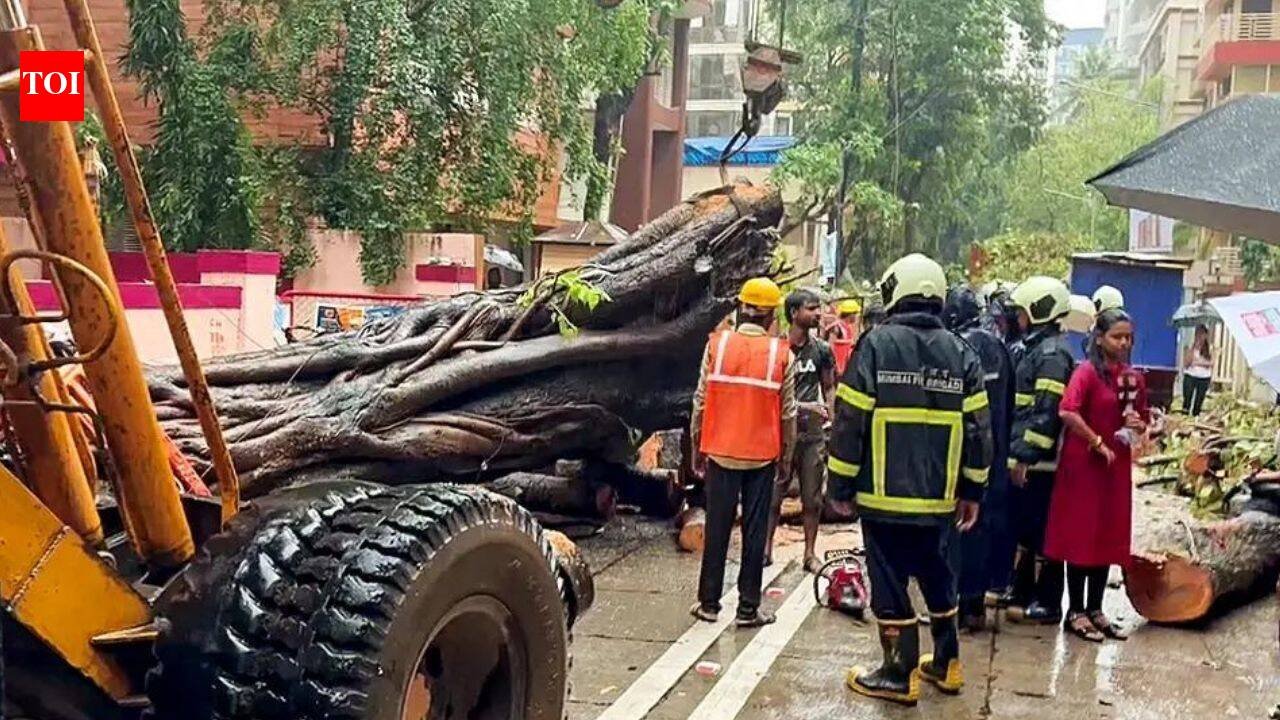
The death of 11-year-old Vihaan Srivastava after a 70-year-old peepul tree collapsed onto his school van in Mumbai’s Chembur is more than another monsoon tragedy. Coming within a day of a separate incident in Uttar Pradesh‘s Firozabad district, where five people died after a tree crashed onto an e-rickshaw during a dust storm, it raises an uncomfortable question: can cities identify dangerous trees before they become killers?Every monsoon, civic agencies brace for flooded roads, waterlogging and potholes. Tree falls are treated as an inevitable consequence of heavy rain and strong winds. Yet the Chembur incident suggests that weather may have been only one part of the story. Civic officials have indicated that while the tree had undergone routine pre-monsoon pruning, its roots may have been damaged during road concreting carried out earlier this year. Residents living near the site have voiced similar concerns.
If the inquiry confirms that construction activity weakened the tree, it will expose a larger problem confronting Indian cities: trees are valued as environmental assets but are rarely managed as living infrastructure requiring scientific monitoring throughout their lifespan.An ageing green assetMumbai has one of the country’s largest urban tree populations. Many of its rain trees, peepul, banyan and gulmohar trees were planted decades ago. They provide shade, reduce temperatures, absorb carbon, support biodiversity and soften the impact of dense urbanisation. But like bridges, buildings and flyovers, trees age. Their structural strength changes over time. Roots decay, trunks develop cavities, branches become unstable and construction around them alters the soil that supports them.
Despite this, very few Indian cities maintain detailed health records of mature trees. Annual pruning before the monsoon remains the principal preventive exercise. While pruning removes weak branches, it cannot detect internal decay, root damage or fungal infection hidden beneath the surface.Civic officials are expected to conduct regular visual inspections, but these are often infrequent or inconsistent—a pattern seen across many Indian cities.A tree may appear perfectly healthy on the outside even as its root system has been severely weakened. Equally, an old, weathered-looking tree may still be structurally stable. Judging risk by appearance alone can therefore be misleading.
When development becomes the problemAs cities expand, trees are increasingly competing with infrastructure for space. Road widening, footpath reconstruction, utility trenching and underground cable projects often disturb root systems. Concreting close to tree trunks reduces the soil’s ability to absorb water and limits root growth, while excavation can cut through the large anchor roots that keep trees stable during heavy rain and strong winds.The Chembur tragedy has brought this issue into sharp focus. Civic officials have said the garden department had raised concerns about protecting the peepul tree’s roots during road concreting carried out earlier this year. Whether those concerns were adequately addressed will be established by the inquiry, but the incident underscores a larger problem: poor coordination between civic departments can unintentionally weaken trees long before they become a public safety hazard.One of the biggest challenges is that root damage is rarely visible. A tree can continue to produce a dense canopy and appear perfectly healthy for months, or even years, after its underground support system has been compromised. It is often only when heavy rain loosens the soil or strong winds exert additional pressure that these hidden weaknesses become apparent—sometimes with devastating consequences.Technology is changing tree managementSeveral cities around the world are replacing reactive tree management with data-driven monitoring. The starting point is a digital tree inventory—a database in which every roadside tree is assigned a unique identification number and mapped using GPS. Along with its location, civic or state authorities record details like the tree’s species, age, height, trunk diameter, maintenance history and previous complaints. State or city civic bodies can continuously monitor the trees’ condition and prioritise inspections, instead of waiting for a tree to fall before taking action. The Geographic Information Systems (GIS) is the next layer, which combine tree data with information on roads, schools, hospitals, power lines and ongoing infrastructure projects. GIS allows authorities to identify trees located in high-footfall or high-risk areas and inspect them more frequently.Artificial intelligence (AI) is also beginning to transform urban tree management. AI can flag trees that may be more vulnerable during storms by analysing a tree’s age and species, soil conditions, rainfall, wind patterns, disease history and past tree-fall incidents. No technology can indeed predict the exact moment a tree will collapse, these AI tools can significantly narrow down the list of trees that require immediate attention, enabling civic agencies to intervene before a tragedy occurs.Technology is also making it easier to detect problems that are invisible to the naked eye. Engineers are enabled by ground-penetrating radar to assess the condition of a tree’s root system beneath city roads and pavements without excavation. These steps will help identify damaged roots or underground voids that could compromise stability.There are other diagnostic tools available that can reveal what lies inside the tree itself. Sonic tomography and resistograph drills are used to detect hidden decay and cavities within trunks. Soil moisture sensors track water conditions around vulnerable trees. Tilt sensors can also provide early warning if a tree starts to lean beyond safe limits following prolonged rain or strong winds. Drones fitted with high-resolution cameras and thermal imaging are predominantly being used to inspect tree canopies, especially in areas that are difficult to access or after severe weather conditions. These technologies are not meant to replace trained professionals. They enable experts to identify high-risk trees more quickly and direct inspections and maintenance where they are needed most.A shift from reaction to preventionIndian cities generally respond to tree falls rather than preventing them. Emergency teams remove debris, restore traffic and prune nearby branches. The cycle repeats every monsoon.The incidents in Mumbai and other cities demonstrate why prevention deserves equal attention. Tree safety should become part of annual disaster preparedness, much like flood management or building inspections. High-risk locations—including school routes, bus stops, hospitals, railway stations and densely populated residential areas—should receive priority.Trees cannot simply be classified as “old equals dangerous”. Many centuries-old trees remain healthy, while younger trees weakened by disease or construction may pose greater risks. Scientific assessment, rather than age alone, should determine intervention.A national policy is overdueIndia lacks uniform standards for assessing urban tree risk. Municipal practices vary widely, with different inspection methods, pruning schedules and documentation systems. A national tree safety framework could bring consistency while preserving urban green cover. Such a framework could include mandatory pre-monsoon health audits of mature roadside trees, standard protocols for pruning based on species and structural condition, and strict guidelines protecting roots during road construction and utility work.Every city should maintain a digital tree registry recording inspections, maintenance history and risk classification. Trees could be categorised as low, medium or high risk, allowing municipal resources to be directed where they are needed most.Public participation should also be strengthened. A mobile application allowing citizens to report leaning trees, exposed roots or cracked trunks would expand the number of eyes monitoring urban greenery. Reports could be integrated into municipal control rooms for rapid inspection.Emergency response protocols should also be standardised. Fire services, disaster management teams, electricity utilities and municipal departments need clearly defined responsibilities when trees fall during severe weather.Protecting trees without compromising safetyTree conservation and public safety are often portrayed as competing priorities. They need not be. Indiscriminate felling after every accident would weaken cities already struggling with rising temperatures and shrinking green cover. Mature trees deliver ecological benefits that young saplings cannot replicate for decades.At the same time, preserving every tree regardless of condition is equally irresponsible. The objective should be scientific management. Healthy trees should be protected. Trees showing manageable defects should receive treatment, pruning or structural support. Only those posing unacceptable risks after professional assessment should be removed and replaced. This balanced approach has become standard practice in several global cities where urban forests are treated as critical public infrastructure rather than ornamental landscaping.The lesson from ChemburThe inquiry into the Chembur tragedy will determine whether construction activity, extreme weather, hidden decay or multiple factors contributed to the collapse. But irrespective of its findings, the broader lesson is clear.Climate change is increasing the frequency of intense rainfall, strong winds and extreme weather events. As these events become more common, ageing urban trees will face greater stress. Cities can no longer rely solely on visual inspections and seasonal pruning to manage that risk.The technology to identify vulnerable trees already exists. The challenge lies in adopting it at scale, integrating it into civic planning and ensuring that departments responsible for roads, utilities and gardens work together rather than in isolation.The choice facing Mumbai—and many other Indian cities—is not between saving trees and saving lives. With scientific management, digital monitoring and better planning, it is possible to do both. The cost of such a system would almost certainly be lower than the human and social cost of another tragedy like the one that unfolded on a narrow lane in Chembur.


